
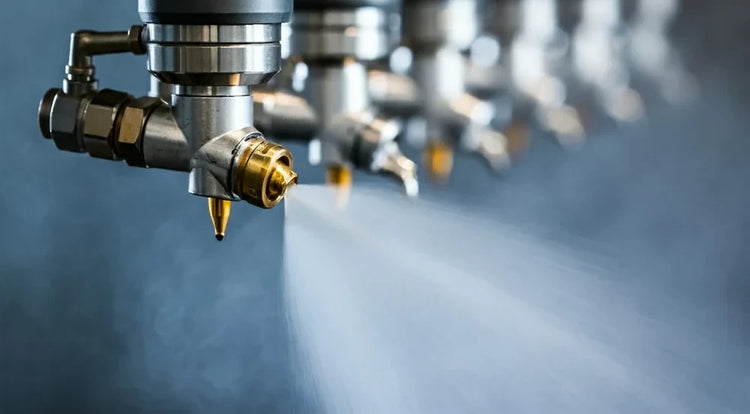
Spray Nozzles for
Roll Shop & Maintenance Washing
The roll shop is where million-dollar work rolls are ground to the tolerances that determine strip profile accuracy and surface quality at the cold mill. It is also where bearing chocks, mill housings, and roll components covered in heavy mill grease, scale, and hydraulic oil must be stripped clean before rolls can be returned to service. Both operations share an engineering requirement that distinguishes roll shop spray systems from general industrial washing: precision matters more than volume. A grinding coolant nozzle that delivers uneven flow causes a temperature gradient that destroys a roll. A degreasing nozzle that leaves residual film in a bearing bore causes premature bearing failure in the mill.
In most industrial spray applications, flow rate and coverage are the primary specifications. In the roll shop, they are secondary to precision and uniformity. A grinding coolant system that delivers the correct total flow rate but delivers it non-uniformly — more at the center of the roll than at the edges, or with pulsation from turbulent internal nozzle geometry — produces a temperature gradient across the roll face during grinding. That gradient creates differential thermal expansion of the roll surface: the hotter sections expand more than the cooler sections, which the grinding wheel interprets as high spots and removes more aggressively. The result is a roll with a ground profile that deviates from the target — a deviation that only becomes visible as strip crown or edge wave at the cold mill, not during the grinding operation itself.
The degreasing application is different in mechanism but similar in the consequences of inadequate specification. A bearing chock with residual emulsified mill grease in the bearing bore bore surfaces causes accelerated bearing wear from the first revolution after reinstallation. Heavy-duty mill grease at low temperature is extremely viscous and does not flush away with low-pressure spray — it requires the combination of high-pressure mechanical impact, hot alkaline chemistry, and sufficient contact time to saponify and remove the grease base. The nozzle choice for degreasing is about impact velocity and chemical compatibility, not coverage area.
Grinding Coolant Delivery and Bearing Chock Degreasing
Roll Grinding Coolant Placement
Laminar solid-stream and narrow flat-fan — even thermal profile across full roll lengthRoll grinding machines recondition work rolls by traversing a vitrified or CBN (cubic boron nitride) grinding wheel along the full length of the rotating roll, removing a precise depth of metal to restore the roll profile to specification. The grinding process generates intense localized heat at the wheel-roll contact arc — a zone approximately 2–5 mm long and equal in width to the grinding wheel — where cutting forces and friction create temperatures that can reach 800–1,200°C at the wheel face. This heat must be extracted before it conducts into the roll surface subsurface, where temperatures above the phase transformation point (approximately 720°C for carbon tool steel) cause martensite formation in the surface layer that is more brittle than the bulk roll material.
When this martensite layer is subsequently loaded by the compressive stresses of cold rolling, micro-cracks initiate at the embrittled surface layer — the thermal bruising failure mode that takes a roll permanently out of service. The grinding coolant nozzle's function is to deliver the cooling fluid to the wheel-roll contact zone with sufficient coherence and uniformity to provide consistent heat extraction across the full grinding traverse length. An inconsistent or turbulent coolant stream creates localized hot zones along the roll face that produce the exact martensite formation the coolant is supposed to prevent.
Bearing Chock & Component Degreasing
High-impact rotating cleaners and flat-fan nozzles in automated washing cabinetsBearing chocks from a rolling mill arrive at the roll shop after a campaign of 4–16 hours in the mill, during which they have accumulated a coating of heavy mill grease (typically a lithium complex or calcium sulfonate grease with NLGI Grade 2 or 3 consistency), iron oxide scale flakes from the rolled strip, mill coolant emulsion residue, and hydraulic oil from the mill balance and crown control systems. This contamination mixture is not amenable to simple rinsing — the grease requires chemical saponification by hot alkaline solution to convert the soap-thickened base oil into a water-dispersible form, and the scale requires the mechanical impact of high-velocity spray to dislodge the flakes from the chock bore and housing surfaces.
Automated roll shop washing cabinets use a programmed wash cycle: typically a hot alkaline wash stage at 60–80°C with 2–5% caustic or alkaline degreaser concentration, followed by a hot water rinse stage, followed in some cases by a corrosion inhibitor application stage. The nozzles in these cabinets must sustain high flow rates at elevated pressure throughout these cycles while resisting the combined attack of hot alkaline solution and the abrasive iron scale particles carried in the wash water. The nozzle material specification for washing cabinet service is a balance between chemical resistance to hot alkali and mechanical wear resistance to abrasive scale.
Thermal Bruising: The Roll Failure Mode That Starts at the Coolant Nozzle
Thermal bruising — the formation of a brittle martensite surface layer during grinding — is the most costly and most preventable roll failure mode in the roll shop. Every case of thermal bruising is a cooling system failure before it is a metallurgical failure. Understanding the mechanism makes it clear why laminar coolant delivery and consistent nozzle alignment are not engineering preferences — they are the difference between a reconditioned roll and a scrapped one.
The Martensite Formation Mechanism in Grinding
Cold mill work rolls are typically manufactured from high-chromium iron or forged steel with surface hardness in the 60–75 Shore C range. This hardness is achieved through controlled heat treatment that produces a specific microstructure in the roll barrel — a tempered martensite with fine carbide distribution that provides the wear resistance needed for cold rolling service. The key characteristic of this microstructure is that it is metastable: if it is reheated above the austenitizing temperature (approximately 700–750°C for high-chromium roll steel) and cooled rapidly, it re-transforms to fresh, untempered martensite — a harder but more brittle phase.
During grinding, the wheel-roll contact zone reaches temperatures of 800–1,200°C at the very surface of the roll in the milliseconds that the grinding wheel passes. If the coolant delivery is adequate — coherent, high-velocity, precisely aimed at the contact zone — it quenches this surface layer back below the martensite start temperature (Ms, typically 200–300°C for roll steel) before it has time to transform. The roll surface remains in its tempered martensite condition. If the coolant is inadequate — if the stream is turbulent and deflects from the contact zone, if the nozzle standoff is too far and the jet breaks up into droplets before reaching the contact, or if there is a temperature gradient along the roll face from uneven coolant distribution — sections of the roll surface are not quenched adequately and re-transform to fresh untempered martensite.
This fresh martensite layer — typically 10–100 µm thick — is detectable in cross-sectional metallography as a bright "white layer" with Vickers hardness typically 100–150 HV above the surrounding tempered martensite. Under the compressive loading of cold rolling, the white layer cracks at its interface with the tempered martensite below, initiating the spalling progression that eventually produces a roll with visible surface defects that transfer to the strip surface as periodic marks at the roll circumferential pitch.
The thermal bruising damage occurs beneath the ground surface at a depth of 10–100 µm and is not visible in the normal roll inspection process after grinding. The roll passes dimensional and surface roughness inspection, is installed in the mill, and then produces strip surface defects — circumferential marks at regular intervals equal to the roll circumference — after typically 2–8 hours of rolling service. Investigation of the roll at that point reveals the martensite white layer and the incipient crack network. The total cost of a thermally bruised roll includes: the grinding cost (time and abrasive consumed on a roll that needed to be scrapped anyway), the mill downtime for roll change (typically 30–90 minutes), the strip downtime waste product, and the roll replacement cost. All of this is preventable by correct coolant nozzle selection and maintenance.
Nozzle Configuration for Uniform Temperature Profile
The temperature profile across a roll being ground depends on two variables: the grinding energy input (controlled by the grinding machine parameters) and the coolant extraction rate (controlled by the nozzle system). For a given grinding pass, the grinding energy input is essentially uniform along the roll length (assuming consistent wheel dressing and roll hardness). Non-uniform temperature profiles therefore arise from non-uniform coolant delivery — more coolant at some roll positions than others.
The most common sources of non-uniform coolant delivery in roll grinder nozzle systems are: nozzle-to-nozzle flow variation in multi-nozzle headers (which is why flow-matching of the nozzle set is important), nozzle angular misalignment relative to the wheel-roll contact zone (which deflects the coolant stream away from the contact point at some positions), and nozzle orifice wear that enlarges the exit diameter over time (which reduces the jet velocity and breaks up the coherent jet at the same supply pressure).
- Verify coolant jet coherence after nozzle installation by visually inspecting the jet at the design supply pressure — a correctly performing solid-stream coolant nozzle produces a transparent, coherent column of fluid; a turbulent or degraded nozzle produces a white, aerated stream or breaks into droplets within 100 mm of the exit; replace any nozzle that fails this visual check before grinding begins
- Flow-test coolant nozzle sets individually against a rated flow standard at the grinding machine supply pressure — nozzles that deliver more than ±5% deviation from the rated flow at operating pressure create the differential thermal load along the roll face that produces the temperature gradient; replace the full set when any position exceeds this threshold
- Align nozzle exit angle to aim directly at the wheel-roll contact zone — mark the contact zone position on the grinding machine fixture at the design operating conditions and verify that each nozzle in the manifold is aimed at this mark; angular alignment errors of more than 5° significantly reduce the proportion of coolant that reaches the contact zone
- Use 316L SS smooth-bore coolant nozzles — the smooth bore eliminates the turbulence-generating internal features (swirl inserts, rough passages) that break up the coolant jet; in coolant service at the modest pressures used in roll grinding (typically 5–15 bar), a smooth-bore 316L SS nozzle provides the best jet coherence of any nozzle design at a practical cost
Washing Cabinet Engineering: Chemical Attack Plus Mechanical Impact for Heavy Mill Grease Removal
Heavy rolling mill greases are formulated specifically to resist water wash-out — they are designed to stay on the bearing surface in a hot, wet mill environment. This very property makes them difficult to remove in the roll shop. The grease removal process requires chemistry and mechanics working together: hot alkaline solution to chemically break down the grease structure, and high-impact spray to physically displace the softened grease from internal bearing bore surfaces.
Grease Saponification and the Role of Nozzle Impact Pressure
The chemical degreasing mechanism for metallic soap-thickened greases (lithium, calcium, and calcium sulfonate types) is saponification — the alkaline solution (typically 2–5% NaOH or sodium silicate-based degreaser) converts the fatty acid components of the grease thickener into water-soluble soap through the reaction: RCOOH + NaOH → RCOONa + H₂O. This reaction proceeds at a rate that is strongly temperature-dependent — at 70°C, saponification is 5–8× faster than at 40°C, which is why hot alkaline wash at 65–75°C is specified rather than ambient-temperature degreasing.
However, chemical saponification alone does not remove the softened grease from the bearing bore surface — it must be physically displaced by the mechanical action of the spray. The spray impact creates a shear stress at the grease-metal interface that exceeds the adhesion force between the softened grease layer and the steel surface. The impact pressure required to displace saponified grease from a steel surface is approximately 0.5–2.0 MPa at the surface — achievable at the standoff distances inside a washing cabinet with nozzle supply pressures of 80–150 bar.
Rotating Jet Cleaner Selection for Bearing Bore Access
The internal geometry of a bearing chock bore presents a specific cleaning challenge: the cylindrical bore surface, the tapered roller bearing seat, and the seal groove are all recessed surfaces that cannot be directly impinged by a fixed flat-fan or solid-stream nozzle from the cabinet spray bar without either entering the bore physically or sweeping the jet through a wide angular range. A rotary jet cleaner — a device that generates two or four high-velocity jets that rotate in a controlled 3D pattern — addresses this challenge by systematically sweeping the internal bore geometry from a mounting position outside or at the bore entrance. The rotation creates complete internal surface contact without requiring the nozzle to be inside the bore. NozzlePro offers rotary jet cleaners in 316L SS and hardened stainless configurations scaled for bearing bore diameters from 200 mm to 900 mm. Contact our application engineers with your chock bore dimensions and wash chemistry for a sizing recommendation.
Nozzle Wear in Alkaline Wash Service at High Pressure
The combination of hot alkaline solution (pH 11–13), iron scale particles entrained from the washed surfaces, and operating pressures of 80–150 bar creates an aggressive wear environment for washing cabinet nozzles. At 100 bar supply pressure, the fluid velocity at the nozzle exit is approximately 40–50 m/s — high enough for the entrained scale particles to cause measurable orifice erosion in standard austenitic stainless steel within months of continuous service. The orifice enlargement that results reduces the jet impact pressure at the cleaning distance and changes the jet shape from a coherent high-velocity stream to a wider, lower-velocity cone — exactly the opposite of what effective heavy grease removal requires.
Two material approaches address this wear mechanism: hardened 410/420 martensitic stainless steel nozzle bodies (28–35 HRC, compared to 17–20 HRC for 316L), which provide 3–5× longer service life in alkaline wash service with moderate abrasive loading; and TC inserts pressed into a hardened stainless body at the exit orifice, which provide the maximum wear resistance (10–20× longer than standard stainless) at positions where scale particle loading in the wash water is highest.
- Verify wash cabinet nozzle jet quality by observing the spray pattern on a flat test plate at the design wash distance — a worn or partially blocked nozzle produces a distorted, asymmetric impact pattern; this test takes 30 seconds and identifies degraded nozzles before they allow incompletely cleaned chocks to be returned to service
- Maintain alkaline wash chemistry within the specified concentration and temperature range — below 2% degreaser concentration or below 60°C, grease saponification slows significantly and residual grease remains on the chock surfaces after the wash cycle; periodic titration of the wash tank alkalinity confirms the chemistry is within the effective operating range
- Install 100-mesh strainers upstream of the high-pressure wash pump — scale particles above approximately 150 µm cause rapid erosion of pump seals and nozzle orifices at high pressure; strainers extend the service life of both the pump and the nozzles and are low-maintenance hardware relative to the equipment they protect
- Replace nozzle sets on a preventive maintenance schedule tied to wash cycles, not to visible failure — a wash cabinet nozzle that has processed 500 chocks is not the same nozzle it was when new; set a replacement interval based on empirical wear rate data for your specific scale particle loading and verify it by flow-testing a sample of removed nozzles at each scheduled maintenance
Nozzle Selection by Roll Shop Application
Contact NozzlePro with your roll grinder model, grinding wheel dimensions, coolant flow rate, chock bore diameter, and wash cabinet pressure. Roll shop nozzle selection is a precision specification — provide actual operating parameters, not catalog defaults.
| Application | Nozzle Type | Pressure / Flow | Critical Requirement | Material |
|---|---|---|---|---|
| Roll grinding coolant — standard oil-based coolant | Smooth-bore solid-stream | 5–15 bar / 5–15 L/min per nozzle | Laminar coherent jet; 20–60 mm standoff; rigid vibration-isolated manifold; ±5% flow tolerance across nozzle set | 316L SS smooth bore |
| Roll grinding coolant — water-soluble coolant | Smooth-bore solid-stream or narrow flat-fan (10°–20°) | 5–15 bar / 8–20 L/min per nozzle | Higher flow than oil-based — water-soluble coolants have lower specific heat capacity; same laminar coherence requirement; narrow fan for wide wheel face coverage | 316L SS smooth bore |
| CBN wheel grinding — high-precision rolls | Smooth-bore solid-stream, precision-ground orifice | 10–20 bar / 5–10 L/min | CBN grinding generates higher specific energy than vitrified wheels; tighter coolant placement tolerance required; flow-match the full nozzle set to ±3% | 316L SS, precision-ground exit |
| Bearing chock bore cleaning — rotating jet | Rotary jet cleaner, 3D sweep | 80–150 bar / 50–200 L/min | Sized to bore diameter and depth; complete internal surface coverage; hardened SS body for hot alkaline service with scale abrasive loading | 410/420 SS hardened or TC inserts |
| Chock external surfaces — high-pressure wash bar | Flat-fan, traversing manifold | 80–150 bar / 10–30 L/min | Systematic surface coverage by manifold traverse; TC inserts at highest-pressure positions; upstream 100-mesh strainer mandatory | TC inserts (above 100 bar) / 410 SS (below 100 bar) |
| Mill housing and roll neck wash — heavy scale | High-impact flat-fan or rotating jet | 100–200 bar / 20–60 L/min | Scale particle loading is highest on mill housing surfaces; TC inserts mandatory above 100 bar; 100-mesh strainer upstream of pump | TC orifice inserts |
| Corrosion inhibitor final rinse application | Full-cone, fine coverage | 1–3 bar / low flow | Even coverage of all chock surfaces with inhibitor film; low pressure — inhibitor must wet not blast; 316L SS; chemical compatibility verification with inhibitor formulation | 316L SS |
Materials for Roll Shop Spray Service
316L SS smooth bore for grinding coolant — jet coherence over chemical resistance. Hardened 410/420 SS for washing cabinet alkaline service with scale abrasive loading. TC inserts for positions above 100 bar where jet erosion of stainless occurs within months.
Thermal Bruising and Failed Bearing Chocks Both Start at the Spray Nozzle.
Grinding coolant coherence, precise standoff alignment, and washing cabinet impact pressure are not secondary considerations — they directly determine roll surface quality and chock cleanliness. Contact NozzlePro with your grinder model, roll dimensions, chock bore size, and wash cabinet pressure.