
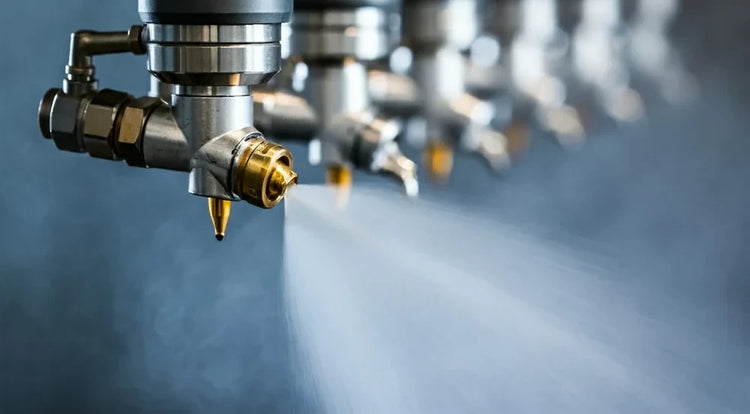
Injector Nozzles & Tank Mixing Eductors
High-efficiency Venturi-powered eductors and industrial injector nozzles for tank mixing, chemical injection, and fluid blending. Circulate up to 5× the pumped volume with zero moving parts.
What Are Industrial Injector Nozzles?
Industrial injector nozzles—commonly called eductors, jet mixers, or Venturi mixers—are precision-engineered devices that use high-velocity fluid jets to entrain and mix surrounding liquids. Unlike mechanical agitators or propeller mixers, eductors have no moving parts, making them exceptionally reliable and virtually maintenance-free.
Operating on the Venturi principle, these devices create a low-pressure zone when pressurized liquid passes through a specially designed nozzle at high velocity. This pressure differential draws in additional liquid from the tank, amplifying total flow by 4–5 times the pumped volume and creating powerful, uniform mixing action throughout the vessel.
Whether you need to homogenize chemicals, suspend solids, maintain uniform temperatures, or blend different-density liquids, industrial eductors provide an energy-efficient, dependable solution that outperforms traditional mixing equipment in many applications.
Venturi Mixing Principle
Types of Industrial Injector Nozzles
From compact mini eductors to high-capacity air-induced models, find the right injector for your tank mixing needs.
Tank Mixing Eductors
Standard-size eductors for medium to large tank applications. Ideal for chemical blending, temperature equalization, and solids suspension in industrial processing tanks.
Mini Tank Mixing Eductors
Compact design for smaller tanks, tight spaces, and applications requiring multiple nozzle placement. Delivers same Venturi performance in a reduced footprint.
Air-Induced Eductors
Entrains air along with liquid for enhanced agitation and aeration. Excellent for oxidation processes, aerobic treatment, and applications requiring oxygen transfer.
How Eductor Nozzles Work
Simple physics, powerful results. The Venturi effect enables eductors to multiply flow without mechanical complexity.
Pressurized Input
Pumped liquid (motive flow) enters the eductor inlet under pressure, typically 15–60 PSI depending on application requirements.
High-Velocity Jet
Fluid accelerates through a precision nozzle, exiting at high velocity (15–30 m/s) and creating a focused jet stream.
Venturi Effect
The high-velocity jet creates a low-pressure zone, drawing in 4–5× the pumped volume from surrounding tank contents.
Amplified Discharge
Combined motive and entrained flow exits as a powerful discharge plume, circulating and mixing the entire tank volume.
Where Injector Nozzles Excel
From electroplating to wastewater treatment, eductors deliver reliable mixing across diverse industrial processes.
Chemical Processing
Blend reagents, maintain uniform concentrations, and ensure complete chemical reactions in processing tanks, reactors, and mixing vessels.
Electroplating & Metal Finishing
Achieve uniform metal deposition with consistent bath agitation. Prevents concentration gradients and ensures even plating quality.
Water & Wastewater Treatment
Keep solids in suspension, distribute treatment chemicals evenly, and prevent sedimentation in clarifiers, equalization tanks, and lagoons.
Oil & Gas Tank Farms
Homogenize fuel storage tanks, prevent stratification, and maintain consistent product quality in petroleum terminals and refineries.
Food & Beverage
Mix ingredients, maintain uniform temperatures in pasteurization tanks, and blend syrups, flavorings, and other liquid ingredients safely.
Pharmaceutical & Biotech
Gentle mixing for sensitive formulations, temperature control in bioreactors, and CIP-compatible designs for sanitary applications.
Why Choose Eductor Mixing?
Compared to mechanical mixers, agitators, and propeller systems, eductors offer compelling operational benefits.
Zero Moving Parts
No seals, bearings, or shafts to fail. Eliminates mechanical wear, reduces maintenance costs, and increases system reliability.
Energy Efficient
Smaller pumps circulate larger volumes. Flow amplification of 4–5× means significantly reduced energy consumption versus agitators.
Lower Operating Costs
Reduced energy usage, minimal maintenance, and long service life combine to deliver significant cost savings over the equipment lifecycle.
Self-Cleaning Design
Flow-through chamber design prevents internal buildup. Continuous operation keeps nozzles clean and maintains consistent performance.
Chemical Resistant Materials
Available in polypropylene, PVC, PVDF, and 316 stainless steel to handle corrosive chemicals, acids, and aggressive process fluids.
Compact & Flexible
Small footprint allows installation in tight spaces. Multiple units can be positioned strategically to eliminate dead zones in any tank geometry.
Eductor Specifications
Compare key performance parameters across our tank mixing eductor product line.
| Specification | Standard Eductor | Mini Eductor | Air-Induced Eductor |
|---|---|---|---|
| Inlet Connection | 3/8" – 1-1/2" NPT | 1/4" – 3/8" NPT | 1/4" – 1/2" NPT |
| Operating Pressure | 15 – 60 PSI | 15 – 60 PSI | 15 – 40 PSI |
| Entrainment Ratio | 4:1 to 5:1 | 4:1 to 5:1 | 3:1 to 4:1 (liquid) |
| Materials Available | PP, PVC, Kynar, 316SS | PP, PVC, Kynar, 316SS | PP, PVC, 316SS |
| Max Temperature | Up to 200°F (PP) | Up to 200°F (PP) | Up to 200°F (PP) |
| Mounting Options | Threaded, Wall Mount | Threaded | Threaded |
| Tank Size Range | 500 – 50,000+ gal | 50 – 2,000 gal | 100 – 5,000 gal |
How to Choose the Right Eductor
Consider these key factors when specifying eductors for your tank mixing application.
Tank Size & Shape
Volume, dimensions, and geometry determine the number and placement of eductors needed for complete coverage.
Turnover Rate
Target 3–5 turnovers/hour for homogenization, 5–10+ for solids suspension. Higher rates require more or larger eductors.
Fluid Properties
Viscosity, specific gravity, solids content, and chemical compatibility influence material selection and sizing.
Available Pressure
Pump capacity and system pressure determine flow rates and entrainment performance. Typical operation: 15–60 PSI.
Eductor & Injector Nozzle FAQ
The terms are often used interchangeably in industrial applications. "Eductor" typically refers to tank mixing nozzles that use the Venturi principle to entrain surrounding liquid and amplify flow. "Injector nozzle" is a broader term that can include eductors as well as devices designed to inject chemicals, steam, or other fluids into process streams. In the context of tank mixing, both terms generally describe the same Venturi-based mixing technology.
The number of eductors depends on tank volume, desired turnover rate, and available pump capacity. As a general guideline: calculate the total flow needed (tank volume × desired turnovers per hour), account for the entrainment ratio (typically 4–5×), and select eductors to achieve that combined output. Most medium-sized tanks (1,000–10,000 gallons) require 2–4 strategically placed eductors. Contact our engineering team for specific sizing recommendations for your application.
Industrial eductors are manufactured in a variety of materials to handle different chemical environments: Polypropylene (PP) offers excellent chemical resistance at an economical price point. PVC provides good resistance to acids and bases. Kynar (PVDF) handles aggressive chemicals and higher temperatures. 316 Stainless Steel offers durability, high-temperature capability, and broad chemical compatibility. Selection depends on the specific chemicals, temperatures, and process conditions in your application.
Yes, eductors are commonly used to keep solids in suspension and can handle moderate slurry concentrations. The flow-through design minimizes clogging, and there are no moving parts to wear or jam. For heavy slurries or abrasive solids, material selection (such as stainless steel) and proper sizing become important. Higher operating pressures and flow rates may be needed to maintain effective solids suspension. Consult with our team for applications involving significant solids content.
Optimal eductor placement maximizes circulation while eliminating dead zones. General guidelines: Install eductors 1–2 nozzle diameters above the tank floor. Angle nozzles parallel to the floor or slightly upward (10–30°) for sweeping action. Position to direct flow along tank walls for enhanced circulation. In rectangular tanks, place eductors at opposite corners pointing in the same rotational direction. In cylindrical tanks, arrange eductors to create a circular flow pattern. Multiple eductors should work together to cover the entire tank volume.
The entrainment ratio (ER) is the volume of liquid drawn in from the tank divided by the pumped (motive) flow. An ER of 4:1 means for every gallon pumped through the eductor, four additional gallons are entrained from the tank. This creates a total output of 5 gallons—a 5× flow multiplication. Higher entrainment ratios mean greater circulation from smaller pumps, resulting in energy savings. Typical eductors achieve ER values of 3:1 to 5:1 depending on design and operating conditions.
Ready to Optimize Your Tank Mixing?
Our spray nozzle experts can help you select the right eductors for your application. Get personalized recommendations, sizing assistance, and competitive pricing.