
Reducing Product Waste and Improving Moisture Consistency in Dried Meat Processing
Reduced
Product loss from over-drying
Consistent
Moisture throughout every batch
Recovered
Previously rejected product returned to yield
Improved
Overall production profitability
Smokehouse Variation Was Costing Product on Every Run
A meat processor producing a dried meat product was experiencing moisture consistency issues during the drying and smoking process. Uneven heating throughout the smokehouse resulted in variations in the finished product — some product becoming overcooked or excessively dry. As a result, the processor routinely had to discard finished product that did not meet quality standards.
Smokehouse drying is an inherently variable process. Temperature and airflow are never perfectly uniform throughout the chamber — zones near heat sources, circulation fans, or the top of the stack dry faster and lose more moisture than zones in less-ventilated or cooler areas of the same chamber. Over a full drying cycle, these small differences accumulate into meaningful variation in finished product moisture content across the same batch.
For a processor targeting a precise finished moisture level — as all dried meat producers must, to meet both quality and food safety standards — this variation presents a no-good-options problem: run the process until every piece meets specification, accepting that the faster-drying zones will be over-dried, or pull product early and accept that some zones are under-dried. Over-dried product loses weight, texture, and often palatability. Significantly over-dried product must be discarded entirely, representing a complete loss of raw material, processing time, and energy cost.
Why smokehouse moisture variation is difficult to eliminate at the source
Achieving perfectly uniform temperature and airflow in a commercial smokehouse is genuinely difficult. The chamber geometry, product loading density, the thermal mass of racks and product itself, and the way smoke and heat move through the space all create local variation. Retrofitting a smokehouse for perfect uniformity requires significant capital investment. Many processors operate with smokehouses that have well-understood hot and cold spots — and simply accept the resulting batch variation as a cost of production. The spray nozzle solution addresses the consequence of that variation (finished product moisture inconsistency) without requiring modification of the smokehouse itself.
Controlled Moisture Application After Drying — Without Changing the Smokehouse
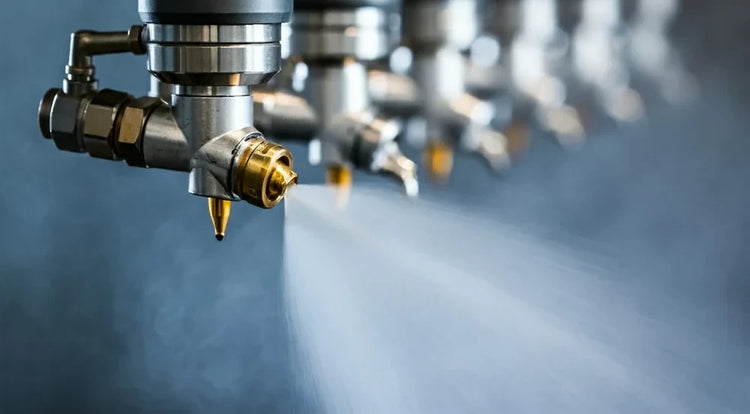
NozzlePro worked with the processor to develop a spray nozzle solution that allowed a controlled amount of moisture to be applied to the finished product after the smoking process. The spray system was designed to provide consistent, uniform coverage across the product surface — allowing the processor to compensate for moisture variations created during drying without requiring changes to the existing smokehouse operation.
Post-drying moisture reapplication via spray nozzle is a recognized and effective technique in dried meat production. The principle is moisture equilibration: when moisture is applied uniformly to the product surface, it migrates into the product by diffusion over a short equilibration period. Product that exited the smokehouse slightly over-dried absorbs the applied moisture and equilibrates toward the target moisture level. Product that exited at or near the target moisture level absorbs less. The net result is a more uniform moisture distribution across the batch than the smokehouse alone could achieve.
"Instead of accepting product loss as an unavoidable cost, the processor gained a practical tool to correct moisture variation and recover product that previously would have been discarded."
What the Spray System Needed to Achieve
The nozzle specification for this application required careful attention to several variables. The spray pattern had to provide complete, even coverage across the product surface — any area of the product that received significantly more or less moisture than others would create a new source of inconsistency rather than correcting the existing one. The flow rate had to be precisely controllable to deliver the target moisture addition without over-saturating the product. And the droplet size had to be appropriate for surface wetting rather than misting — fine mist droplets that don't contact the product surface don't contribute to moisture addition.
Post-process moisture reapplication must not compromise product safety. Any spray system applied to ready-to-eat dried meat products must use potable water, be designed to avoid contamination sources, and — in commercial applications — be validated as part of the facility's HACCP plan. NozzlePro works with food processors to recommend spray system designs appropriate for food-contact applications, but customers are responsible for validating process changes within their own food safety management systems.
Moisture Variation Became a Controllable Process Variable
The spray nozzle system transformed a recurring production problem — variable product moisture leading to routine batch rejection — into a controllable process step. Rather than accepting the smokehouse's inherent variation as an unavoidable production cost, the processor gained the ability to correct that variation systematically after each run.
- Reduced product loss caused by over-drying and overcooking
- Improved consistency of finished product moisture content across batches
- Ability to apply controlled moisture to compensate for smokehouse variation
- Recovered previously rejected product — converting waste into sellable yield
- Reduced waste of raw materials and processing time
- Improved overall production yield
- Increased profitability through recovered product and reduced waste costs
The Value of Product Recovery
The financial impact of recovering previously rejected product extended beyond the avoided waste cost. Each unit of dried meat product that exits the smokehouse over-dried carries the full cost of raw material, processing labor, energy, and smokehouse time — costs that are entirely lost when the product is discarded. Recovering even a fraction of that product through controlled moisture reapplication converts a complete loss into saleable inventory. For a processor running multiple smokehouse cycles per week, the cumulative impact on profitability is significant.
A Relatively Simple Spray Solution Turned Waste Into Sellable Product
By incorporating a precisely specified spray nozzle system into the post-drying process, this meat processor converted a recurring source of product loss into a controllable production step. The smokehouse didn't change. The drying process didn't change. What changed was the addition of a targeted spray application that corrected the moisture inconsistency the smokehouse inherently produced — and recovered product that previously represented a complete loss.
Food processing applications often require more than simply selecting a nozzle based on flow rate. Spray pattern, coverage uniformity, droplet size, pressure, product characteristics, and nozzle placement all affect the result. NozzlePro's team worked with this processor to develop a spray solution matched to the specific requirements of dried meat moisture reapplication — not a generic catalog recommendation.
Relevant NozzlePro Solutions
Frequently Asked Questions
How do spray nozzles help with moisture consistency in dried meat processing?
Spray nozzles allow meat processors to apply a controlled, uniform amount of moisture to dried meat products after the smoking or drying process. This targeted reapplication compensates for uneven moisture loss that occurs in smokehouses due to temperature and airflow variation across the chamber. A spray nozzle system with a full cone or flat fan pattern distributes moisture evenly across the product surface, where it equilibrates and redistributes through the product over a short resting period. The result is more consistent finished product moisture content, reduced rejection of over-dried product, and improved overall yield. The nozzle type, spray pattern, flow rate, and mounting geometry must all be matched to the specific product geometry and moisture addition target.
Why does smokehouse drying cause moisture inconsistency in meat products?
Smokehouse drying causes moisture inconsistency because temperature and airflow are rarely perfectly uniform throughout the chamber. Products near heat sources, air circulation fans, or the top of the chamber dry faster and lose more moisture than products in cooler or less-ventilated zones. Over a full drying cycle, these differences compound: product in high-airflow zones may reach the target moisture loss threshold well ahead of product in dead zones. Without a corrective step, the processor must choose between running the cycle long enough for all zones to reach target — accepting that faster-drying zones will be over-dried — or pulling product early and accepting under-dried product in some areas. Post-process spray moisture reapplication addresses this without requiring modification of the smokehouse itself.
What spray nozzle type is best for applying moisture to dried meat products?
The best nozzle type for dried meat moisture reapplication depends on the product geometry and how it is positioned during the spray step. For products on flat trays or belts, flat fan nozzles in a spray bar arrangement provide even, overlapping coverage across the product width at controlled flow rates. For products suspended on hooks or positioned in multiple orientations, full cone nozzles distribute moisture in all directions from each nozzle, providing coverage on product surfaces that a single flat fan spray would miss. All nozzles in food-contact applications must be manufactured in food-safe materials — 316L stainless steel is standard for water spray applications. NozzlePro can specify the appropriate nozzle type, pattern angle, flow rate, and mounting configuration for the specific product and production line layout.
Can the spray system be integrated into an existing production line without major modifications?
In most cases, a post-drying moisture spray system can be integrated into an existing production line without significant changes to the smokehouse, oven, or upstream equipment. The spray step typically takes place after the product exits the smokehouse — on a conveyor, in a staging area, or in a separate spray cabinet — before the product moves to cooling, packaging, or further processing. This downstream position means the spray system is added to the process rather than inserted into it, which minimizes disruption to the existing operation. What the integration does require is a controlled, repeatable position for the product during spray (a conveyor at controlled speed, a fixed rack position, or a dedicated spray station), a consistent water supply at the correct pressure, and a defined spray duration and nozzle layout matched to the product geometry. NozzlePro can specify the nozzle arrangement based on your product dimensions, production line layout, and target moisture addition rate.
Is post-drying moisture reapplication used only for dried meat, or does it apply to other dried food products?
The same principle — using a controlled spray system to compensate for moisture variation introduced during a drying or heat process — applies across a range of food manufacturing situations, not only dried meat. Any product that undergoes a drying, baking, smoking, or thermal process that produces batch-to-batch or within-batch moisture variation can potentially benefit from a post-process moisture correction step. This includes dried fruit and vegetable products, baked goods where crust moisture needs to be controlled post-oven, smoked fish and seafood products, and other protein products that go through dehydration stages. The specific nozzle type, spray pattern, flow rate, and system design differ for each product type and application geometry, but the underlying approach — applying a precise, uniform amount of moisture to correct process variation — is broadly applicable in food manufacturing.
How does post-drying moisture spray affect product texture, not just moisture content?
Post-drying moisture reapplication affects surface texture as well as moisture content — and this is worth understanding when specifying the spray system. Product that has been over-dried often has a harder, drier surface texture than the target specification calls for. When moisture is reapplied and given time to equilibrate through the product, the surface texture as well as the internal moisture content both move toward the target. However, the equilibration time matters: product that is sprayed and packaged immediately will have surface moisture that has not yet redistributed through the product, which can affect both texture and appearance in the final package. Designing a brief resting or conditioning period after spray — allowing the moisture to migrate through the product before packaging — is part of a well-designed post-drying moisture system. The required equilibration time depends on the product thickness, the amount of moisture added, and the temperature of the product and environment. These are process variables that should be validated for each specific product in the specific production environment.
What operating pressure is typically used for food spray nozzles applying water to meat products?
Post-drying moisture spray systems for meat products typically operate at low to moderate pressures — commonly in the range of 1 to 5 bar (15 to 70 PSI) at the nozzle. The appropriate pressure depends on the nozzle type, the required flow rate, and the target droplet size. Low pressure produces larger droplets that wet the product surface directly and drain by gravity; this is appropriate for products where you want the moisture to contact the surface rather than form a fine mist that might drift rather than deposit. Higher pressures produce finer atomization that covers surface area more uniformly but may produce some airborne mist depending on nozzle design. For most post-drying moisture reapplication systems, the goal is controlled surface wetting with complete deposition — which generally favors lower pressure and larger droplet sizes over fine-mist atomization. NozzlePro can size the system based on your required moisture addition rate per unit of product and the available water supply pressure at your facility.
Losing Product to Drying Variation in Your Facility?
NozzlePro works with food and meat processors to develop spray solutions for moisture management, product consistency, and yield improvement — matched to your specific product, process, and production requirements.
Talk to a Spray Specialist View All Case Studies