
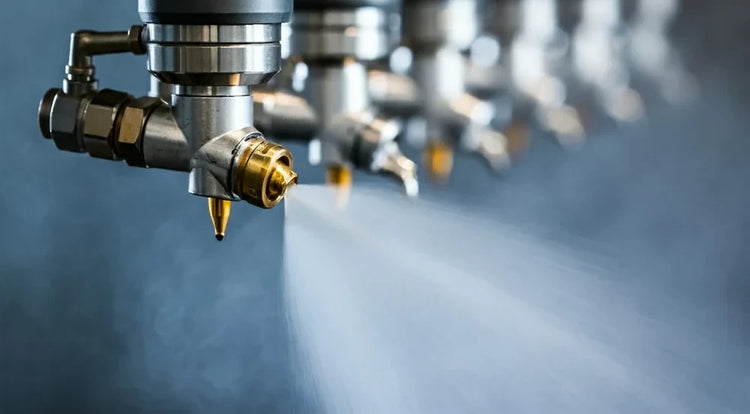

Spray Nozzles for Commercial Bagel Production
Proofer humidification, tacking agent application, and wash room cleaning — where spray nozzles belong on a commercial bagel line, and where they don't.
Key Takeaways
- A commercial bagel line has fewer spray applications than a bread line. The ones that matter are tacking agent application ahead of the seeder conveyor, proofer humidification, and manual cleaning in the wash room.
- Most commercial bagel bakeries use a tacking agent — not water — to make seeds and toppings stick. Water on raw bagels causes sticking on boards and conveyors and blistering in the oven.
- The proofer has to hold humidity high enough to prevent skinning without dripping on the product. Fine-droplet fog nozzles running on treated water add humidity without leaving wet spots.
- Proof boards get cornmeal only. Water or a liquid release agent on the boards causes bagels to stick.
- On the line, bagel bakeries sweep, scrape, and wipe down — no water. Dough troughs and mixers are cleaned by hand in a wash room or at the point of use, not with CIP systems or hose-down washdown.
- Wheat is a major allergen in every bagel, and sesame has been a major US food allergen since 2023. Most bagel bakeries manage sesame through their allergen control program and labeling rather than full wet changeovers between seeded and plain runs.
Walk the floor of a commercial bagel bakery and you'll see high-gluten dough coming off the mixer, bagel formers turning out rings by the thousands, racks rolling into the proofer or the retarder, and a seeder conveyor showering sesame, poppy, and everything seasoning onto bagel tops. What you won't see is a spray nozzle at every station. Bagel lines are mostly dry processes, and the few spray applications they do have need to be done right.
This guide covers the spray applications that do exist on a bagel line, what each one needs from a nozzle, and the places where liquid spray causes more problems than it solves. The most important of those applications is the tacking agent spray that makes toppings stay put.
The Commercial Bagel Line, Stage by Stage
Mixing
High-gluten flour, water, yeast, salt, and malt are mixed into a stiff, low-hydration dough. Water is metered straight into the mixer. No spray application.
Dividing and Forming
The dough is divided and formed into rings by a bagel former, then set on proof boards dusted with cornmeal. Boards never get water or liquid release agent. No spray application.
Proofing or Retarding
These are two different routes, not two steps. Bagels are either proofed in a warm, humid proofer or retarded in a cooler, typically overnight, to build flavor. A proofed bagel does not then go into the retarder. Spray application: proofer humidification.
Boiling (Kettle-Boiled Bagels Only)
Traditional kettle-boiled bagels come out of the boiler and go straight to the seeder conveyor while the surface is still wet. Few commercial bakeries run this process today.
Tacking Agent and Seeding
A tacking agent is sprayed onto the bagel tops, and the seeder conveyor or topping applicator deposits sesame, poppy, everything seasoning, onion, garlic, or salt. Tacking agent coverage decides whether toppings stay on.
Baking
Bagels move from the boards into the oven. No spray application covered in this guide.
Cooling, Freezing, and Packaging
Bagels sold frozen are frozen only after baking. No spray application.
Cleaning
The line is swept, scraped, and wiped down. Dough troughs, mixer components, and removable parts are cleaned by hand in a wash room or at the point of use. Spray application: wash room spray guns and nozzles.
Where Spray Belongs — and Where It Doesn't
Commercial bagel bakeries use spray nozzles in three main places: applying tacking agent to bagel tops ahead of the seeder conveyor so toppings adhere, humidifying the proofer so the dough doesn't skin, and manually cleaning troughs, mixer parts, and removable equipment in the wash room. Bagel lines generally do not spray water for seed adhesion, spray release agent on proof boards, use oven steam injection the way bread lines do, or use CIP and hose-down washdown on the production floor.
| Line Stage | Spray? | What Actually Happens |
|---|---|---|
| Mixing | No | Water is metered directly into the mixer |
| Proof boards | No | Cornmeal only — liquid on boards causes sticking |
| Proofer | Yes | Fog nozzles hold humidity to prevent skinning |
| Retarder | No | Cold hold, typically overnight; a separate route from proofing |
| Tacking agent station | Yes | Tacking agent sprayed onto bagel tops before the seeder |
| Seeder conveyor | No | Dry toppings deposited onto tacked bagels |
| Oven | No | Steam injection is common in bread and hearth production, not typical for bagels |
| Production floor | No | Swept, scraped, and wiped down — no water |
| Wash room | Yes | Manual cleaning of troughs, mixer parts, and removable equipment |
Tacking Agent Application: Making Toppings Stay On
Most bagels on the market carry a topping, and every one of those toppings depends on a tacking agent. On a commercial line, the bagels pass under a spray station that coats the tops with tacking agent, then move directly into the seeder conveyor or topping applicator. The seeds land on a tacky surface, bond to it, and stay on through baking, freezing, slicing, and bagging.
Why not water? Water is sometimes used for seed adhesion in bread production, but bagel bakeries avoid it. Water on a raw bagel surface causes sticking on boards and conveyors, blistering in the oven, and a range of downstream production problems. The only time a bare-water surface carries seeds on a bagel line is a kettle-boiled bagel moving straight from the boiler to the seeder — a process few bakeries run today.
Tacking agents vary by supplier and formula, and many are thicker or carry more solids than plain water. That changes what the nozzle has to do. A tacking agent nozzle needs to lay down a thin, even coat across the full belt, shut off cleanly between products, and keep doing it all shift without clogging or dripping.
What to Specify for a Tacking Agent Spray Station
| Parameter | What to Specify | Why It Matters |
|---|---|---|
| Nozzle type | Air-atomizing nozzles for most tacking agents; low-flow flat fan nozzles only for thin, water-like formulas | Air atomization handles thicker liquids at the low flow rates a thin coat requires. External-mix designs are commonly preferred for thicker or solids-bearing liquids. |
| Coverage | A spray bar with nozzle count and spacing set for even overlap across the full belt width | Gaps in coverage leave bald spots with no topping; heavy overlap leaves pooled agent and clumped seeds. |
| Application rate | A thin, consistent coat matched to line speed and bagel count | Over-application wastes tacking agent and creates sticking on the seeder and conveyor. Under-application lets toppings fall off after baking. |
| On/off control | Clean shutoff (spring-loaded or needle shutoff) with spray triggered only when product is present | Drips and spray between bagels end up on the belt, where they collect seeds and cause sticking. |
| Clog resistance | Inline strainers, adequate free passage, and a flush procedure for end of run | Tacking agent that dries in an orifice during a stop is the most common cause of a streaky or dead nozzle. |
| Cleanability | Tool-free caps and quick disassembly for wash room cleaning | The spray station touches every seeded bagel and needs to come apart easily for routine cleaning. |
NozzlePro air-atomizing nozzles are available in stainless steel with external-mix and shutoff options for low-flow coating applications like tacking agent spray.
Proofer Humidification: Preventing Skinning
For bagels that go the proofing route rather than the retarder, the proofer has one job: give the dough a warm, humid environment to rise without the surface drying out. When humidity falls short, the bagels skin — a dry, leathery outer layer that restricts the rise, dulls the finished surface, and can crack in the oven. When humidity is added badly, the proofer drips, and the bagels pick up wet spots that stick and bake out unevenly.
Typical proofer conditions: Settings vary with the formula and the line, but bagel proofers commonly run warm and humid — often around 85–95°F (29–35°C) at 75–85% relative humidity. Your formula and proof time set the target; the humidification system's job is to hold it consistently, rack after rack and shift after shift.
What Goes Wrong When Humidity Drifts
- Skinning: Low humidity dries the dough surface, limits the rise, and leaves a dull, leathery finish after baking.
- Wet spots and drip: Oversized droplets, condensation on the proofer ceiling, or a nozzle that drips when it cycles off puts liquid water on the product. Those spots stick to boards and bake out unevenly.
- Uneven proof: Humidity that's high near the humidifier and low near the doors gives you a mixed rack — some bagels fully proofed, some under-proofed.
- Shift-to-shift variation: Partially clogged nozzles, drifting pump pressure, and mineral scale all change output gradually. A well-maintained system takes humidification off the list of variables.
Nozzle Specification for Proofer Humidification
High-pressure fog nozzles produce droplets fine enough to evaporate in the air before they reach the racks, the boards, or the dough. The proofer air gets more humid; the product stays dry. Low-pressure misting nozzles produce larger droplets that settle on surfaces before they evaporate — the source of wet spots and drip.
- Anti-drip check valves stop the nozzle from dribbling when the system cycles off.
- Treated water — reverse osmosis or softened — keeps orifices from scaling and prevents mineral dust from settling on product and equipment.
- Placement should give the fog room to evaporate before it reaches the racks, with coverage that reaches the corners and door areas.
- 316 stainless steel nozzle bodies hold up to continuous duty in a warm, wet environment.
Proof Boards: Cornmeal, Not Spray
Proof boards — or simply "boards" on the bakery floor — are dusted with cornmeal and nothing else. Water or a liquid release agent on a board makes the bagels stick — exactly the problem the cornmeal is there to prevent.
That's why you won't find a board spray station on this list. Knowing which applications don't need a nozzle is as important as specifying the ones that do.
Sanitation: Dry on the Line, Wet in the Wash Room
A bagel line builds up flour dust, cornmeal, loose seeds, and dough scrap over every shift. On the production floor, that buildup is removed dry — swept, scraped, and wiped down. Water on the floor and equipment would turn flour and dough into paste and create the very conditions a bakery works to avoid. Bagel bakeries don't use CIP systems on dough troughs or mixers, and they don't hose down the production area.
Dough troughs, mixer components, and removable parts — including the tacking agent spray bar and nozzles — are cleaned by hand, either in a dedicated wash room or at the point of use. This is where cleaning spray belongs in a bagel bakery: spray guns and nozzles that let wash room staff rinse and clean parts quickly, with a controlled pattern and without excessive splash.
- Controlled pattern: A spray gun with an adjustable or fixed fan pattern cleans parts without spraying the whole room.
- Chemical and temperature rating: Seals and gun bodies should be rated for the hot water, detergents, and sanitizers in your cleaning program.
- Ergonomics: Wash room staff use the gun all shift — a comfortable trigger and the right flow rate matter.
Allergen Control on a Bagel Line
Every bagel contains wheat, one of the major food allergens under US law. Sesame joined the list as the ninth major allergen when the FASTER Act took effect on January 1, 2023, and it's one of the most common bagel toppings.
In practice, many bagel bakeries don't run a full cleaning between seeded and plain bagels. Instead, they manage sesame through their allergen control program — production scheduling, labeling, and treating products from shared lines accordingly. Where a bakery does run dedicated sesame-free product, the tacking agent spray station and seeder are the pieces of equipment that need the most attention, which is one more reason to specify nozzles that come apart quickly and completely.
Your allergen program comes first. NozzlePro can help you specify cleanable spray equipment, but allergen control decisions belong to your food safety team and your regulatory requirements.
Nozzle Materials and Specifications for Bagel Production
| Application | Liquid | Nozzle Body | Key Considerations |
|---|---|---|---|
| Tacking agent spray | Tacking agent (formula varies by supplier) | 316 stainless steel air-atomizing nozzle | Seals chemically compatible with the agent; clean shutoff; clog resistance; tool-free disassembly |
| Proofer humidification | RO or softened water at high pressure | 316 stainless steel fog nozzle | Anti-drip check valve; fine droplet size; water treatment to prevent scale |
| Wash room cleaning | Hot water, detergent, sanitizer | Stainless steel or food-grade spray gun | Temperature and chemical rating; controlled pattern; ergonomic trigger |
Not sure which nozzle fits your tacking agent or your proofer? Send us your line speed, belt width, tacking agent formula, and proofer dimensions, and our team will recommend a configuration.
Spray Nozzles Built for the Bagel Line
NozzlePro supplies stainless steel air-atomizing nozzles for tacking agent application, high-pressure fog nozzles for proofer humidification, and spray guns for wash room cleaning.
Shop Bakery Nozzles Request a QuoteFrequently Asked Questions
What spray nozzles are used in commercial bagel production?
Commercial bagel bakeries use spray nozzles in three places. Air-atomizing nozzles on a spray bar apply tacking agent to bagel tops just before the seeder conveyor so toppings adhere. High-pressure fog nozzles humidify the proofer to prevent skinning without wetting the dough. Spray guns and nozzles are used in the wash room to clean dough troughs, mixer parts, and removable equipment by hand.
Why don't bagel bakeries use water to make seeds stick?
Water on a raw bagel surface causes sticking on boards and conveyors, blistering in the oven, and other production problems. Instead, most commercial bagel bakeries spray a tacking agent onto the bagel tops just before the seeder conveyor. The tacky surface holds sesame, poppy, everything seasoning, and other toppings through baking and packaging. Water-based seed adhesion is more common in bread production. The exception on a bagel line is a kettle-boiled bagel that moves straight from the boiler to the seeder while still wet, a process few bakeries run today.
What humidity does a bagel proofer need, and how do you add it without wetting the bagels?
Proofer settings depend on the formula, but bagel proofers commonly run around 75–85% relative humidity at 85–95°F (29–35°C). The goal is to prevent skinning without dripping on the product. High-pressure fog nozzles produce droplets fine enough to evaporate before they reach the racks or dough, so the air gets more humid while the bagels stay dry. Anti-drip check valves and treated water (RO or softened) prevent drips and mineral scale.
Do bagel bakeries use CIP systems or hose-down washdown?
No. Bagel bakeries — like bread, pita, and other baked-goods producers — don't use CIP systems on dough troughs or mixers, and they don't hose down the production floor. The line is swept, scraped, and wiped down. Dough troughs, mixer components, and removable parts are cleaned by hand in a wash room or at the point of use, which is where spray guns and cleaning nozzles are used.
How do bagel bakeries manage wheat and sesame allergens?
Wheat is in every bagel, and sesame has been a major US food allergen since the FASTER Act took effect on January 1, 2023. Many bagel bakeries don't clean between seeded and plain runs; they manage sesame through their allergen control program, including production scheduling and labeling. Bakeries that do run dedicated sesame-free product focus on the tacking agent station and seeder, so cleanable, easy-to-disassemble nozzles help. Contact NozzlePro to discuss nozzle options for your line.
Serving Commercial Bakeries Across the US
Tell us about your bagel line — line speed, belt width, tacking agent, and proofer — and we'll recommend nozzles that fit the way your bakery actually runs.
Request a Quote Shop Bakery Nozzles


