
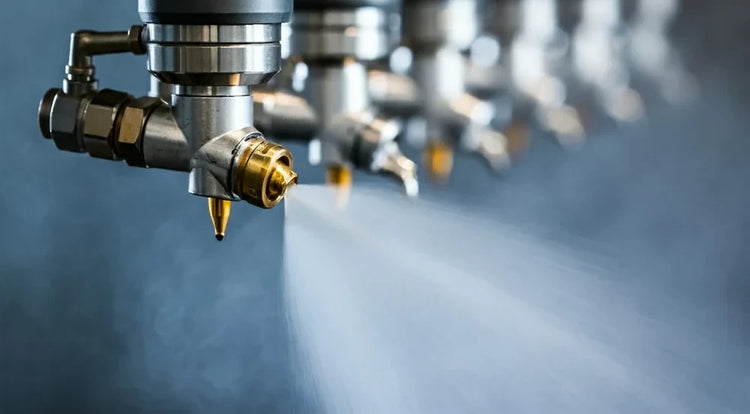

Spray Nozzles for Frozen Asian Food Manufacturing
From wrapper dough to finished frozen product — a complete guide to where spray nozzles are essential in gyoza, potsticker, dim sum, spring roll, egg roll, and steamed bun production, and how to specify the right nozzle for each stage.
Key Takeaways
- Frozen Asian food facilities typically use spray nozzles at six or more distinct production stages — including anti-stick oil mist on sheeting lines, air-atomizing for product coating, steam injection for cooking, CIP spray balls for tank cleaning, and food-grade washdown throughout the facility.
- Anti-stick oil mist on wrapper sheeting equipment is one of the most overlooked spray applications — and one of the highest-impact for production quality. Uneven or over-applied oil mist causes wrapper tearing, line jams, and wrapper quality defects.
- 316L stainless steel is the standard nozzle body material for all food-contact spray applications. Food-grade silicone seals are the standard elastomer for direct food-contact use across the temperature range of food processing.
- CIP spray balls for mixing vessels, filling hoppers, and tanks must be matched to the vessel geometry — diameter, baffles, and internal fittings — to ensure complete cleaning coverage without manual vessel entry.
- Allergen changeover between production runs is a food safety priority: adequate flow rate, nozzle coverage, and contact time during washdown are as important as the cleaning chemistry for effective allergen removal.
A frozen Asian food manufacturing facility producing dumplings, gyoza, spring rolls, egg rolls, steamed buns, and dim sum operates as an integrated system of connected production stages — each with its own liquid application requirements. The spray nozzle is a workhorse component in almost every one of these stages, from the subtle oil mist that keeps dough from sticking to the sheeting rollers at the start of production, through to the CIP spray balls that clean the filling hoppers and mixing tanks at the end of every shift.
The nozzle choice at each stage affects production output, product quality, food safety, and facility compliance simultaneously. Under-specified or worn nozzles cause production problems — line jams from sticking dough, rejected products from uneven coating, extended cleaning times from inadequate CIP spray coverage. Over-specified nozzles waste oil, water, steam, or cleaning chemical. The right specification does both jobs: enough to get the result, not more than necessary.
This guide covers every spray nozzle application typical in a frozen Asian food production facility, with nozzle selection guidance for each.
Spray Nozzle Applications Across a Frozen Asian Food Facility
Frozen Asian food manufacturing uses spray nozzles across at least seven distinct production and sanitation stages. Air-atomizing oil mist nozzles prevent wrapper dough from sticking to sheeting rollers and conveyor surfaces. Air-atomizing nozzles also apply oil glazes, egg wash, or sauce coatings to finished products. Steam injection nozzles introduce controlled steam for cooking buns, shumai, and other steamed dim sum products. CIP spray balls clean mixing tanks, filling hoppers, and sauce vessels during production changeovers. Full cone or flat fan nozzles apply cooling water after cooking before IQF freezing. Fog/mist nozzles maintain correct humidity in dough production and proofing areas. Food-grade washdown spray guns and nozzles clean production lines and facility floors between runs and at end of shift.
Anti-Stick Oil Mist
Air-atomizing nozzles apply a fine, controlled mist of oil or release agent to wrapper sheeting rollers, belt conveyors, and forming equipment — preventing dough adhesion without over-applying oil that would affect product quality.
Product Coating
Air-atomizing nozzles apply oil glazes, egg wash, and sauce coatings to gyoza, buns, spring rolls, and other products before packaging, baking, or further processing — providing uniform surface coating critical to appearance and browning.
Steam Cooking
Steam injection nozzles deliver precise, controlled steam for cooking steamed buns, shumai, har gow, and other dim sum. Steam distribution uniformity directly affects cooking consistency across the entire batch.
Post-Cook Cooling
Full cone water spray nozzles cool cooked products rapidly before IQF freezing — controlling product temperature to the target range before the freezing tunnel to ensure product quality and food safety compliance.
CIP Tank Cleaning
Spray balls deliver rotating or fixed spray coverage inside mixing tanks, filling hoppers, and sauce vessels during CIP cleaning cycles — reaching all interior surfaces without manual vessel entry.
Facility Washdown
Food-grade washdown spray guns and nozzles clean production equipment surfaces, conveyors, floors, and walls between production runs and at the end of each shift — critical for food safety and allergen management.
Dough and Wrapper Production: Anti-Stick Oil Mist
Wrapper production is the foundation of frozen dumpling and Asian food manufacturing — and it's where spray nozzle performance has the most direct impact on line efficiency. Gyoza wrappers, wonton skins, spring roll shells, egg roll wrappers, and dumpling wrappers all begin as sheeted dough that passes through a series of rollers and conveyors before being cut, shaped, and filled. Without proper lubrication of these surfaces, the dough sticks — causing tears, misfeeds, jams, and off-spec wrappers that result in product rejects.
Why anti-stick oil mist matters — and why most applications over-apply
The objective of anti-stick oil spray on wrapper production equipment is to deposit a thin, consistent film of food-grade oil on roller and conveyor surfaces that prevents dough adhesion. The critical word is thin. Too little oil and the dough sticks. Too much oil and the oil transfers to the wrapper in visible quantities, affecting the wrapper's ability to seal at the crimp — a wrapper with excess surface oil doesn't seal properly during dumpling folding, causing filling leakage and rejected product. Over-application also creates floor oil accumulation from drips and overspray, creating slip hazards and wasted product. Air-atomizing nozzles producing a fine, controlled mist achieve the target thin film without excess.
Nozzle Selection for Anti-Stick Oil Mist
Air-atomizing spray nozzles are the standard for anti-stick oil mist in food production. The compressed air atomizes the food-grade oil into droplets fine enough to coat the roller or belt surface uniformly without producing visible oil puddles or runs. External-mix air-atomizing designs are preferred for oil service — the oil doesn't contact the internal compressed air passages, reducing the risk of oil degrading inside the nozzle during idle periods.
For wrapper sheeting rollers specifically, the nozzle must cover the full roller width uniformly. A flat fan air-atomizing nozzle oriented along the roller axis, or a spray bar with multiple nozzles at defined spacing, ensures consistent oil coverage from one edge of the roller to the other. Uneven coverage produces uneven adhesion — one side of the sheet releasing well while the other tears.
NozzlePro's air-atomizing nozzle collection includes external-mix designs in 316L stainless with food-grade silicone seals, in a range of orifice and air cap configurations suitable for food-grade oil mist applications on wrapper production equipment.
Product Coating: Oil Glaze, Egg Wash, and Sauce Application
Many frozen Asian food products receive a surface coating before final packaging, cooking, or freezing. Pan-fried potstickers and gyoza benefit from a controlled oil application to their bottom surface that facilitates browning during the consumer's pan-fry step. Steamed buns receive a glaze application that gives the finished product its characteristic sheen. Some products receive a sauce or marinade coating that is part of the flavor profile.
Gyoza and Potsticker Bottom-Side Oil Application
For pan-fried products, the bottom surface of each piece needs a thin, consistent oil film. Automated spray systems apply this oil as products travel on a conveyor — the spray nozzle(s) positioned above the conveyor apply a controlled volume of oil to the product surface. The nozzle specification must account for line speed, product spacing, and required oil volume per unit area to ensure every product receives the correct amount. An air-atomizing flat fan nozzle traversing the conveyor width, or a spray bar array of multiple nozzles covering the full belt width, are both common configurations.
Egg Wash and Glaze for Baked and Steamed Buns
Steamed buns and baked goods in the Asian food segment — char siu bao, pan-fried buns, sesame balls — typically receive an egg wash or sugar glaze that creates the characteristic golden or shiny surface. Air-atomizing nozzles apply this coating uniformly before the cooking or finishing step. The nozzle must atomize the egg wash or glaze finely enough to prevent runs while covering the full surface of the product.
"In high-speed production of frozen Asian foods, the spray nozzle applying oil or glaze is not a finishing touch — it's a process step with as much impact on product quality and consumer experience as any other in the line."
Steam Cooking: Buns, Shumai, and Steamed Dim Sum
Steam cooking is central to the production of many of the most popular frozen Asian food products — har gow shrimp dumplings, shumai, pork buns (bao), vegetable buns, and a wide range of steamed dim sum items that are partially cooked before freezing for consumers to finish at home by resteaming or microwaving.
In commercial frozen food production, steam cooking is performed in continuous tunnel or batch cabinet steamers. Steam injection nozzles deliver steam into the cooking chamber at a controlled rate and distribution. The uniformity of steam distribution determines cooking consistency across the full product load — products at the steam injection points cook faster than products in regions of lower steam concentration. Non-uniform steam distribution leads to inconsistent internal temperatures across the batch, which creates both quality issues (over- or under-cooked products) and food safety risks if any portion of the batch fails to reach the required internal temperature.
What to Specify for Steam Injection Nozzles
- Steam distribution pattern: Multiple nozzles arranged to distribute steam evenly across the full chamber cross-section — not concentrated at one injection point
- Flow rate per nozzle: Matched to the steamer's total steam supply capacity; individual nozzle flow rates must sum to the system's design steam flow
- Nozzle material: 316L stainless steel rated for saturated steam service; seals must be compatible with continuous steam exposure
- Connection type: Match to existing steam supply manifold connections in the steamer equipment
Post-Cook Cooling Before IQF Freezing
Products that are partially or fully cooked before freezing — steamed buns, pre-cooked dumplings, spring rolls — must be cooled before entering the IQF (individual quick freezing) tunnel. The rate and method of cooling affects product quality, product safety, and IQF performance.
Water spray cooling is used in many facilities to bring product temperature down rapidly after the cooking stage and before the IQF tunnel. Full cone spray nozzles positioned above and around the cooling conveyor apply a controlled water mist or spray that extracts heat from the product surface. The nozzle design, spray angle, flow rate, and nozzle-to-product distance must be calibrated to achieve the target product temperature at the entry to the IQF tunnel without over-wetting the product surface.
Over-wetting during post-cook cooling affects IQF performance and finished product quality. Product with excess surface moisture entering the IQF tunnel develops a thicker ice glaze than intended — affecting net weight, appearance, and moisture content of the finished frozen product. Nozzle specification for post-cook cooling should target the minimum water application rate that achieves the required cooling — not the maximum the system can apply.
CIP Spray Cleaning for Mixing Tanks, Filling Hoppers, and Sauce Vessels
Food production facilities handling raw meat, seafood, egg, and vegetable filling ingredients operate multiple enclosed mixing tanks, filling hoppers, and sauce preparation vessels that require thorough cleaning and sanitation between product runs, at shift end, and during allergen changeovers. CIP (Clean in Place) spray systems allow these vessels to be cleaned with hot cleaning solution without manual vessel entry — faster, more consistent, and safer than manual cleaning.
CIP Spray Ball Selection for Food Vessels
The spray ball is the cleaning nozzle used in vessel CIP systems. It is installed at the top of the vessel and connected to the CIP supply line. When the CIP cycle runs, hot cleaning solution flows through the spray ball, distributing the cleaning solution across the interior vessel surface.
| Spray Ball Type | How It Works | Best For | Cleaning Mechanism |
|---|---|---|---|
| Static spray ball | Fixed nozzle with multiple orifices; distributes solution in a fixed pattern around the sphere | Smooth-interior tanks without complex baffles or internal fittings | Chemical cleaning — relies on cleaning chemistry and flow volume, not mechanical impact |
| Rotary spray head (gear-driven) | Mechanically rotating nozzle; arms rotate through the cleaning solution supply pressure | Larger tanks, vessels with baffles, agitator shafts, or internal components | Mechanical + chemical — rotating jets provide higher impact for stubborn food deposits |
| Rotary jet cleaner | High-impact rotating jets; higher velocity cleaning solution than spray balls | Large-volume vessels, tanks with heavy protein or fat buildup, difficult geometry | Primarily mechanical — high-velocity jets physically dislodge deposits; less reliant on extended soak time |
For filling hoppers holding meat or seafood filling — which have high protein and fat content that bakes onto surfaces if not promptly removed — rotary spray heads providing mechanical impact cleaning are typically preferred over static spray balls. The mechanical action supplements the cleaning chemistry to remove adherent protein deposits that a static spray ball at the same solution concentration and temperature may leave behind.
NozzlePro's cleaning and washing collection includes CIP spray balls and rotary spray heads for food vessel cleaning — in 316L stainless steel with food-grade seals, in a range of sizes matched to tank diameter and required flow rate.
Facility Washdown: Between Runs and End of Shift
Food-grade facility washdown — cleaning production equipment surfaces, conveyors, floors, walls, and drains after each production run and at end of shift — is one of the highest-frequency spray activities in a food manufacturing facility. In an Asian food plant running multiple product runs per shift across dough, filling, forming, and freezing sections, washdown is not a single event but a continuous activity that intersects with production at every transition point.
The spray gun or nozzle used for washdown affects cleaning effectiveness, water consumption, and the physical effort required by cleaning staff. A well-specified washdown system:
- Delivers sufficient impact: Cleaning spray must have enough force to physically displace food debris and grease from equipment surfaces — mist nozzles designed for fine distribution don't provide the impact needed for effective equipment cleaning.
- Provides controllable flow: The operator needs to be able to concentrate spray on heavily soiled areas and reduce flow when rinsing delicate electronics or controls. A variable-flow spray gun gives cleaning staff this control without having to work with a fixed nozzle output.
- Minimizes water use and aerosol: Excessive water application during washdown spreads contamination (including allergens) across surfaces via water splatter and creates excessive aerosol in the production environment. Controlled, targeted spray minimizes both risks.
- Food-grade materials throughout: All washdown spray equipment that may contact food-contact surfaces must be constructed from food-safe materials — hose materials, gun body, nozzle tip, and all O-rings and seals.
Humidity Control in Dough Production and Proofing Areas
Wheat dough for dumpling wrappers, wonton skins, and spring roll shells is highly sensitive to ambient humidity. In a low-humidity production environment, the dough surface dries faster than the interior, creating a tougher, less elastic surface layer that tears during sheeting and forming. In proofing areas for yeast-leavened buns, humidity control is essential for consistent proofing rates and uniform product volume.
High-pressure fog nozzles producing sub-50 micron droplets that evaporate completely in air — achieving dry fog humidification — maintain the target relative humidity in these areas without wetting dough surfaces, equipment, or floors. The nozzles are installed on manifolds in the ceiling or ductwork above the dough production area, with the fog evaporating before it reaches surfaces below.
Food-Grade Nozzle Material Selection for Asian Food Production
| Application | Liquid Contact | Nozzle Body | Seals / O-rings |
|---|---|---|---|
| Anti-stick oil mist on dough equipment | Food-grade vegetable or mineral oil | 316L stainless steel | Food-grade silicone or PTFE |
| Egg wash / glaze application | Liquid egg, sugar glaze, sauce | 316L stainless steel | Food-grade silicone (compatible with egg protein) |
| Steam injection for cooking | Saturated steam (100°C+) | 316L stainless steel | PTFE or high-temperature silicone rated for steam service |
| Water cooling spray | Potable water | 316L stainless steel or food-grade PP | Food-grade silicone or EPDM |
| CIP spray balls — tanks and hoppers | Hot caustic (NaOH), acid (HNO3), sanitizer | 316L stainless steel | PTFE — resistant to both caustic and acid CIP chemistries at CIP temperatures |
| Facility washdown | Water, detergent, sanitizer | 316L stainless steel (food-grade gun body) | Food-grade silicone or EPDM; PTFE for gun seats |
| High-pressure fog humidification | Potable or softened water | 316L stainless steel | Food-grade silicone or PTFE anti-drip needle seals |
Allergen Changeover Spray Protocol
Frozen Asian food manufacturing presents significant allergen management challenges. A single production line may run products containing shellfish, wheat, egg, soy, peanut, and tree nut allergens across different products and shifts. The equipment washdown between allergen-containing product runs is a food safety critical control — inadequate cleaning can result in allergen cross-contact, product recall, and serious consumer health risk for allergic individuals.
The spray nozzle's role in allergen changeover extends beyond simple cleaning to several specific requirements:
- Complete equipment coverage: Washdown nozzles must reach all food-contact surfaces on the line — including inside forming dies, under conveyor belts, inside hopper corners, and inside all conveyor frame channels where food debris accumulates. Coverage gaps leave allergen residues that survive subsequent product runs.
- Controlled water volume: Allergen washdown is not a rinse — it is a cleaning step with defined contact time and physical action. Too little water doesn't remove allergen residue; too much water creates splatter that can spread allergen-containing residue to surfaces that were already clean.
- Nozzle design for crevice access: Standard flat fan or full cone nozzles don't reach inside tight crevices, under belt edges, or inside complex forming equipment profiles. Narrow spray angle nozzles or spray gun extensions are needed for these areas.
NozzlePro's food and beverage nozzle range serves the full spectrum of frozen Asian food manufacturers — from regional producers to national brands:
What to Have Ready When You Contact NozzlePro
Frozen Asian Food Facility — Nozzle Quote Checklist
Spray Nozzle Solutions for Every Stage of Your Frozen Food Facility
NozzlePro supplies food-grade spray nozzles for anti-stick oil mist, product coating, steam cooking, product cooling, CIP tank cleaning, and facility washdown — in 316L stainless steel with food-safe seals, matched to your production process and sanitation requirements.
Shop Food & Beverage Nozzles Request a QuoteFrequently Asked Questions
What spray nozzles are used in frozen dumpling and Asian food manufacturing?
Frozen Asian food manufacturing uses spray nozzles across multiple production and sanitation stages. Air-atomizing nozzles apply food-grade oil mist to wrapper sheeting equipment to prevent dough adhesion, and apply oil glazes, egg wash, and sauce coatings to finished products before cooking or packaging. Steam injection nozzles deliver controlled steam for cooking buns, shumai, and other steamed products. Full cone nozzles apply cooling water to cooked products before IQF freezing. CIP spray balls clean mixing tanks, filling hoppers, and sauce vessels during changeovers. Food-grade washdown nozzles and spray guns clean production equipment and facility surfaces between runs and at end of shift. High-pressure fog nozzles maintain humidity in dough production and proofing areas.
What nozzle material is required for food-contact spray in frozen food manufacturing?
Food-contact spray nozzles must be manufactured from materials that are safe for contact with food, cleanable, and resistant to the cleaning and sanitizing chemistries used in food facilities. 316L stainless steel is the standard nozzle body material — it is corrosion resistant, maintains a smooth, hygienic surface finish, and is compatible with standard food facility cleaning and sanitizing chemistries including caustic, acid, and quaternary sanitizers. PVDF is appropriate where additional chemical resistance is needed. For seals and O-rings in direct food-contact applications, food-grade silicone is the most widely used elastomer — it is compatible with food products, oils, glazes, and cleaning chemistries across the temperature range of food processing. PTFE is used where chemical resistance to strong acids or caustic at elevated CIP temperatures is required.
How are CIP spray balls selected for mixing tanks and filling hoppers in food facilities?
CIP spray ball selection for food vessels depends primarily on vessel diameter, internal geometry, and the soil type present. For smaller, smooth-interior tanks (up to approximately 1.5m diameter): static spray balls with appropriate orifice size and flow rate for the CIP pump capacity provide adequate coverage through chemical cleaning action. For larger vessels or those with baffles, agitator shafts, or filling equipment inside: rotary spray heads that rotate through the CIP pump pressure provide better mechanical coverage of complex internal geometry. For vessels with heavy protein or fat soil (filling hoppers for meat-based fillings): rotary jet cleaners with higher impact force supplement the cleaning chemistry to remove adherent deposits that static spray balls may leave. The spray ball must be sized for the vessel diameter — a spray ball positioned at the top of the vessel must produce a coverage pattern that reaches the full vessel circumference and all internal surfaces. Contact NozzlePro with your vessel diameter, height, and internal geometry description to recommend the appropriate spray ball type and size.
Why does anti-stick oil spray on wrapper sheeting equipment affect dumpling sealing quality?
Over-application of oil mist to wrapper sheeting equipment deposits excess oil on the wrapper surface — and when these oiled wrappers reach the folding and sealing step, the crimp surfaces have too much oil to seal properly. The oil acts as a release agent at the crimp, preventing the dough surfaces from bonding to each other under the folding pressure. The result is incompletely sealed dumplings that open during the IQF freezing process or during cooking, releasing filling and producing misshapen, rejected product. The correct anti-stick application is a very thin, even oil film on the sheeting equipment surfaces — just enough to prevent adhesion, not enough to transfer visible oil onto the wrapper surface. Air-atomizing nozzles producing a fine mist at low flow rates are most effective for achieving this thin application without over-applying. Flat fan nozzles or drip systems tend to over-apply relative to what the application actually needs.
How should allergen changeover washdown be designed for multi-product Asian food lines?
Allergen changeover washdown in Asian food facilities requires a different approach from routine end-of-shift cleaning because the objective is allergen elimination, not just visible cleanliness. A surface can appear visually clean while retaining allergenic protein residue at levels sufficient to cause a reaction in a sensitive consumer. Effective allergen changeover washdown should include: adequate water pressure at the nozzle to physically dislodge allergen-containing deposits (typically 3–5 bar minimum); complete coverage of all food-contact surfaces including difficult-to-access areas — under conveyor belts, inside forming dies, inside hopper corners, and conveyor frame channels; a sufficiently high-concentration cleaning detergent that disrupts allergen proteins; and a final water rinse that removes cleaning chemical residue along with loosened allergen material. Spray nozzle selection for allergen washdown should prioritize coverage completeness and controlled water application over high volume — spreading allergen-containing water broadly through excessive spray creates cross-contamination risks rather than eliminating them.
Supply Your Frozen Asian Food Facility with the Right Nozzles for Every Stage
NozzlePro supplies food-grade spray nozzles for the full spectrum of frozen Asian food manufacturing — from dough line anti-stick to product coating, steam cooking, post-cook cooling, CIP cleaning, and facility washdown.
Request a Quote Shop Food & Beverage Nozzles


