

1029 Products

Hollow Cone Spray Nozzles
Hollow cone spray nozzles produce a ring-shaped spray pattern with fine droplets and maximum air entrainment. Designed for dust suppression, evaporative cooling, fire protection, and gas conditioning applications.


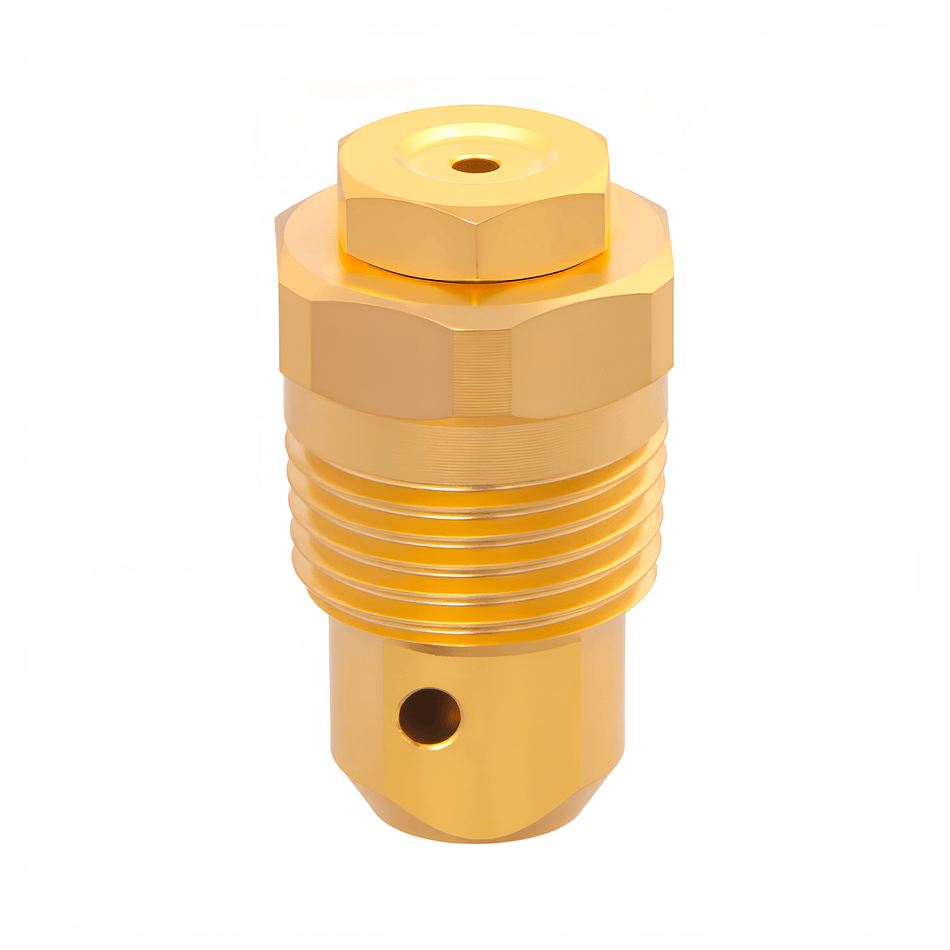


Hollow Cone Spray Nozzles for High-Impact Ring-Pattern Spray
Hollow cone nozzles create a ring-shaped spray that excels in gas scrubbing, quenching, and processes requiring intense droplet-to-gas contact.

Spray Pattern
Hollow Cone
Available SKUs
1029 Products
Quality
Industrial Grade
Shipping
Ships Fast
How Hollow Cone Spray Nozzles Work
Liquid exits through a grooved insert or tangential inlet, forming a spinning hollow cone with high-velocity droplets at the perimeter.
Operating Principle
Hollow cone spray nozzles create their characteristic ring-shaped spray pattern through centrifugal force. Liquid enters the nozzle and is forced into rotation, either through tangential entry or internal vanes. As the spinning liquid exits the orifice, centrifugal force pushes droplets outward, forming a hollow cone pattern with an empty center.
Hollow Cone Spray Pattern Characteristics:
• Pattern Shape: Ring or donut pattern with an empty center.
• Droplet Size: Fine to very fine droplets, typically smaller than full cone spray patterns.
• Air Entrainment: High air entrainment promotes evaporation and gas mixing.
• Coverage: Spray concentrates on the outer perimeter at close range but fills in at longer distances.
• Spray Angles: Typically available between 60° and 120° depending on nozzle design.
Why Choose Hollow Cone Pattern
The hollow cone spray pattern is commonly selected when fine atomization and efficient mixing are required.
• Fine Atomization: Produces small droplets without requiring compressed air systems.
• Air Entrainment: High entrainment helps improve evaporation and gas contact in process systems.
• Wide Coverage with Low Flow: Fine droplets allow small liquid volumes to cover large areas.
• Controlled Drift Behavior: Fine droplets remain suspended longer, supporting cooling and gas scrubbing processes.
Hollow Cone vs Full Cone Comparison
Key differences between hollow cone and full cone spray patterns:
• Pattern: Hollow cone creates a ring pattern with an empty center; full cone fills the entire circular spray area.
• Droplet Size: Hollow cone produces finer droplets; full cone produces medium droplets.
• Air Entrainment: Hollow cone provides higher air entrainment; full cone produces lower entrainment.
• Coverage: Hollow cone focuses on perimeter coverage; full cone provides complete circular coverage.
• Typical Applications: Hollow cone nozzles are preferred for cooling, dust suppression, and gas contact processes, while full cone nozzles are commonly used for washing, tank cleaning, and fire protection.
Hollow Cone Nozzle Applications
These Nozzles perform best in gas absorption towers, venturi scrubbers, cooling towers, and high-pressure washing systems.
Cleaning & Washing
Support rinsing, washdown, parts cleaning, and surface cleanup with coverage and impact matched to the soil load and line speed.
Cooling & Quenching
Control part temperature and process heat with spray coverage sized for the required cooling rate and heat removal.
Humidification & Conditioning
Produce droplets suited to humidity control, evaporative conditioning, and air treatment tasks.
Dust & Pollution Control
Capture airborne dust, cool gas streams, and suppress fugitive emissions with the right droplet size and coverage.
Hollow Cone Nozzle Selection Guide
Match cone angle, flow rate, and droplet size to your scrubbing efficiency targets and available operating pressure.
Flow Rate & Pressure
Start with the flow rate you need at the operating pressure available at the nozzle or assembly.
Spray Pattern & Coverage
Choose the hollow cone spray pattern that best matches the coverage width, impact, atomization, or washdown result your process requires.
Materials & Connections
Select wetted materials compatible with the fluid, temperature, and wear conditions; common options may include 316L stainless steel, brass, 303/304 stainless steel, and polypropylene; common sizes include 3/8 in., 1/4 in., 1/8 in., and 1/2 in. with NPT connections where available.
Maintenance & Reliability
Consider clogging risk, wear life, ease of change-out, and the maintenance routine your process can realistically support.
Industries Using Hollow Cone Nozzles
Chemical processing, power generation, steel, and environmental control industries rely on hollow cone nozzles for gas-liquid contact.
Hollow Cone Nozzle FAQ
Answers to common questions about hollow cone nozzle sizing, spray angle selection, and maintenance best practices.
What are hollow cone nozzles used for?
Hollow cone nozzles are used in applications requiring fine atomization and maximum air contact. Typical uses include dust suppression where fine droplets capture airborne particles without over-wetting surfaces; evaporative cooling where high droplet surface area improves heat transfer; fire protection systems where fine spray absorbs heat from flames and hot gases; gas scrubbing where droplet surface area maximizes gas-liquid contact; and humidification systems where fine mist evaporates quickly without surface wetting.
What is the difference between hollow cone and full cone nozzles?
Hollow cone nozzles produce a ring-shaped spray pattern with an empty center and generate finer droplets with greater air entrainment. They are commonly used for cooling, dust suppression, humidification, and gas treatment where evaporation and air contact are important. Full cone nozzles produce a solid circular spray pattern with complete coverage and larger droplets, making them better suited for washing, rinsing, tank cleaning, fire suppression, and applications requiring full surface coverage.
What hollow cone nozzles are used for fire suppression?
Hollow cone nozzles are used in fire suppression systems such as deluge systems, water mist fire protection, and cooling systems. They generate fine droplets that absorb heat rapidly from flames and hot gases, create steam that helps displace oxygen, and cool surrounding structures and equipment. When selecting fire protection nozzles, choose models rated for the required flow rate, coverage area, and K-factor, and use stainless steel construction for corrosion resistance and durability.
How do I select between tangential and spiral hollow cone nozzles?
Tangential hollow cone nozzles produce the finest atomization and smallest droplets, making them ideal for humidification, evaporative cooling, and gas contact processes, but they are more susceptible to clogging and require clean fluids. Spiral hollow cone nozzles have larger internal passages that resist clogging and are better suited for fluids containing particulates or debris. They produce slightly coarser atomization and are commonly used for dust suppression, industrial washing, and other heavy-duty applications.
Related Spray Nozzle Types
Spiral nozzles, full cone nozzles, and air atomizing nozzles offer complementary spray patterns for similar applications.

NPSJ
Compare NPSJ by spray performance, material compatibility, connection size, and application fit.

NPBD
The NozzlePro NPBD Series features inline hollow cone spray nozzles with a tangential liquid inlet that creates a circular, ring-shaped spray pattern with liquid concentrated around the pattern’s outer edge. Its large free-passage design supports dependable liquid flow and helps reduce maintenance concerns in demanding industrial spray applications. Standard-angle NPBD nozzles and wide-angle NPBD-W models are available to accommodate different coverage, flow-rate, and operating-pressure requirements. Choose from brass, 303/304 stainless steel, and 316L stainless steel constructions to match the fluid, operating environment, and corrosion-resistance requirements of your system. Use the filters below to compare capacity, inlet connection, material, spray angle, and flow performance across the NPBD hollow cone nozzle series.

NPBX
Compare NPBX by spray performance, material compatibility, connection size, and application fit.

NPAX
Compare NPAX by spray performance, material compatibility, connection size, and application fit.

NPAF
Compare NPAF by spray performance, material compatibility, connection size, and application fit.

NPEW
Compare NPEW by spray performance, material compatibility, connection size, and application fit.
Need Help Selecting the Right Nozzle?
Our engineering team is ready to help you find the perfect spray solution for your application.