

Spray Systems for Vibrating Screen Washing:
Reducing Misting Without Sacrificing Coverage
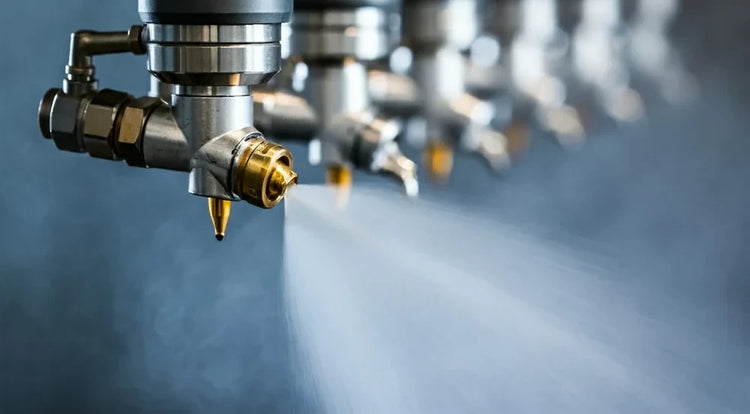
When standard flat fan nozzles create excessive misting on vibrating screen washing systems — in chemical production, mineral processing, and specialty manufacturing — these are the alternatives that eliminate atomization while maintaining uniform, effective washing performance.
Key Takeaways
- Misting on vibrating screens is driven by both nozzle atomization and screen re-atomization — the mechanical energy of the vibrating screen surface breaks larger droplets into finer mist on impact, compounding the misting from the nozzle itself.
- The "shower curtain" distributor — a slotted pipe or closely-spaced manifold at gravity or near-gravity pressure — eliminates atomization entirely, delivering washing liquid as continuous streams or a laminar sheet with zero airborne mist generation.
- Deflector flat spray nozzles create a wide fan of large drops by deflecting a solid stream off a smooth surface — dramatically less misting than equivalent atomizing flat fan nozzles at the same flow rate.
- Reducing supply pressure and increasing orifice size to maintain the same flow rate reduces droplet energy and produces larger average droplet size — less misting with the same coverage area from standard flat fan nozzle designs.
- 316L stainless steel is the standard material for vibrating screen washing nozzles with fatty alcohol and most organic process chemical media; PVDF is the upgrade path for more chemically aggressive service or mixed solvent/acid environments.
The tradeoff between washing performance and misting is built into the physics of spray nozzles. Effective washing — penetrating screen apertures, dislodging fine particles, maintaining screen cleanliness across the full width — requires the liquid to reach the screen surface with enough energy and coverage to do the job. But the same atomization that distributes liquid uniformly across the spray zone also produces the fine droplets that drift as mist into the surrounding workspace.
On vibrating screens specifically, this tradeoff is compounded by the screen itself: the mechanical vibration energy breaks larger droplets into finer mist on impact, re-atomizing what the nozzle delivered as a manageable large drop into an airborne mist cloud. The result is that misting in vibrating screen washing applications is consistently worse than an engineer might predict from nozzle data sheets alone.
This guide covers four engineering approaches to breaking that tradeoff — reducing or eliminating mist while preserving the washing performance that keeps screens running effectively. The right approach depends on available supply pressure, screen geometry, and the specific liquid being used.
Why Standard Flat Fan Nozzles Create Excessive Mist on Screens
Standard flat fan nozzles are engineered to atomize — to convert liquid supply pressure into kinetic energy that breaks the liquid jet into a distributed spray of droplets. The orifice geometry and operating pressure together determine the resulting droplet size distribution. Even at modest pressures (0.5–3 bar), standard flat fan nozzles produce droplets ranging from 100–500 microns at the median with a significant tail of sub-50 micron droplets that remain airborne and become the visible mist cloud. On vibrating screens, the vibration energy of the screen surface adds a second atomization mechanism: larger droplets that would normally wet the screen and flow away are instead broken into finer droplets on impact. The result is that misting on a vibrating screen is consistently worse than the same nozzle in a static application.
Understanding exactly where the mist comes from helps identify which solution is appropriate. There are three contributions to total misting in a vibrating screen washing system:
- Primary atomization at the nozzle orifice: The orifice converts pressure into droplet kinetic energy. Small-orifice, high-pressure nozzles produce the finest droplets and the most mist. Large-orifice, low-pressure nozzles produce larger droplets and less primary misting.
- Secondary atomization on screen impact: Droplets hitting the vibrating screen surface at velocity are broken into smaller droplets by the impact energy. The faster the screen vibration and the smaller the initial droplet, the more secondary misting occurs. This is the mechanism that makes vibrating screen applications worse than static washing applications.
- Drift from the spray zone: Fine droplets from both atomization mechanisms remain airborne and are carried by air currents — ventilation, the air movement created by the vibrating screen itself — out of the spray zone and into the surrounding workspace.
Solving the primary atomization eliminates the first source. Switching to a non-atomizing delivery method (shower curtain, deflector, very low pressure) eliminates the secondary atomization mechanism as well, because the liquid arrives at the screen as large drops or streams with low kinetic energy rather than as high-velocity fine droplets.
How Screen Vibration Amplifies the Misting Problem
"A vibrating screen is an atomizer. Any droplet that hits the screen surface at velocity is broken into finer droplets by the vibration energy. The screen compounds whatever misting the nozzle creates — and reduces whatever larger drops the nozzle produces into mist."
Vibrating screens for classification and washing in chemical and mineral processing applications typically operate at frequencies of 900–6,000 RPM with stroke amplitudes of 2–12mm. At these operating conditions, the screen surface is moving at accelerations many times greater than gravity, and any liquid droplet contacting the screen at velocity is subject to additional breakup forces from the impact and rebound.
This mechanism explains why reducing nozzle operating pressure alone — without changing the nozzle design — only partially solves the misting problem on vibrating screens. A nozzle producing 300-micron average droplets at reduced pressure delivers those droplets to the screen with less velocity, which reduces secondary atomization somewhat. But the screen vibration still breaks a significant fraction of those drops into sub-100 micron mist. Switching to a truly non-atomizing delivery approach — where the liquid arrives at the screen as large streams or a continuous sheet at very low velocity — eliminates the secondary atomization mechanism almost entirely.
Four Low-Mist Alternatives to Standard Atomizing Flat Fan Nozzles
Each of the four alternatives addresses the misting problem through a different mechanism. The choice between them depends on available supply pressure, required washing performance, screen geometry, and how much misting reduction is needed. A 60% misting reduction may be sufficient for some workplaces; others — particularly where the washing liquid has specific health, odor, or safety characteristics — need to approach zero misting.
NozzlePro's flat fan and chemical processing nozzle collections include deflector, low-pressure, and large-orifice designs for screen washing applications with process chemicals and fatty alcohols.
Option 1: The Shower Curtain Distributor
A shower curtain distributor replaces spray nozzles with a pipe-based liquid distribution system that delivers washing liquid as a continuous sheet, curtain, or array of closely spaced streams across the full screen width — with zero atomization and zero misting. In its simplest form it is a pipe with a longitudinal slot cut along its lower side, through which liquid flows by gravity or very low pressure as a laminar sheet. More controlled designs use closely spaced small holes (2–4mm diameter, spaced 15–25mm) along the underside of the distribution pipe to produce individual streams that merge into a near-continuous curtain before contacting the screen surface. Because the liquid exits as continuous streams or a laminar film rather than through a small orifice under spray pressure, there is no atomization and therefore no mist generation at the nozzle. The only misting that occurs is secondary atomization from screen impact — which is minimized by mounting the distributor close to the screen surface so the streams arrive with low velocity.
Design Principles for a Shower Curtain Distributor
- Pipe sizing: The distribution pipe must be large enough that pressure drop from the supply end to the far end is negligible — otherwise the holes near the supply will flow more than those at the far end, creating uneven distribution across the screen width. As a rule of thumb, the pipe cross-sectional area should be at least 5× the total hole area to maintain uniform distribution.
- Hole sizing and spacing: 2–4mm holes at 15–25mm spacing produce closely spaced streams that provide near-continuous coverage. Smaller holes (2mm) at close spacing (15mm) are appropriate for fine-screen washing; larger holes at wider spacing work for coarser screens where less liquid coverage is needed per unit area.
- Mounting height: The closer the distributor is to the screen surface, the lower the impact velocity of the streams and the less secondary atomization occurs. For mist minimization, mount as close to the screen as practical — typically 50–150mm above the screen surface — while allowing for screen vibration amplitude.
- Supply pressure: Gravity supply or pump supply of 0.1–0.3 bar is sufficient. Higher supply pressure increases stream velocity and misting at the screen surface. Gravity-fed systems with a header tank produce the most mist-free operation.
The shower curtain distributor trades some washing impact energy for mist elimination. The absence of spray velocity means the washing mechanism is purely liquid volume and coverage — the liquid wets the screen and drains through the apertures by gravity, carrying fine particles with it. This is highly effective for screens washing with organic liquids (fatty alcohols, solvents) where the washing medium has good wetting properties. For applications where mechanical spray impact is needed to dislodge stubborn particles from screen apertures, the deflector nozzle or low-pressure flat fan alternatives may be more appropriate.
Option 2: Deflector Flat Spray Nozzles
Deflector flat spray nozzles — sometimes called impingement nozzles or tangential flat spray nozzles — produce a wide, flat fan spray pattern through a completely different mechanism than standard atomizing flat fan nozzles. Instead of forcing liquid through a precision-shaped orifice to create a fanlike spray by hydraulic action, they direct a solid stream of liquid onto a smooth curved deflector surface at a shallow angle. The deflector bends the stream into a wide fan — producing a very wide, low-angle spray pattern with dramatically larger average droplet size than an equivalent-flow atomizing nozzle at the same operating pressure.
Why Deflectors Produce Less Mist
The deflection mechanism imparts the energy of deflection to the droplets rather than the energy of orifice shear. Orifice shear — forcing liquid at high velocity through a small aperture — produces high-energy liquid sheets that break into fine droplets through Rayleigh-Taylor instability. Deflection simply bends the liquid stream without the high-shear fragmentation that creates fine droplets. The result is a spray pattern of large, energetic drops with a much narrower droplet size distribution — minimal sub-100 micron mist, much of the energy concentrated in the 300–1,500 micron range.
For vibrating screen washing, deflector nozzles provide a meaningful middle ground: the spray still has some impact energy to assist in washing screen apertures, but the droplets are large enough that secondary atomization on screen contact is significantly reduced. The washing performance is closer to the original flat fan nozzle than the shower curtain approach, with misting reduced to a fraction of the original.
Specification for Screen Washing with Deflectors
- Wide-angle deflector designs (100°–140°) provide coverage comparable to a standard wide-angle flat fan nozzle at equivalent mounting height
- Operating pressure range: typically 0.5–3 bar — within or below the typical flat fan nozzle operating range
- Flow rates are determined by the supply orifice size and supply pressure; the deflector does not restrict flow independently
- Mounting height must account for the lower spray angle of deflector designs vs. standard flat fan nozzles — coverage width per nozzle at the same height may be wider or narrower depending on the specific deflector geometry
Option 3: Large-Orifice Flat Fan Nozzles at Reduced Pressure
The simplest hardware change — swapping the existing nozzles for a larger-orifice equivalent operating at lower supply pressure — reduces primary atomization without changing the spray delivery concept. The principle is straightforward: the same flow rate through a larger orifice at lower pressure produces lower liquid exit velocity, lower kinetic energy at the orifice, and therefore larger average droplet size with less mist.
| Orifice Size | Operating Pressure | Flow Rate | Avg. Droplet Size | Mist Level |
|---|---|---|---|---|
| Small (standard) | 2–4 bar | Nominal (reference) | 150–300 µm | High — reference case |
| Medium (2× area) | 0.5–1.5 bar | Equivalent to reference | 300–600 µm | Moderate — significant improvement |
| Large (4× area) | 0.2–0.5 bar | Equivalent to reference | 600–1,500 µm | Low — approaching shower curtain behavior |
The limitation of this approach is available supply pressure. If the supply system can only reduce to 0.5 bar, then a 2× orifice area achieves moderate misting reduction. Reducing to near-gravity supply (0.1–0.2 bar) with a very large orifice approaches shower curtain behavior without the engineering of a custom slot distributor. When the supply pressure cannot be reduced below 1–2 bar, the large-orifice approach provides partial improvement but deflector or shower curtain designs are needed for more aggressive misting reduction.
Option 4: Full Cone Nozzles at Very Low Pressure
Full cone nozzles at very low operating pressure (0.1–0.5 bar) distribute washing liquid across a circular area with a uniformly filled pattern — covering the screen surface in all directions from each nozzle position rather than in a linear fan. At low pressures, the full cone pattern produces large droplets in the 500–2,000+ micron range with minimal fine-mist tail. The tradeoff is that full cone nozzles at very low pressure cover a smaller area than flat fan designs at the same height — more nozzle positions may be needed to achieve equivalent coverage across a wide screen.
Full cone designs are particularly suited for vibrating screen washing when the screen is wider in both dimensions (closer to square) rather than very long and narrow, and when the available supply pressure is genuinely low — close to atmospheric gravity supply. For four nozzle positions on a rectangular screen, the full cone pattern can provide complete coverage at lower misting than an equivalent flat fan array, provided the mounting height and nozzle spacing are calculated from the reduced-pressure coverage width.
How to Choose Between the Four Options
Shower Curtain Distributor
Choose when: misting must be eliminated as completely as possible; supply pressure is gravity or near-gravity (0–0.2 bar); the washing liquid wets the screen well and gravity drainage is sufficient to carry particles through screen apertures; the screen width is fixed and uniform coverage across full width is the primary requirement. Not ideal when: high spray impact energy is needed to clear stubborn screen blinding; supply pressure is not controllable down to near-atmospheric.
Deflector Flat Spray Nozzle
Choose when: significant misting reduction is needed but some spray impact energy is useful for washing performance; existing supply pressure (0.5–2 bar) cannot be easily reduced; a direct nozzle-for-nozzle replacement without changing supply infrastructure is preferred. Provides the best combination of reduced misting and retained washing effectiveness for most screen washing retrofit situations.
Large-Orifice Flat Fan, Low Pressure
Choose when: supply pressure can be reduced (pressure regulator available or adjustable pump); a drop-in nozzle change with the same connection thread and similar installation geometry is desired. A two-variable change (larger orifice + lower pressure) that reduces primary atomization meaningfully without changing the spray delivery concept. Good first step before considering deflector or curtain solutions.
Full Cone, Very Low Pressure
Choose when: the screen geometry is closer to square than rectangular; supply pressure is already very low; coverage in all directions from each nozzle position is needed. Less common for long-and-narrow vibrating screen configurations where a flat fan's linear coverage is more efficient.
Spray System Design for Fatty Alcohols and Organic Process Chemicals
Fatty alcohols — aliphatic C8–C12 alcohols including decanol (C10), octanol (C8), and dodecanol (C12) — are used as washing, rinsing, and processing agents in specialty chemical manufacturing, mineral processing, and pharmaceutical applications. Their spray behavior differs from water in several ways that affect nozzle selection and system design.
How Fatty Alcohol Properties Affect Spray Behavior
| Property | Decanol (C10) vs. Water | Effect on Spray System Design |
|---|---|---|
| Viscosity at 20°C | ~11 cP vs. 1 cP (water) | Flow rate through a given nozzle is 10–15% lower than the water-rated flow at the same pressure. Account for this when sizing nozzle capacity from water-rated tables. |
| Density | ~0.83 g/cm³ vs. 1.0 (water) | Liquid is lighter than water; gravitational drainage through screen apertures is slightly faster. Minor effect on system design. |
| Surface tension | ~28 mN/m vs. 72 mN/m (water) | Much lower surface tension than water — fatty alcohols wet surfaces more readily and drain through screen apertures more easily at lower liquid volumes. Less liquid may be needed for equivalent washing performance vs. water. |
| Volatility | Low (BP ~232°C for decanol) | Misting creates inhalation exposure concern not from evaporation but from liquid aerosol. The odor threshold is low — even small airborne concentrations are detectable. This is the primary driver for misting reduction in fatty alcohol screen washing applications. |
| Flash point | ~82°C (decanol) | Not a concern at ambient conditions with atmospheric spraying. No ignition risk from spray at room temperature. Relevant if the spray system operates near elevated temperatures. |
The lower surface tension of fatty alcohols is actually advantageous for screen washing — because the liquid wets the screen and particles more readily than water, less liquid volume is needed to achieve equivalent washing. This means a shower curtain distributor or deflector system with a lower liquid flow rate than the original atomizing nozzle system may provide equivalent or better washing performance, while simultaneously reducing the total liquid volume being aerosolized.
Material Selection for Chemical Screen Washing Service
| Material | Fatty Alcohol Compatibility | Recommended Use |
|---|---|---|
| 316L Stainless Steel | Excellent — compatible with all C8–C12 aliphatic fatty alcohols at ambient and elevated temperatures | Standard recommendation for all fatty alcohol screen washing applications. Mechanically robust for vibrating screen environments, easy to source in all nozzle configurations. |
| PVDF (Kynar®) | Excellent — broader chemical resistance for mixed or more complex process chemistry | Preferred when the washing medium contains acids, halogens, or other aggressive components in addition to the fatty alcohol base. PVDF provides an additional margin for unknown trace chemistry. |
| Polypropylene (PP) | Good — compatible with fatty alcohols at ambient and moderate temperatures | Lower cost than SS or PVDF for less demanding applications; appropriate for purely fatty alcohol or dilute aqueous fatty alcohol service below 60°C. |
| PTFE | Excellent — near-universal chemical resistance | Used for seals, seats, and gaskets where maximum chemical resistance is needed. Full PTFE nozzle bodies are available for the most demanding chemical combinations. |
| Brass / Bronze | Generally acceptable but not recommended | Copper alloys can potentially catalyze oxidation reactions in some fatty alcohol systems. Avoid where extended contact and high temperatures may be involved. 316L SS is preferable in all cases where a choice exists. |
For sealing materials (O-rings, seats), Viton (FKM) provides excellent compatibility with C8–C12 fatty alcohols and is the standard recommendation. PTFE seals are appropriate where FKM is unavailable. EPDM seals are generally compatible but should be verified against the specific chemical formulation — mixed systems containing aromatic components can degrade EPDM. Nitrile (NBR) should be tested per formulation before specifying.
What to Have Ready When You Contact NozzlePro
Vibrating Screen Washing System — Low-Mist Nozzle Quote Checklist
Solving a Misting Problem on a Vibrating Screen Washing System?
NozzlePro supplies deflector flat spray nozzles, large-orifice flat fan designs, full cone low-pressure nozzles, and slotted pipe distributor components for screen washing applications — in 316L stainless steel, PVDF, PP, and PTFE for fatty alcohol and process chemical service.
Request a Quote Shop Flat Fan NozzlesVibrating screen washing with misting requirements appears across a broad range of manufacturing and processing industries:
Frequently Asked Questions
What causes excessive misting from flat fan nozzles on vibrating screens?
Two compounding mechanisms create excessive misting on vibrating screens. First, primary atomization at the nozzle: standard flat fan nozzles convert supply pressure into droplet kinetic energy through precision orifice shear, producing a range of droplet sizes including a significant sub-100 micron fraction that remains airborne. Second, secondary atomization on screen impact: the mechanical vibration energy of the screen surface breaks larger droplets into finer mist when they contact the screen at velocity. This secondary mechanism is unique to vibrating screen applications and makes misting worse than the same nozzle would produce in a static application. Solving the problem requires either eliminating primary atomization (shower curtain, deflector nozzles) or significantly reducing it (large-orifice, low-pressure designs) to also reduce the secondary contribution.
What is the best low-mist alternative to flat fan nozzles for vibrating screen washing?
The best alternative depends on how much misting reduction is needed and whether the existing spray impact performance needs to be preserved. For near-zero misting with gravity or near-gravity supply: a shower curtain distributor (slotted pipe or closely-spaced hole manifold) eliminates atomization entirely. For significant misting reduction while retaining some spray impact energy: deflector flat spray nozzles — which produce large drops through surface deflection rather than orifice shear — provide the best balance for most retrofit applications. For a simpler hardware change: larger orifice flat fan nozzles at reduced supply pressure reduce primary atomization meaningfully without changing the installation concept. Contact NozzlePro with your screen dimensions, available supply pressure, and washing medium and we can recommend the most appropriate option for your specific parameters.
Will a shower curtain distributor provide adequate washing performance compared to spray nozzles?
For most vibrating screen washing applications involving organic liquids — fatty alcohols, solvents, liquid processing aids — yes, a well-designed shower curtain distributor provides equivalent or better washing performance than atomizing spray nozzles at comparable liquid flow rates. The key reason: the lower surface tension of organic liquids compared to water means they wet the screen apertures and particle surfaces very readily, and gravity drainage through the apertures is highly effective without spray impact energy. The shower curtain approach applies liquid at zero velocity to the screen surface, allowing it to wet and drain uniformly without the bouncing and re-atomization that atomizing spray produces. For applications where abrasive particles must be mechanically dislodged from screen apertures rather than simply washed through, some spray impact energy may be needed — in which case a deflector nozzle design is a better choice than a shower curtain.
What nozzle material is compatible with decanol and fatty alcohols?
316L stainless steel is the standard material recommendation for vibrating screen washing nozzles with decanol (1-decanol, C10) and other C8–C12 aliphatic fatty alcohols. Stainless steel provides excellent resistance across this family of chemicals at ambient and elevated temperatures, is mechanically robust in vibrating screen environments, and is straightforward to source in the required configurations. PVDF provides additional chemical resistance for mixed-chemical service or where trace contaminants in the washing medium are not fully characterized. Polypropylene (PP) is acceptable at ambient temperatures for purely fatty alcohol service as a lower-cost option. For sealing materials, Viton (FKM) is the standard recommendation for fatty alcohol contact; PTFE is the safe universal option for seals in chemically complex or poorly characterized service.
How do I calculate how many shower curtain holes or nozzles I need for my screen?
For a shower curtain distributor: size the hole count from the desired total flow rate and the flow per hole at the available supply head. A 3mm hole at 100mm head (gravity supply) flows approximately 0.15–0.2 L/min. Divide the total required flow rate by this per-hole rate to determine the number of holes needed, then space them across the full screen width. The hole spacing should be ≤25mm for near-continuous coverage; wider spacing creates visible dry lanes between streams. For standard flat fan or deflector nozzles: each nozzle's coverage width at the mounted height determines how many are needed to span the screen width with overlap. Contact NozzlePro with your screen width, target total flow rate, and available supply pressure — we can calculate the appropriate nozzle count, spacing, and coverage geometry for the specific option you are considering.
Ready to Eliminate Misting from Your Screen Washing System?
NozzlePro's application engineering team can recommend the right low-mist spray solution for your specific screen geometry, supply pressure, and washing medium — with a quote for standard configurations typically within one business day.
Request a Quote Shop Flat Fan Nozzles


