
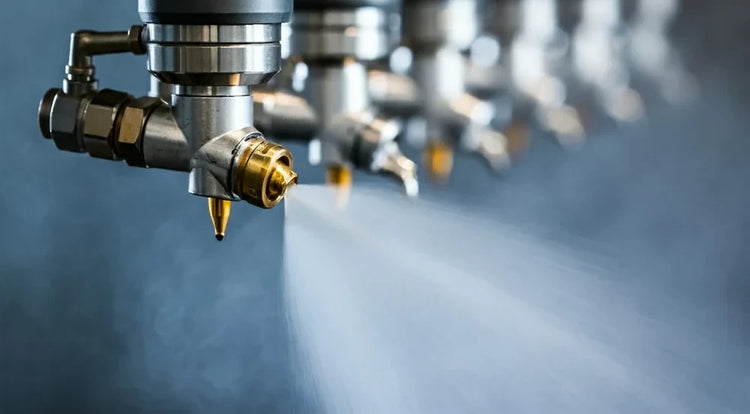

Spray Nozzles for Mining &
Mineral Processing Operations
From dust suppression at crushing and transfer points through heap leach irrigation, flotation reagent delivery, scrubber systems, and acid-resistant processing nozzles — a complete application guide for every spray requirement in modern mining operations.
Key Takeaways
- Mining operations use spray nozzles across at least six distinct applications — dust suppression, heap leach irrigation, flotation reagent delivery, wet scrubbers, conveyor systems, and acid process spray — each with different nozzle type, material, and specification requirements.
- Dust suppression is the highest-volume nozzle application in most mining operations and serves both an environmental compliance function and a worker health function — effective dust control at crusher feeds, transfer points, and stockpiles requires correctly specified nozzles, not any available hardware.
- Heap leach nozzles are subject to chemical attack from sulfuric acid (copper leach) or cyanide (gold/silver leach) — polypropylene and PVDF are the standard materials; standard stainless steel corrodes in acid leach service.
- Tungsten carbide nozzle bodies and inserts extend service life dramatically compared to stainless steel in any application where ore slurry, abrasive solids, or high-velocity particulate-laden flow contacts the nozzle orifice.
- Spiral hollow cone nozzles are the standard for scrubber applications above process tanks — their unobstructed bore handles the contaminated recirculating scrubbing liquid without the clogging that plagues internal-vane designs.
Mining is one of the most demanding environments for industrial spray nozzles on the planet. The liquids being sprayed range from clean fresh water to concentrated sulfuric acid, cyanide solution, ore slurry, tailings water, and flotation chemical reagents. Temperatures span from near-freezing in underground operations to desert-ambient in open pit mines. Abrasive particulates are present at concentrations that destroy standard spray nozzles in weeks rather than years. And the consequences of nozzle failure — missed dust suppression targets, uneven leach solution distribution, loss of scrubber efficiency — affect both operational performance and environmental compliance simultaneously.
This guide covers every major spray nozzle application in mining and mineral processing, the nozzle type and material appropriate for each, and the specification variables that determine whether a nozzle lasts weeks or years in service.
Where Spray Nozzles Work Across a Mining Operation
Dust Suppression
Crushing stations, screen decks, transfer points, stockpiles, haul roads, and loading areas. The highest-volume nozzle application at most mine sites — critical for both environmental compliance and worker exposure control.
Heap Leach Irrigation
Uniform distribution of acidic leach solution (copper) or cyanide solution (gold/silver) across stacked ore heaps. Full cone and deflector nozzles at precisely calculated spacing and flow rate per the target application rate.
Flotation & Reagents
Controlled delivery of frothers, collectors, pH modifiers, and other flotation reagents into flotation circuits. Consistent dosing rate is essential for grade and recovery — nozzle flow rate must be stable and well-characterized.
Wet Scrubbers
Gas and dust control above process tanks, smelters, acid plants, and enclosed crushing stations. Spiral hollow cone nozzles for maximum clog resistance in recirculating contaminated scrubbing liquid.
Conveyor Systems
Water addition for dust suppression, moisture conditioning of dry ore, and return belt cleaning. Flat fan nozzles provide even coverage across belt width; high-pressure designs for belt cleaning applications.
Acid & Chemical Process
Rinse stages in SX-EW copper recovery, acid plant scrubbers, tank wash systems, and neutralization spray. Chemical-resistant PP, PVDF, and PTFE nozzles for direct acid service.
Dust Suppression: The Largest Nozzle Application at Most Mine Sites
Mining dust suppression uses two distinct spray approaches depending on the generation point and particle characteristics. High-pressure fog systems (500–1,000 PSI, sub-50 micron droplets) capture fine airborne dust particles by collision and agglomeration — the tiny water droplets collide with dust particles in the air, adding weight and causing them to fall from suspension. These systems are used inside enclosed crusher stations, screen buildings, and conveyor transfer enclosures where containment allows the fog to remain in contact with the dust. Low-pressure soaker and hollow cone systems (20–60 PSI) apply water directly to ore on conveyors, at stockpile faces, and on haul roads — suppressing dust at the generation source before it becomes airborne. Each application requires a different nozzle type, pressure range, and coverage strategy.
Crusher and Transfer Point Dust Suppression
The highest-intensity dust generation points on any mine site are primary and secondary crushers and conveyor transfer points — where ore is dropped, impacted, or transferred between conveyors. Hollow cone and full cone nozzles mounted above or within the crusher enclosure apply water mist that captures airborne fines and suppresses the dust cloud generated by impact. Nozzle placement must achieve coverage of the full generation zone without wetting the ore excessively — excess moisture creates handling problems downstream, particularly if the ore will undergo processes that are moisture-sensitive.
Stockpile and Open Area Suppression
Stockpile dust suppression at the reclaim face, on exposed ore piles, and at haul road intersections near loading zones typically uses larger-capacity fog nozzles or oscillating systems that project mist into the dust cloud generated by wind or equipment activity. The application rate must be sufficient to achieve effective suppression without creating mud or runoff — a balance that depends on ore type, ambient conditions, and the rate of activity at the suppression zone.
Haul Road Dust Control
Haul roads at open pit mines generate some of the highest particulate loads of any mine site area — heavy trucks on unpaved roads raise dust plumes that can extend kilometers downwind. Water trucks with spray bar systems distribute water on road surfaces at calculated application rates to achieve suppression. Flat fan nozzles on spray bars provide even coverage across the road width; the nozzle capacity and bar pressure are selected to achieve target application rate at truck operating speed.
NozzlePro's dust and pollution control collection includes hollow cone, full cone, flat fan, and fog nozzle designs for mine site dust suppression at all generation points — from enclosed crusher stations to open stockpiles and haul roads.
Heap Leach Irrigation Nozzles
Heap leaching is the dominant recovery process for copper from oxide ores and a major process for gold and silver from lower-grade ore bodies. The process stacks crushed ore on impermeable pads, then irrigates the heap surface with leach solution — sulfuric acid for copper, sodium cyanide for gold and silver — that percolates through the ore, dissolving the target metal and collecting at the pad base as pregnant leach solution (PLS) for downstream recovery.
The nozzle's role in heap leaching is to distribute leach solution uniformly across the heap surface at a controlled application rate. Non-uniform distribution produces zones of under-irrigated ore with lower metal recovery, and zones of over-irrigated ore where solution runs off the surface without adequate contact time. In a heap leach operation processing thousands of tonnes of ore per month, a 2–3% improvement in leach efficiency from better solution distribution translates directly to significant additional metal recovery.
"In heap leaching, the nozzle is a production tool. The uniformity of leach solution distribution is a direct input to metal recovery — and recovery is the number that determines whether the operation is profitable."
Full Cone Nozzles for Heap Leach
Full cone nozzles are the standard for heap leach drip or spray emitter systems because their circular, uniformly filled pattern distributes solution evenly in all directions from the nozzle position. Spacing between nozzles on the distribution headers is calculated to provide overlapping coverage with no gaps. For low-pressure systems (typically 10–30 PSI), nozzle selection must account for the reduced pattern width at lower pressure — the overlap calculation changes significantly between a 15 PSI and 30 PSI system.
Chemical Compatibility is Non-Negotiable
Heap leach nozzles are in continuous contact with the leach chemistry for months or years — the lifespan of a heap leach pad. This extended chemical exposure makes material selection critical:
| Leach Process | Chemical | Typical Concentration / pH | Required Nozzle Material |
|---|---|---|---|
| Copper oxide heap leach | Sulfuric acid (H2SO4) | 5–20 g/L H2SO4; pH 1.5–2.5 | Polypropylene (PP) — excellent H2SO4 resistance at leach concentrations |
| Gold / silver heap leach | Sodium cyanide (NaCN) | 0.1–1.0 g/L NaCN; pH 10–11 | PP or 316L SS — cyanide at leach concentrations is compatible with both; confirm for specific formulation |
| Oxide gold / heap leach | Weak acid thiourea or similar | Mildly acidic | PP — acid stability; verify with specific reagent data |
| Rinse / wash phase | Process water (slightly acidic) | pH 5–7 | PP or 316L SS — low aggression; either is suitable |
Flotation Circuits and Reagent Delivery
Froth flotation separates valuable mineral particles from waste gangue by exploiting differences in surface hydrophobicity. Reagents — collectors, frothers, activators, depressants, and pH modifiers — are added to the flotation circuit in controlled doses to create the surface chemistry conditions that allow selective bubble attachment and mineral recovery.
Spray nozzles deliver liquid reagents from holding tanks into the flotation circuit at metered, consistent flow rates. The nozzle specification for reagent delivery is different from most mining spray applications: the priority is flow rate consistency and compatibility with the specific reagent chemistry, not spray pattern or coverage area. A nozzle that delivers 10% more or less than its rated flow changes the reagent dosing ratio — affecting grade, recovery, or both — without any visible sign at the flotation cells themselves until the assay results indicate a problem.
Reagent chemical compatibility is reagent-specific, not just "chemical resistant." Flotation reagents span a wide range of chemistries — from xanthate collectors (mildly alkaline, compatible with most materials) to sulfuric acid for pH adjustment (requires PP or PVDF) to sodium cyanide (compatible with PP and SS) to potassium amyl xanthate and other organics (may swell or degrade certain plastics). Always verify nozzle material compatibility with the specific reagent rather than relying on general acid or alkali resistance ratings.
Wet Scrubbers for Gas and Dust Control
Mining operations generate hazardous gas streams — sulfur dioxide from smelter off-gases, hydrogen sulfide from some ore bodies, acid mist from acid plants, and dust-laden air from enclosed processing areas — that must be treated before release. Wet scrubbers absorb these contaminants by contacting the gas stream with scrubbing water or reagent solution.
Spiral hollow cone nozzles are the standard for mining wet scrubbers because the scrubbing liquid in mining applications is recirculated — and it rapidly accumulates dissolved minerals, captured solids, and chemical reaction products that would clog an internal-vane hollow cone nozzle within days. The spiral nozzle's unobstructed bore passes contaminated recirculating liquid without clogging, maintaining scrubber performance between cleaning cycles.
Scrubber Nozzle Material by Gas Type
- Sulfur dioxide (SO2) scrubbers — scrubbing liquid becomes sulfuric acid as SO2 dissolves. PVC or PP for dilute acid service; PVDF for higher concentrations or temperatures at the feed gas inlet.
- Dust scrubbers (crusher/transfer) — scrubbing liquid carries mineral fines, which accumulate in recirculation. PP spiral nozzles with large free passage; 316L SS where water chemistry permits.
- Acid mist scrubbers — direct contact with acid mist. PP or PVDF depending on acid type and concentration; never standard stainless in HCl or HF acid mist service.
- Hydrogen sulfide (H2S) scrubbers — H2S at low concentrations typically scrubbed with caustic soda (NaOH). 316L SS or PP handle caustic scrubbing service well.
Conveyor and Material Handling Spray Systems
Conveyor systems at mine sites use spray nozzles for two primary functions: dust suppression at transition and loading points, and moisture addition for ore conditioning. Both functions require nozzles that can handle process water — which at mine sites typically carries dissolved minerals, suspended fines, and may have pH values outside the neutral range — and that maintain consistent flow rate over extended service without frequent maintenance.
Transfer Point Spray
Hollow cone or full cone nozzles at conveyor transfer chutes — water mist in the dust generation zone captures airborne fines before they escape the transfer enclosure. Critical placement within the fall zone captures maximum dust at minimum water addition.
Ore Conditioning
Flat fan nozzles across the belt width add controlled water to dry ore for moisture conditioning before agglomeration, pelletizing, or stacking. Flow rate calibration is critical — over-wetting causes downstream handling problems; under-wetting reduces agglomeration quality.
Return Belt Wash
High-pressure flat fan nozzles remove adhered material from the return belt surface. The carryback from wet or sticky ores builds rapidly on return belts and contaminates idlers and structure below. High-impact spray at the belt return removes carryback before it can accumulate.
Conveyor Fire Detection
Fixed deluge nozzle arrays above conveyor galleries activate on fire detection to suppress belt fires before they spread to structure and adjacent equipment — a critical safety system in underground mines and enclosed surface conveyors.
Acid Process and Chemical Spray in SX-EW and Refinery Operations
Solvent extraction and electrowinning (SX-EW) — the hydrometallurgical process used to recover copper from heap leach PLS — involves multiple stages where spray nozzles contact concentrated sulfuric acid, organic solvent, and acidic process water. The nozzle selection standard for all stages is chemical compatibility first, then flow rate and spray pattern.
- Wash water spray in SX mixer-settlers: Controlled water wash removes entrained organic from the aqueous phase. Flat fan or full cone PP nozzles for dilute acid wash service.
- Electrolyte spray and cooling: Electrowinning electrolyte (concentrated H2SO4, typically 150–180 g/L) contacts all wetted surfaces. PVDF or PTFE nozzles for high-concentration H2SO4 service at elevated temperatures.
- Tank and equipment rinse: Process area washdown after maintenance or spills. PP or PVDF for any surface that contacts process chemistry; standard SS for clean water rinse in process-free areas.
- Acid plant gas scrubbing: Wet scrubbers in acid plants handle the most chemically aggressive conditions on the mine site. PVDF and PTFE are the standard nozzle materials for direct H2SO4 gas scrubbing service.
Material Selection for Mining Spray Nozzles
| Application | Liquid Contact | Recommended Material | Avoid |
|---|---|---|---|
| Dust suppression — water | Process water, slightly acidic/alkaline | 316L SS or PP | Carbon steel — corrodes rapidly in process water |
| Heap leach — copper (H2SO4) | Dilute sulfuric acid, pH 1.5–2.5 | Polypropylene (PP) | SS — chloride pitting; brass — acid attack |
| Heap leach — gold/silver (cyanide) | Sodium cyanide solution, pH 10–11 | PP or 316L SS | Copper alloys — cyanide attacks copper-bearing materials |
| Flotation reagent delivery | Reagent-specific — verify per formulation | PP (general); PVDF for acid dosing | Blanket "chemical resistant" assumption — verify per reagent |
| Wet scrubbers — acid gas | Dilute acid scrubbing liquid (recirculated) | PP or PVDF; spiral body design | SS in HCl or HF acid mist service |
| SX-EW electrolyte | Concentrated H2SO4, 150–180 g/L | PVDF or PTFE | PP degrades at concentrated H2SO4 at elevated temperature |
| Abrasive slurry spray | Ore slurry, tailings, sand | Tungsten carbide body or insert | Standard SS — erodes rapidly in abrasive service |
Wear and Abrasion: Why Mining Nozzles Fail Faster Than in Other Industries
Nozzle wear is a bigger issue in mining than in almost any other industrial spray application. The combination of chemically aggressive liquids, high solid particle loads, and the operational reality that nozzle maintenance is infrequent in remote mine environments means that the nozzle material must provide both corrosion resistance and abrasion resistance simultaneously.
Standard 316L stainless steel nozzles in ore slurry service may wear out their orifice geometry within 4–8 weeks of continuous operation — the orifice enlarges as ore particles continuously erode the metal at the highest-velocity point in the nozzle. As the orifice enlarges, flow rate increases above design, spray angle changes, and the nozzle eventually produces a distorted pattern that provides neither the coverage nor the droplet characteristics the application was designed for.
Tungsten carbide nozzles — either solid carbide body designs or carbide-insert designs with a plastic or stainless body — provide orifice hardness approximately 10 times greater than stainless steel. In the same abrasive slurry service where a stainless nozzle lasts 6 weeks, a tungsten carbide design may last 12–18 months. In operations where nozzle access requires a work stoppage or safety procedure to service, this service life difference has operational value far beyond the nozzle's material cost premium.
Enlarged orifice is wear. Blocked orifice is clogging. They produce opposite effects on flow rate — wear increases flow rate above rated; clogging decreases it. Measuring actual flow rate against rated capacity identifies which failure mode is occurring and determines the correct response: replacement (wear) or cleaning (clogging). In abrasive mining applications, both can occur simultaneously in different nozzles on the same header.
Applications by Mine and Metal Type
What to Have Ready When You Contact NozzlePro
Mining Spray Nozzle Quote Checklist
Specifying Nozzles for a Mining or Mineral Processing Application?
NozzlePro stocks dust suppression, heap leach, scrubber, and process spray nozzles in PP, PVDF, PTFE, 316L stainless, and tungsten carbide for the full range of mining and mineral processing environments — with application-specific technical support.
Shop Dust Control Nozzles Request a QuoteFrequently Asked Questions
What spray nozzles are used in mining operations?
Mining operations use nozzles across six major application areas, each with different specifications. Hollow cone and fog nozzles for dust suppression at crushers, transfer points, and stockpiles. Full cone nozzles in PP or PVDF for heap leach solution distribution. Chemical-resistant designs for flotation reagent delivery. Spiral hollow cone nozzles for wet scrubbers in gas and dust control. Flat fan nozzles for conveyor belt dust suppression and moisture conditioning. Tungsten carbide nozzles for any application involving abrasive ore slurry or tailings. The correct specification requires matching nozzle type, material, and capacity to the specific application chemistry, pressure, and particle load.
What nozzle material is required for heap leach acid irrigation?
For copper heap leach with dilute sulfuric acid (pH 1.5–2.5), polypropylene (PP) is the standard nozzle material. PP provides excellent resistance to dilute H2SO4 at the concentrations and temperatures used in heap leach irrigation. PVDF is used for higher acid concentrations or elevated temperatures where PP begins to degrade. For gold and silver cyanide heap leach (pH 10–11), PP and 316L stainless steel are both compatible with dilute sodium cyanide at leach concentrations — confirm with the specific solution chemistry before specifying SS, particularly if chlorides are present. Brass, copper alloys, and zinc-containing materials should not be used in any cyanide service — cyanide forms complexes with copper and zinc that contaminate the solution.
Why do mining nozzles wear out faster than in other applications?
Mining process water and slurry carry suspended ore fines — silica, mineral particles, and other hard abrasive solids — that act as continuous abrasive cutting media on the nozzle orifice at high velocity. Standard 316L stainless steel nozzles in abrasive slurry service can see orifice enlargement within 4–8 weeks of continuous operation as these particles erode the metal. As the orifice enlarges, flow rate increases above design, the spray angle changes, and the nozzle eventually produces a distorted pattern. Tungsten carbide nozzle bodies or inserts provide orifice hardness approximately 10× that of stainless steel — translating to service life measured in months to years rather than weeks in the same abrasive service. The higher upfront cost of carbide nozzles in mining applications typically pays back in less than one replacement cycle when maintenance frequency and labor are factored in.
What is the best nozzle type for wet scrubbers in mining?
Spiral hollow cone nozzles are the standard for mining wet scrubbers because the recirculating scrubbing liquid rapidly accumulates mineral fines, dissolved solids, and chemical reaction products that would clog an internal-vane hollow cone nozzle within days. The spiral nozzle's unobstructed bore — where the swirl is generated by a helical groove in the bore wall rather than an internal vane — allows contaminated liquid to pass straight through without lodging on any internal element. The material should match the specific gas stream chemistry: PP for most acid dust and SO2 scrubbing; PVDF for more aggressive or concentrated acid service; 316L SS for neutral gas streams where the scrubbing liquid is not acidic.
Can NozzlePro supply nozzles through industrial distributors serving mining operations?
Yes — NozzlePro works with industrial distributors that supply maintenance, repair, and operations (MRO) products to mining companies and mineral processing plants. Distributors supplying nozzles to mine sites benefit from NozzlePro's application-specific technical support, stable product availability for ongoing MRO programs, and a product range that covers the full spectrum of mining spray applications in a single source. If you are an industrial distributor serving mining operations and would like to discuss a supply program, contact NozzlePro directly — we can provide technical training support, application reference materials, and volume pricing appropriate for distributor programs.
Ready to Source Mining-Grade Spray Nozzles?
NozzlePro supplies dust suppression, heap leach, scrubber, and process spray nozzles in tungsten carbide, PP, PVDF, PTFE, and stainless steel for the full range of mining and mineral processing applications — from open pit copper to underground precious metals operations.
Request a Quote Shop Dust Control Nozzles


