
Reducing Release Agent Waste and Improving Bakery Efficiency Through Proper Nozzle Sizing
Reduced
Release agent consumption
Eliminated
Overspray and airborne carryover
Improved
Pan glaze life and safety
Lower
Cleaning labor and maintenance costs
Better
De-panning performance
One Spray Problem Was Creating Five Downstream Costs
A commercial bakery was using air-atomizing spray nozzles to apply release agents to baking pans. Worn spray nozzles, improperly sized spray setups, and incorrect fluid and atomizing air settings were contributing to over-application — creating excessive overspray that generated costs throughout the entire production operation.
Release agents are essential in commercial baking. Applied to baking pans before product is loaded, they prevent the baked product from adhering to the pan surface during and after baking — enabling clean, efficient de-panning without product damage. When applied correctly, release agents protect the pan glaze, extend equipment life, and reduce de-panning rejects (known as "cripples" in the industry). When applied incorrectly — too much, too fine, at the wrong pressure — the consequences propagate far beyond the spray station.
In this case, the bakery had accumulated a cluster of problems that traced back to a single root cause: over-application of release agent from nozzles that were worn, incorrectly sized, and operated at out-of-specification pressures. The consequences cascaded through the entire production environment:
- Premature pan glaze failure: Excess release agent buildup on pan surfaces accelerated degradation of the non-stick glaze, requiring pans to be replaced more frequently than their designed service life.
- Equipment and surface buildup: Release agent that missed the target pan deposited on conveyor systems, oven structure, and surrounding equipment — requiring cleaning that took labor and time.
- Increased cleaning requirements: Release agent buildup throughout the production area required more frequent cleaning cycles, consuming both labor hours and cleaning chemistry.
- Slippery floor conditions: Airborne release agent eventually settled on production area floors, creating slip hazards that represented a genuine worker safety concern.
- Product damage during de-panning: Despite the excess release agent, inconsistent spray coverage — a consequence of the improper atomization — still produced de-panning failures in areas of the pan where coverage was uneven.
- Wasted release agent: A significant fraction of the release agent consumed each shift was ending up on equipment, floors, and the surrounding environment rather than on pan surfaces — representing a direct chemical cost with zero production benefit.
How air-atomizing nozzles work — and why sizing matters
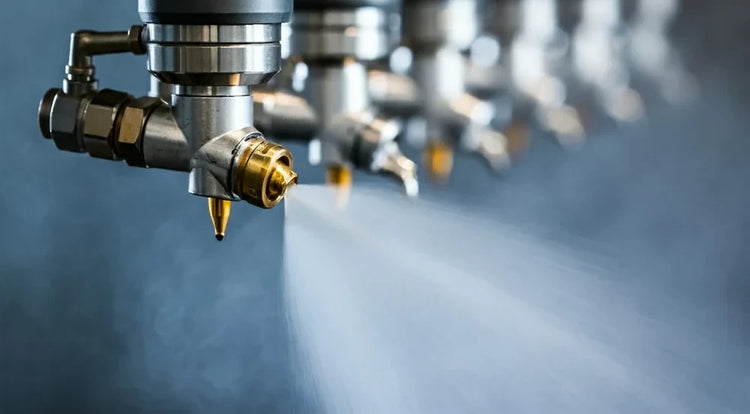
Air-atomizing nozzles use compressed air to break a liquid stream into fine droplets. The fluid orifice controls how much liquid flows through the nozzle at a given fluid pressure; the air cap and atomizing air pressure control how finely that liquid is atomized and in what pattern. These two variables are interdependent: the correct fluid orifice size must be matched to both the required flow rate and the available fluid pressure, and the atomizing air pressure must be set to achieve the desired droplet size without creating droplets so fine that they become airborne rather than depositing on the target surface. Worn nozzles change both variables simultaneously — a worn fluid orifice flows more than its rating, and a worn air cap changes the atomization pattern, producing a different droplet distribution than the nozzle was designed to achieve.
A Nozzle Audit Identified the Root Cause Across Four Variables
NozzlePro performed an audit of the bakery's air-atomizing spray nozzles — evaluating nozzle condition, sizing, fluid pressure, and atomizing air settings. The audit identified two primary issues: spray setups that were improperly sized for the actual application, and operating pressures that were contributing to excessive atomization and airborne carryover.
What the Nozzle Audit Evaluated
NozzlePro Nozzle Audit — Key Evaluation Points
The Two Root Causes Identified
The audit identified that the spray setups were improperly sized — the fluid orifice capacity significantly exceeded what was required to apply the correct amount of release agent to the pan surface at the specified application rate. At the installed fluid pressure, the nozzles were flowing substantially more release agent than the pans needed, with the excess having nowhere to go except onto surrounding surfaces.
The second issue was atomizing air pressure. Running atomizing air at excessive pressure produced very fine droplets — so fine that the droplets didn't have enough mass to follow the intended spray trajectory and land on the pan surface. Instead, they became entrained in the air current and carried throughout the production area as airborne mist, settling on floors, equipment, and surfaces well beyond the spray station.
"Proper nozzle sizing, condition, fluid pressure, and atomizing air settings are all critical to achieving controlled application. Changing any one without considering the others produces an uncontrolled result."
The solution was to properly size the spray setup for the required application rate — selecting nozzle fluid orifice sizes matched to the actual target flow rate at the correct fluid pressure — and to adjust the atomizing air pressure to produce the right droplet size for the pan surface application without excessive atomization. The combination of correct sizing and correct pressures produced precise, targeted release agent application with minimal overspray.
Precision Application — and Lower Costs Across the Entire Operation
The corrected spray setup eliminated the over-application that had been generating costs throughout the production environment. The results extended well beyond reduced release agent consumption:
- Reduced release agent consumption — only the required amount applied to each pan
- More precise, uniform application to the target pan surface
- Eliminated airborne overspray and carryover to surrounding equipment and surfaces
- Reduced buildup on equipment requiring cleaning labor and time
- Reduced cleaning frequency and associated labor costs
- Eliminated slippery floor conditions created by settled release agent mist
- Improved protection of pan glazing — less chemical buildup, longer glaze service life
- Reduced pan maintenance and replacement costs
- Reduced product damage during de-panning — more consistent coverage across the pan surface
- Improved overall production efficiency throughout the affected production area
The Value of a Proper Nozzle Audit
A key insight from this case study is that the bakery was already paying the cost of improper spray performance through every one of the downstream consequences — increased chemical usage, higher cleaning labor, accelerated pan replacement, floor maintenance, safety incidents. Each of these costs was treated as a separate operational issue. The nozzle audit revealed they all had a single cause, and a single solution addressed all of them simultaneously.
The Right Nozzle, Properly Sized and Properly Operated, Can Deliver Significant Savings
The bakery was spending money to apply release agent — but a significant portion of that material was landing on floors, equipment, and surrounding surfaces rather than on the pans that needed it. By auditing the spray system, properly sizing the nozzle setup for the actual application requirement, and optimizing the fluid and atomizing air pressures, NozzlePro helped the bakery move from over-application and overspray to controlled, precision application.
The result was less waste, less cleaning, improved pan life, and a more efficient production environment — all contributing directly to improved profitability. Achieving this didn't require new equipment or significant capital investment. It required identifying what the application actually needed and matching the spray system specification to that requirement.
Relevant NozzlePro Solutions
Frequently Asked Questions
How does improper nozzle sizing cause release agent overspray in bakeries?
Improper nozzle sizing causes release agent overspray through two compounding mechanisms. First, an oversized fluid orifice flows significantly more release agent than the pan actually requires — the excess material has nowhere to go except onto surrounding surfaces. Second, excessive atomizing air pressure in air-atomizing systems produces very fine droplets that don't have enough mass to resist airflow and settle on the target surface. Instead, they become entrained in the air current and carry far beyond the pan, depositing on equipment, floors, and structures throughout the production area. Worn nozzle orifices compound this further — a worn fluid orifice allows more liquid than its rating, and a worn air cap alters the atomization pattern, so the nozzle performs differently from its design specification even if the operating pressures are correct.
What does a spray nozzle audit for a bakery release agent system involve?
A spray nozzle audit for a bakery release agent system evaluates four key variables across the installed nozzle setup. Nozzle condition: worn orifices and air caps change flow rate and atomization characteristics — a nozzle that performed correctly when new may be significantly out of specification after wear. Nozzle sizing: the fluid orifice size must match the required application flow rate at the specified fluid pressure — an oversized orifice allows more fluid than needed regardless of other settings. Fluid pressure: operating above the specified fluid pressure for a given orifice size increases flow rate and may change atomization behavior. Atomizing air pressure: in air-atomizing systems, this controls droplet size — too high produces fine, drifting droplets; too low produces large drops that may not coat the pan uniformly. The audit identifies which variables are out of specification and recommends the correct nozzle sizing and operating parameters for the actual application requirement. Contact NozzlePro to discuss a nozzle audit for your bakery spray system.
What are the symptoms of improperly sized air-atomizing nozzles in a bakery?
Improperly sized or worn air-atomizing nozzles in a bakery release agent system typically present as several co-occurring symptoms that may appear unrelated at first. Visible symptoms include a visible mist cloud beyond the target pan during spray cycles, release agent buildup on conveyor equipment and oven structure, greasy or slippery floor conditions in the spray area, and accelerated pan glaze discoloration or failure. Production symptoms include higher-than-expected release agent consumption, increased cleaning frequency and labor, de-panning failures (cripples) despite apparent release agent application, and pan maintenance issues that repeat faster than expected. If any of these symptoms appear in combination, they likely share a common root cause in the spray setup specification. A nozzle audit — evaluating nozzle condition, sizing, fluid pressure, and atomizing air settings — typically identifies the root cause and the corrective action required.
What is a cripple in bakery production, and how does spray nozzle performance affect it?
A cripple is a baked product that is damaged during the de-panning process — when the baked loaf or roll is removed from the baking pan. Cripples typically occur when the release agent has not been applied uniformly or in sufficient quantity across the pan surface, leaving areas where the baked product adheres to the pan and tears when removed. The consequences are both direct (the damaged product cannot be sold as a first-quality unit and must be downgraded or discarded) and indirect (de-panning rejects interrupt production flow and require handling). The connection to spray nozzle performance is direct: a nozzle that delivers inconsistent coverage — from being worn, incorrectly positioned, or operating at out-of-specification pressure — produces areas of the pan where release agent coverage is insufficient, which are the areas where cripples occur. Paradoxically, over-application from an improperly sized nozzle does not necessarily eliminate cripples if the over-application is concentrated in some areas while others remain under-covered.
How often should air-atomizing nozzles for release agent application be inspected or replaced?
There is no universal replacement interval for air-atomizing release agent nozzles because wear rate depends on the release agent formulation, the production volume, the fluid and air pressures used, and whether the nozzle is cleaned regularly and correctly. What matters most is establishing a regular inspection practice rather than waiting for problems to appear. A useful indicator is nozzle performance: if a spray pattern check (spraying onto a flat surface or card at the operating distance) shows uneven coverage, changed pattern shape, or higher-than-expected fluid flow at the same pressure settings, the nozzle should be evaluated for wear and replaced if the orifice is out of tolerance. Fluid orifice and air cap wear are the two primary failure modes — both can typically be identified visually under magnification or by a flow rate check against the nozzle's rated capacity. Establishing a schedule for inspection — rather than relying on symptom observation — is the most reliable approach to preventing the cascade of production problems that worn nozzles cause.
What is the relationship between fluid pressure and atomizing air pressure in an air-atomizing nozzle?
In an air-atomizing nozzle, fluid pressure and atomizing air pressure control different aspects of spray performance and must be considered together, not independently. Fluid pressure primarily controls the flow rate of liquid through the fluid orifice — higher fluid pressure drives more liquid through the nozzle per unit time. Atomizing air pressure primarily controls droplet size — higher air pressure produces finer atomization (smaller droplets), while lower air pressure produces larger droplets. The two pressures interact: the atomizing air must overcome the fluid momentum to break the liquid stream into droplets, so the correct air pressure also depends on the fluid flow rate and the specific nozzle design. When either pressure is set outside the nozzle manufacturer's recommended range — even if the other parameter is correct — the result is a spray that doesn't match the intended performance. For a release agent application, setting atomizing air pressure too high produces droplets so fine they become airborne rather than depositing on the pan surface, directly causing the misting and overspray problems described in this case study.
Does nozzle-to-pan distance affect the quality of release agent application?
Yes — nozzle-to-pan distance is a critical installation parameter that directly affects coverage area, coverage uniformity, and overspray. Air-atomizing nozzles develop their full spray pattern over a defined distance from the nozzle tip; at shorter distances, the pattern has not fully opened and coverage is concentrated in a narrow area. At longer distances, the pattern has expanded and coverage per unit area decreases, which can produce inadequate application on the pan surface even at the correct total flow rate. The correct nozzle mounting distance is specified by the nozzle manufacturer for the given spray angle and typically validated for the specific application by measuring actual pattern coverage on a test surface at the intended distance. If production line changes — pan size, conveyor height, pan rack geometry — alter the nozzle-to-pan distance from the original specification, coverage quality should be re-evaluated. This is another reason a periodic nozzle audit that confirms installation parameters, not just nozzle condition, provides more complete performance assurance than checking the nozzle alone.
Can the same air-atomizing nozzle setup work across different pan sizes or product formats?
Whether a given nozzle setup covers different pan sizes adequately depends on the spray pattern width relative to the pan dimensions. A nozzle with a defined spray angle at a fixed mounting distance produces a coverage area of a specific width — if a different pan size is introduced that is wider than this coverage area, some portions of the pan will receive inadequate release agent. Narrower pans may receive more release agent per unit area than necessary if the nozzle spacing or position remains unchanged. When a bakery changes pan formats, the nozzle setup should be reviewed to confirm that the existing nozzle count, spacing, mounting height, and spray angle still provide complete, uniform coverage of the new pan geometry. In some cases, the existing nozzle specification remains adequate for a range of pan sizes; in others, additional nozzles, repositioning, or a nozzle pattern change is needed. Contact NozzlePro with your current nozzle specification and the new pan dimensions to evaluate whether your existing setup is appropriate for the new format.
Suspecting Your Bakery's Spray System Is Over-Applying or Creating Overspray?
NozzlePro can audit your spray nozzle system — evaluating nozzle condition, sizing, fluid pressure, and atomizing air settings — and recommend the correct specification for precise, controlled release agent application.
Request a Nozzle Audit View All Case Studies