
Descaling Spray Nozzles for
Steel & Metal Mills
High-impact oxide removal at 150–250 bar for hot rolling mills, plate mills, and bar mills — engineered headers that fracture and dislodge primary, secondary, and tertiary scale before it becomes a surface defect, a rolling-force problem, or a roll-life issue.
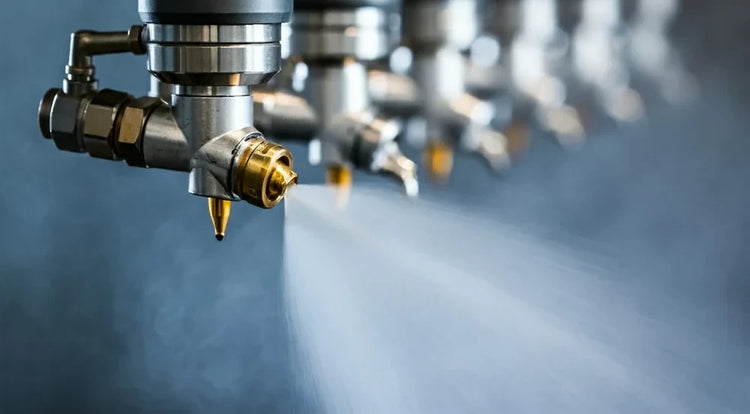
Steel mill descaling uses high-pressure flat-fan nozzles arranged in multi-bank headers positioned at the reheat furnace exit, between roughing stands, and ahead of the finishing mill. Operating at 150–250 bar (2,200–3,600 PSI), these headers generate 20–50 N/cm² impact forces that fracture the brittle oxide-steel bond and hydraulically lift scale from the surface — mechanical removal, not simply washing. Full-cone nozzles see use on bar and section mills where rotary or multi-angle configurations provide circumferential coverage on round and complex cross-sections. Nozzle material matters as much as pattern: descaling water frequently carries abrasive scale fines, so tungsten carbide orifice inserts are standard at any position running above roughly 50 bar in scale-contaminated water, since standard stainless wears out and enlarges within weeks in that service.
Descaling Applications in Steel Production
Each stage of a mill generates a different scale type at a different thickness — the header design and pressure at each position reflects that.
Primary Descaling
Immediately after reheat furnace discharge Recommended Nozzles- Thick Scale Removal: High-Pressure multi-bank headers, 150–250 bar
- Removes primary scale (100–500 µm) formed during slab/billet reheating at 1,200–1,300°C
- Top, bottom, and side banks ensure complete fracture before roughing mill entry
- Incomplete removal here embeds scale that no downstream stage can fully correct
Inter-Stand Descaling
Between roughing stands on hot strip mills Recommended Nozzles- Rapid-Formation Scale: High-Pressure headers, 150–200 bar
- Removes secondary scale (10–50 µm) that forms in seconds between passes
- Strip-presence activation avoids excessive water that disrupts mill temperature control
- Prevents scale roll-in that would otherwise embed into the surface on the next pass
Finishing Mill Entry
Last descaling stage before the finishing train Recommended Nozzles- Final Oxide Removal: High-Pressure headers, 180–220 bar
- Removes tertiary scale and residue (5–20 µm) ahead of the tightest gauge tolerances
- Critical for automotive, appliance, and other high-surface-quality applications
- The single most common point where residual scale becomes a coil-downgrading defect
Plate Mill Descaling
Heavy sections from 8–300mm thick, 1,200–5,000mm wide Recommended Nozzles- Heavy-Duty Removal: High-Pressure headers, 200–250 bar
- Multi-pass systems provide sufficient dwell time on thick sections where adhesion is strongest
- Supports surface quality requirements for pressure vessel, structural, and shipbuilding plate
- Header width must accommodate the full range of plate widths run on the mill
Bar & Section Mill Descaling
Rebar, angles, channels, beams, and rounds Recommended Nozzles- Circumferential Coverage: Full-Cone rotary heads or multi-angle configurations
- Complex cross-sections need coverage on all faces, not just top and bottom
- Web-flange intersections on beams and channels are common scale accumulation points
- Rotary or multi-angle designs reach these geometries that flat headers can't
Header Maintenance & Optimization
Keeping impact force consistent over the header's service life Recommended Nozzles- Wear-Resistant Replacement: Tungsten Carbide orifice inserts
- Orifice erosion enlarges flow and distorts pattern before it's visible on inspection
- Periodic flow testing catches degradation before it shows up as a quality problem
- Quick-change nozzle systems reduce the maintenance window per header service event
Descaling Parameters by Mill Type
Pressure, impact force, and water consumption vary by mill position — every recommendation reflects standard descaling practice for that stage.
| Application | Pressure Range | Impact Force | Water Consumption | Nozzle Type |
|---|---|---|---|---|
| Primary Descaling (Reheat Exit) | 200–250 bar | 35–50 N/cm² | 15–40 m³/hour per header | High-Pressure |
| Inter-Stand (Roughing Mill) | 150–200 bar | 25–40 N/cm² | 8–20 m³/hour per station | High-Pressure |
| Finishing Mill Entry | 180–220 bar | 30–45 N/cm² | 12–30 m³/hour per header | High-Pressure |
| Heavy Plate Mill | 200–250 bar | 40–55 N/cm² | 25–60 m³/hour per header | High-Pressure |
| Bar & Section Mills | 150–220 bar | 28–45 N/cm² | 10–25 m³/hour per header | Full-Cone |
| Wire Rod Mill | 120–180 bar | 20–35 N/cm² | 5–15 m³/hour per station | Full-Cone |
Understanding Mill Scale Formation & Removal
Three scale types form at three different stages, each with its own thickness and adhesion strength — and one removal mechanism common to all of them.
- Primary Scale (Reheat Furnace) — Thick oxide layers (100–500 µm) form during slab reheating at 1,200–1,300°C. Multilayer structure: wüstite (FeO) adjacent to the steel, magnetite (Fe₃O₄) as the middle layer, hematite (Fe₂O₃) as the outer layer. Strong adhesion requires 200–250 bar impact forces for complete removal.
- Secondary Scale (Inter-Stand) — Thin oxide layers (10–50 µm) form between roughing passes as hot steel briefly contacts atmosphere. Formation is rapid — on the order of seconds — which is why inter-stand descaling exists at all: without it, this fresh scale rolls into the surface on the very next pass. Lighter adhesion allows 150–200 bar descaling pressures.
- Tertiary Scale (Finishing Entry) — Very thin oxides (5–20 µm) and residue remaining after primary and secondary descaling. Final descaling before finishing ensures a clean surface for tight gauge control and defect-free product — critical for automotive, appliance, and other high-quality applications.
- Hydraulic Scale Removal Mechanism — High-pressure water jets create shock waves that fracture brittle oxide layers, propagate cracks through the scale-steel interface, and hydraulically lift the broken scale from the surface. Impact force (pressure × velocity) must exceed scale adhesion strength, which varies 10–50 MPa depending on steel grade, temperature, and oxidation time — this is why a single pressure setting doesn't work across every mill position.
Engineering High-Performance Descaling Systems
Hydraulic Design & Scale Removal Mechanics
NozzlePro engineers descaling systems using impact force modeling and scale fracture mechanics to optimize nozzle placement, spray angle, impact density, and water flow distribution — maximizing scale removal efficiency while minimizing water and pumping energy consumption.
Critical Design Parameters:
- Impact Force Delivery — Nozzle selection and operating pressure generate 20–50 N/cm² impact forces sufficient to fracture oxide layers and overcome scale adhesion
- Spray Coverage Uniformity — Header geometry provides ±5% impact force uniformity across the full strip, plate, or bar width, preventing weak descaling zones at the edges
- Dwell Time Optimization — Nozzle spacing, spray angle, and line speed calculations ensure sufficient water-steel contact time (0.1–0.5 seconds) for complete removal
- Multi-Bank Configuration — Top, bottom, and side descaling banks surround the workpiece, preventing shadow zones where scale remains intact
- Pressure Loss Management — Manifold sizing and header design minimize pressure drop across 20–80 nozzles per header bank
- Wear-Resistant Materials — Tungsten carbide orifice inserts deliver substantially longer service life than standard stainless in scale-abrasive service
- Water Quality Requirements — Filtration (50–200 µm) protects small nozzle orifices (1.5–4mm) from plugging and preserves spray pattern integrity
Descaling Specification at a Glance
Key Parameters by Application
Frequently Asked Questions
Common questions about descaling spray nozzles for steel and metal mills.
Mill scale is a brittle, strongly-adherent oxide layer that must be mechanically fractured and dislodged rather than simply washed away. The impact force needed to overcome scale adhesion (typically 10–50 MPa depending on steel grade and reheat temperature) is well above what a standard washdown or cleaning nozzle can deliver. Descaling headers operate at 150–250 bar specifically to generate the 20–50 N/cm² impact forces required to fracture the oxide-steel bond — pressure much lower than this leaves scale intact or only partially removed, which shows up downstream as surface defects.
Primary scale forms during slab or billet reheating (100–500 µm thick, multilayer oxide structure) and requires the highest impact force to remove. Secondary scale forms rapidly between roughing passes as hot steel is briefly exposed to atmosphere (10–50 µm, lighter adhesion, removable at somewhat lower pressure). Tertiary scale is the thin residue (5–20 µm) remaining before the finishing mill, where complete removal is critical for surface finish and gauge control on premium products. Each stage typically has its own descaling header tuned to that scale type's thickness and adhesion strength.
Orifice wear from erosion or scale-laden water gradually enlarges the opening, increasing flow and distorting the spray pattern before the change is obvious on visual inspection. Watch for declining impact force at the same operating pressure, uneven descaling patterns across the strip or plate width, or a rising rate of scale-related surface defects downstream. Because this degradation is progressive rather than sudden, a periodic flow-verification schedule catches worn nozzles before they become a quality problem — waiting for visible pattern distortion means some defective product has likely already gone through.
Descaling water often carries fine scale particles removed from earlier stages, making it inherently abrasive — combined with the high velocities involved at 150–250 bar, standard stainless steel orifices wear out and enlarge quickly in this service. Tungsten carbide orifice inserts resist this erosive wear substantially better, holding their rated flow and spray pattern far longer than stainless in the same duty. For any descaling position running consistently above roughly 50 bar with scale-contaminated water, tungsten carbide is the standard specification rather than an upgrade.
In most cases, yes — descaling header retrofits are common when a mill is experiencing scale-related quality issues, upgrading line speed, or replacing a header that's reached the end of its service life. The key constraints are available water supply pressure and flow at the header location, physical clearance for the header bank around the existing roll or strand geometry, and confirming the upstream pump and piping can deliver the required flow at the target pressure. NozzlePro application engineers can work from your existing mill layout and water supply specifications to size a replacement or retrofit header without requiring a broader line rebuild.
Scale left on the strip or plate surface acts as an abrasive between the workpiece and the work roll, accelerating roll wear well beyond what clean steel produces — this is why complete descaling is directly tied to extended roll campaigns rather than being a separate maintenance consideration. Residual scale also increases the force needed to achieve proper roll bite, since the scale layer interferes with metal-to-metal contact between the roll and the workpiece. Mills that improve descaling completeness typically see both effects simultaneously: lower rolling forces at the same reduction, and longer intervals between roll changes.
Ready to Optimize Your Descaling System?
Share your steel grade, product dimensions, line speed, scale thickness, and current header configuration — we'll provide header layouts, hydraulic calculations, and impact force modeling for your mill.