
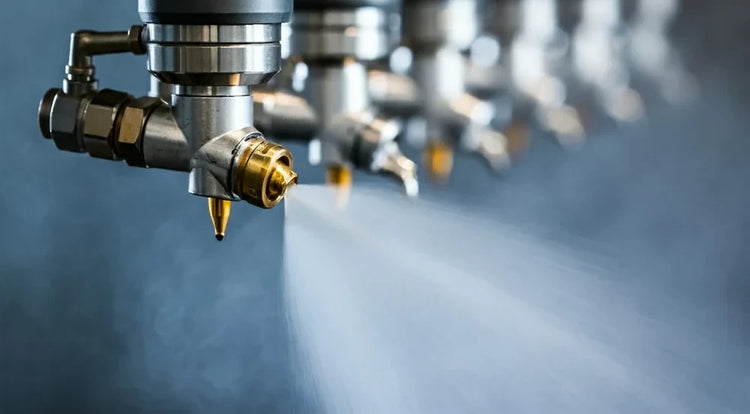

For the engineers and facility managers who view compressed air as more than just "blowing things off," understanding the physics behind the tool is the first step toward optimization.
How Air Nozzles Work: The Science Behind Compressed Air Flow
If you take a standard pipe and pump compressed air through it, the air exits in a turbulent, disorganized blast. This is inefficient, loud, and expensive. An engineered air flow nozzle changes the game by using two primary physical principles: the Venturi Effect and the Coanda Effect.
1. The Venturi Effect & Air Amplification
Most modern air nozzle designs rely on the Venturi effect to achieve what we call "air amplification."
As compressed air is forced through a narrowed internal orifice, its velocity increases while its pressure decreases. This creates a low-pressure zone (a partial vacuum) just outside the nozzle’s exit. Nature hates a vacuum, so it pulls in a massive volume of the surrounding "ambient" air into the stream.
-
The Result: You might only use 1 unit of compressed air from your compressor, but the nozzle delivers 20 to 25 units of total air to your target.
-
Why it matters: This is the key to air amplification nozzles. You get more "push" for less "pay."
2. The Coanda Effect: Directing the Blast
While the Venturi effect handles the volume, the Coanda effect handles the direction. This principle states that a high-velocity fluid (like air) will follow the curve of a nearby surface.
In high-performance air nozzles, the air is often directed over a curved "bullet" or through precise slots. The air "hugs" these surfaces, creating a focused, high-velocity stream that doesn't scatter. This creates a laminar flow—a straight, smooth stream of air that hits the target with maximum impact and minimum noise.
Anatomy of a High-Performance Air Nozzle
The air flow nozzle isn't just a hole in a piece of metal; it’s a carefully tuned instrument. Here are the technical components that define its performance:
-
The Orifice: Precisely machined to ensure the correct pressure-to-velocity conversion.
-
Bypass Ports: Small holes or slots that prevent "dead-ending." If the nozzle is pressed against a surface, these ports allow air to escape, keeping the pressure below 30 PSI to remain OSHA compliant.
-
Fins and Grooves: Many designs incorporate external fins to help protect the orifice from damage and further stabilize the air stream.
Why Laminar Flow Beats Turbulent Flow
When air exits an open pipe, it is turbulent. Think of it like a crowd of people rushing out of a stadium—they bump into each other, lose energy, and create a lot of noise.
Laminar flow is like a synchronized marching band. Every molecule of air is moving in the same direction at the same speed.
The Economics of Compressed Air Nozzle Design
For engineers, the bottom line is often the "Coefficient of Discharge." Cheap, poorly designed nozzles create "backpressure," which forces your compressor to work harder than necessary.
By utilizing a high-efficiency air nozzle design, you reduce the "artificial demand" on your air system. This allows your compressors to cycle off more frequently, extending their lifespan and drastically reducing your facility's peak energy demand.
Technical Comparison: Air Nozzle Orifice Designs
| Orifice Design | Flow Pattern | Best For... | Technical Advantage |
| Multi-Slot (Flat) | Wide, Linear | Conveyors, Web Drying | Uniform force across a wide area; minimizes "striping." |
| Single Circular | Concentrated, Point | Blind Holes, Ejection | Maximum "punch" or impact force at a specific spot. |
| Annular (Ring) | 360° Cylindrical | Pipe/Cable Cooling | Even cooling or drying around the entire outer diameter of a part. |
| Venturi-Style | High-Volume, Broad | General Blow-off | Highest air amplification ratio; best for energy savings. |
Technical Audit Checklist: Evaluating Your Blow-Off Stations
Engineers and facility managers can use this checklist to determine if their current compressed air setup is a precision tool or a profit-drain.
-
[ ] Operating Pressure (PSI): Is the line pressure regulated at the point of use, or is it running at full compressor pressure (often 100+ PSI)? Tip: Reducing pressure to the minimum required for the task saves significant energy.
-
[ ] Air Consumption (SCFM): Have you measured the actual flow rate? Open pipes can consume 3–4x the air of an engineered air amplification nozzle.
-
[ ] Noise Levels (dBA): Is the station exceeding 85–90 dBA? Engineered nozzles utilize laminar flow to significantly drop noise pollution.
-
[ ] OSHA Compliance: If the nozzle is dead-ended against a surface, does the static pressure drop below 30 PSI? (Check for safety bypass slots).
-
[ ] Target Distance: Is the nozzle mounted at the optimal distance? High-velocity air nozzles lose effectiveness if placed too far—or too close—to the target.
-
[ ] Material Compatibility: Is the nozzle material (Aluminum, 303/316 Stainless, or Zinc) appropriate for the environment? (e.g., Food grade vs. high-heat washdown).
-
[ ] Connection Size: Are your fittings and hoses sized correctly (1/8", 1/4", 1/2" NPT) to prevent "choking" the air supply before it even reaches the nozzle?
Optimize Your Flow
Understanding the compressed air nozzle working principle is just the start. The real magic happens when you match the right design—whether it's a flat fan or a high-thrust nozzle—to your specific industrial challenge. Shop our air nozzle collection.


