
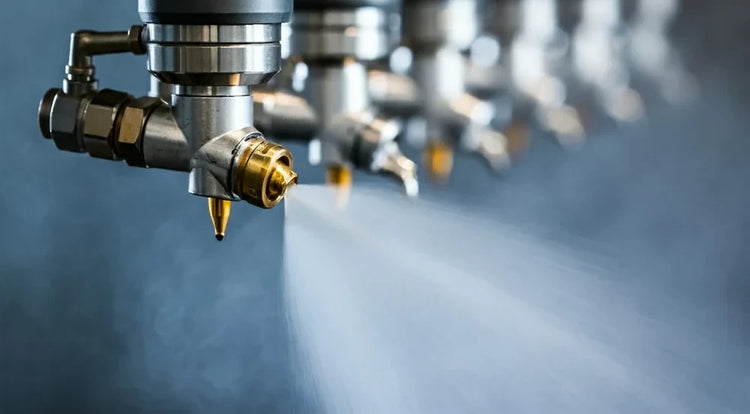
How to Detect Nozzle Wear — And the Hidden Costs of Delay
The seven measurable signs that a nozzle needs replacement, the step-by-step inspection method, and the production cost calculation that proves why timely replacement is less expensive than waiting
A worn spray nozzle shows seven measurable signs: increased flow rate (orifice enlargement), changed or degraded spray pattern, coarser droplet size, reduced impact pressure, visible orifice damage, increased pressure required for design flow, and off-spec process output (uneven coating, poor drying, inadequate dust suppression). The most reliable detection method is timed flow rate measurement at operating pressure — a nozzle delivering more than 10–15% above rated flow has worn orifice geometry and should be replaced. The hidden cost of delay: a 15% orifice enlargement produces a 32% increase in liquid consumption per nozzle. On a system with 20 nozzles, this represents 32% excess chemical or coating usage — often worth tens of thousands of dollars per year in wasted material before anyone notices the spray pattern degrading.
Nozzle wear is a slow, invisible process that causes measurable damage to process quality, material efficiency, and equipment long before the nozzle fails visibly. Unlike a nozzle that clogs — which produces an obvious, immediate symptom — a nozzle that wears produces changes that happen gradually over weeks or months, below the threshold of routine visual observation. The orifice enlarges a few microns per operating hour; the flow rate creeps up by 1–2% per month; the droplet size drifts coarser; the spray pattern distorts slightly. None of these changes trigger an alarm. But after six months, the nozzle is delivering 20–30% more liquid than specified — and the process is producing proportionally more waste, more over-application, or less effective coverage than designed.
The physics of why a 10% orifice diameter increase causes a 21% flow increase — and why this matters more than most maintenance programs account for — is at the core of this guide. So is the specific five-step inspection method that takes less than five minutes per nozzle and will detect wear before it affects process output.
The 7 Measurable Signs of a Worn Spray Nozzle
Each sign identifies a specific wear mechanism — matched to the detection method that confirms it
Flow Rate Above Rated by More Than 10%
Symptom: Timed collection at operating pressure delivers more than the rated flowOrifice wear enlarges the opening, increasing the discharge coefficient and the effective orifice area. Because flow rate scales with orifice area (not diameter), a 10% increase in orifice diameter produces a 21% increase in flow rate (area scales as diameter²). This is the most reliable wear indicator because it is quantitative, directly measurable in the field, and directly correlates with actual process over-application.
Detection method: Timed collection. Divert nozzle output into a calibrated container for exactly 30 seconds at design operating pressure. Compare collected volume against rated flow × 0.5 min. Any result above 110% of rated flow warrants replacement.
⚠ Process consequence: Over-application of coating, chemical, coolant, or suppressant — material waste proportional to the excess flow above ratedDegraded or Distorted Spray Pattern
Symptom: Spray pattern is streaky, asymmetric, has a hollow center, or tails at the edgesPattern degradation occurs when wear is uneven across the orifice — typically caused by abrasive particles that are harder than the nozzle material passing through the orifice at high velocity. The orifice becomes elliptical rather than circular; flat-fan nozzles develop asymmetric fan angles; full-cone nozzles develop dead zones in the coverage area. A degraded pattern is the most visible sign but is often noticed only after it has progressed far beyond the replacement threshold.
Detection method: Pattern test card or water-sensitive paper at design standoff distance and operating pressure. Check for symmetry, coverage uniformity, and absence of streaks or hollow zones. Compare against the pattern card from a new nozzle of the same model.
⚠ Process consequence: Uneven coverage — under-treated or un-treated zones in the process area despite nominal total flow deliveryCoarser Droplet Size Than Specified
Symptom: Spray appears visually less fine; observed droplet coverage on target surface is coarser; dust suppression or cooling effectiveness is reducedAs the orifice enlarges from wear, the liquid emerges at lower velocity per unit area for the same supply pressure (because more liquid volume passes through the larger area at lower specific velocity). Lower exit velocity reduces the liquid sheet energy that drives droplet breakup — producing coarser droplets than a new nozzle at the same pressure. Coarser droplets have less surface area per unit volume, reducing evaporation rate, gas absorption efficiency, and dust capture efficiency.
Detection method: Laser diffraction measurement (Dv50) for critical applications — or qualitative assessment from the pattern card (coarser drops produce larger, more widely spaced impact marks). Compare against new nozzle baseline.
⚠ Process consequence: Reduced evaporation rate, decreased dust suppression effectiveness, lower gas-liquid mass transfer in scrubbers, less effective cooling per gallonReduced Impact Pressure or Cleaning Force
Symptom: Parts washing performance declining; cleaning requires more passes or longer cycle time; surface cleaning result below specificationImpact pressure at the target surface = ½ρv². As the orifice wears larger, the liquid exits at lower velocity for the same supply pressure (more area, same pressure → more volume, same energy → lower velocity per unit area). Lower velocity produces lower impact pressure at the target. Since impact pressure scales with velocity squared, a 10% velocity reduction reduces impact force by 19%. In parts washing and descaling applications, this is often the first operational sign of wear — before flow measurement is performed.
Detection method: Cleaning performance test — run a standardized soil load through the washer and compare cleaning result against the new-nozzle baseline. Alternatively, measure impact pressure directly with a pressure sensor at the target surface position.
⚠ Process consequence: Below-specification cleaning, inadequate descaling, incomplete surface preparation — leading to coating adhesion failures or assembly quality problemsVisible Orifice Damage or Enlargement
Symptom: Orifice edge is visibly eroded, pitted, or elongated under 10× magnification; orifice shape is no longer circular (flat-fan) or correctly profiled (full-cone)Direct visual inspection of the orifice face — ideally with a 10× loupe or digital inspection microscope — is a quick but qualitative assessment. Abrasion wear produces a smooth, rounded orifice edge and enlarged opening. Corrosion produces pitted, irregular surface. Cavitation damage produces a rough, cratered orifice face. Erosion channels in flat-fan slots appear as elongated notches at the slot ends. None of these are detectable by naked-eye inspection at normal working distance — a magnifier is essential.
Detection method: 10× loupe inspection of the orifice face under good lighting. Compare against a new nozzle of the same model. Any visible rounding of sharp orifice edges, pitting, or asymmetric enlargement confirms wear beyond visual-inspection tolerance.
⚠ Process consequence: All of Signs 1–4 above — visible damage typically confirms that flow rate is already significantly above ratedHigher Pressure Required to Achieve Design Flow
Symptom: Supply pressure has been gradually increased at the pump or regulator to maintain target process outcome — but this is a sign of clogging, not wearThis sign is the inverse of the others: if pressure has been increased over time to maintain the same process result, the nozzle orifice has likely become partially restricted (scale buildup, partial clogging) rather than enlarged. Partial clogging from mineral scale or process residue reduces orifice area, reducing flow at the same pressure — requiring higher pressure to maintain design flow. This is distinct from wear (enlarged orifice) and requires a different response: cleaning or removal of scale rather than replacement.
Detection method: Flow test at original design pressure — if flow is below rated at the original pressure, clogging is likely. If flow is above rated, wear is likely. Both require action.
⚠ Process consequence: Under-application from clogging (inadequate treatment) — opposite of wear, but equally damaging to process output qualityOff-Specification Process Output Without Other Obvious Cause
Symptom: Coating weight trending above specification; heat exchanger efficiency declining; dust readings creeping up despite system operation; treated product failing downstream quality checksProcess output quality is the downstream consequence of nozzle wear — and often the first thing that triggers a maintenance investigation. Coating weight above specification on a spray coating line; heat transfer efficiency decline on a cooling system; compliance monitoring showing elevated particulate despite dust suppression operation; chemical dosing results showing over-treatment. Any of these trending in the wrong direction without a process chemistry or supply change should trigger nozzle inspection as the first diagnostic step.
Detection method: Correlate process output data with nozzle installation date. If the trend began 3–6 months after last nozzle replacement and no other process changes occurred, worn nozzles are the primary hypothesis. Confirm with flow testing.
⚠ Process consequence: The cumulative hidden cost — excess material, energy, or chemical usage that has been building since orifice enlargement beganSymptom → Diagnosis → Action Reference
Fast-lookup table — from observed symptom to root cause to corrective action
| Symptom | Most Likely Cause | Confirm With | Corrective Action |
|---|---|---|---|
| Flow rate >110% of rated | Orifice wear — abrasion or corrosion enlarging the orifice | Timed collection at design pressure; compare vs. rated flow on datasheet | Replace nozzle immediately with same-model replacement. Upgrade to TC insert if wear recurs within 3 months |
| Flow rate <90% of rated | Partial clogging — scale, residue, or particle buildup in orifice | Timed collection at design pressure; inspect orifice with 10× loupe for scale | Remove and clean with appropriate chemical (acid for mineral scale; solvent for organic residue). Replace if cleaning does not restore flow. Add upstream strainer |
| Asymmetric or streaky spray pattern | Uneven orifice wear (abrasive particles), or partial clogging on one side of the orifice | Pattern card test at design standoff; 10× loupe inspection | Replace if wear-caused; clean if clog-caused. Add upstream strainer to prevent recurrence |
| Spray angle narrower than rated | Operating below rated pressure; or orifice geometry partially blocked | Verify supply pressure at nozzle inlet under flow; check orifice | Restore design supply pressure; clean orifice if clogged. If pressure is correct and angle is still narrow: replace nozzle |
| Spray angle wider than rated | Orifice wear — worn orifice edge produces wider, less coherent pattern | Flow test (should also show above-rated flow); loupe inspection | Replace nozzle. Wider-than-rated angle is a reliable wear indicator in flat-fan and hollow-cone nozzles |
| Dripping or drooling when flow is off | Worn or damaged check valve or anti-drip tip; or worn orifice with insufficient surface tension hold-back at low pressure | Close supply valve completely — dripping with supply closed indicates check valve or anti-drip failure | Replace anti-drip tip or check valve insert if serviceable; replace full nozzle if orifice is also worn |
| Reduced cleaning or impact performance | Orifice wear reducing exit velocity at same pressure; or supply pressure lower than design | Measure supply pressure at nozzle inlet under flow; then flow test | Restore design pressure first; if performance still degraded at correct pressure → replace nozzle |
| Visible pitting or surface damage on orifice face | Cavitation damage (typically at very high pressure or near a valve); corrosion; or abrasion from particulate impact | 10× loupe or microscope inspection; note damage character (smooth = abrasion; cratered = cavitation; pitted = corrosion) | Replace nozzle; also address root cause — reduce cavitation conditions if that is the mechanism; upgrade to corrosion-resistant material if corrosion is the cause |
| Process output trending off-spec without process change | Gradual nozzle wear producing cumulative over- or under-application since last replacement | Check nozzle installation date; flow-test all nozzles in the system; correlate flow rate deviation with output trend start date | Replace all nozzles in the system as matched sets; establish a scheduled replacement interval based on observed wear rate from this inspection |
The 5-Step Nozzle Inspection Method
A repeatable inspection protocol that takes less than 5 minutes per nozzle and can be performed by maintenance staff without specialized equipment
Step-by-Step Nozzle Wear Inspection Checklist
- Verify supply pressure at the nozzle manifold inlet Attach a calibrated pressure gauge at the manifold supply connection and measure pressure under full-flow operating conditions — not at the pump gauge, not at rest. Record the measured pressure. This is the actual P₁ for all flow calculations. Pressure below design reduces flow regardless of nozzle condition and must be ruled out before blaming the nozzle.
- Perform timed collection flow test at operating pressure Divert each nozzle's output individually into a calibrated measuring container (graduated bucket or jug) for exactly 30 seconds at the measured operating pressure. Record the collected volume. Compare against: Rated flow (GPM or L/min from datasheet) × 0.5 minutes = Expected volume. Calculate deviation: (Collected − Expected) ÷ Expected × 100%. Replace if deviation is above +10%. Clean if deviation is below −10%. Accept if within ±10%.
- Spray pattern test on water-sensitive paper or pattern card Hold water-sensitive paper or a white pattern test card at the design standoff distance from the nozzle tip. Run the nozzle at operating pressure for 1–2 seconds. Examine the impact pattern for: symmetry (flat-fan should be symmetric about the center axis); coverage uniformity (full-cone should show no hollow zones or dead spots); edge sharpness (worn flat-fan nozzles produce fringed rather than clean edge definition). Compare against a new nozzle baseline pattern card. Photograph and retain in the maintenance record.
- Visual inspection of orifice face under 10× magnification Remove the nozzle from the manifold. Inspect the orifice face with a 10× loupe under good lighting (bright LED work light). Look for: rounded or eroded orifice edges (should be sharp on a new nozzle); elongation of the orifice (circular orifices should remain circular; flat-fan orifices should have parallel slot walls); surface pitting or cratering (cavitation or corrosion damage); scale or residue deposits on the orifice face. Any visible enlargement or damage confirmed by loupe inspection almost always correlates with above-threshold flow rate deviation.
- Record results and compare against baseline and previous inspection Log date, nozzle position number, measured supply pressure, collected volume, calculated flow deviation percentage, pattern assessment (pass/fail/marginal), and loupe inspection notes. Compare against: (a) the rated flow from the datasheet; (b) the result from the previous inspection at this position. A position that passed at 5% above rated 3 months ago and is now at 9% above rated is trending toward replacement threshold — flag for replacement at the next scheduled maintenance window. Trending data across multiple inspection cycles reveals the actual wear rate for your specific liquid, material, and operating conditions, enabling accurate prediction of when each position will reach replacement threshold.
Detection Methods by Available Equipment
Four methods ranked from simplest to most precise — choose based on available tools and application criticality
Timed Collection (Bucket & Stopwatch)
The lowest-cost, highest-value inspection method. No specialized equipment required: a calibrated measuring jug (1–5 gallon or 5–20 liter), a stopwatch, and the nozzle's rated flow rate from the datasheet. Collect output for 30–60 seconds at operating pressure; compare to the expected volume for that time at rated flow.
Accuracy: ±3–5% — adequate for the ±10% replacement threshold. Suitable for all flow rates above approximately 0.5 GPM (1.9 L/min) where timing error becomes significant.
✓ Recommended as the primary inspection method for all industrial spray applicationsPattern Test Card or Water-Sensitive Paper
A visual uniformity check that detects pattern distortion before flow measurement shows significant deviation. Water-sensitive paper (commercially available for agricultural sprayer testing) turns blue instantly on water contact, producing a clear record of the impact pattern. Standard white card stock with grid markings also works for field checks.
Particularly valuable for flat-fan nozzles (symmetry check), full-cone nozzles (dead zone detection), and hollow-cone nozzles (ring uniformity). Does not quantify flow rate — use in combination with Method 1.
✓ Add this to every inspection cycle for coating and chemical dosing applications where uniformity matters more than total flowInline Flow Meter at Each Manifold Position
For high-value applications (precision coating, pharmaceutical dosing, FGD compliance systems) where real-time flow monitoring is worth the capital cost: inline ultrasonic or electromagnetic flow meters at each nozzle manifold supply. Alarms at ±5–10% deviation; automatic shutdown or alert if threshold is exceeded.
Eliminates manual inspection entirely for flow rate — but does not detect pattern degradation or droplet size change. Highest-confidence method for continuous production monitoring.
✓ Specify for any application where nozzle flow rate deviation has direct compliance or product quality consequencesLaser Diffraction Droplet Size Measurement
Laser diffraction (per ISO 9276-1 or ASTM E799) measures the full droplet size distribution — Dv10, Dv50, Dv90 — of the spray at defined test conditions. Detects wear-induced droplet size increase before flow rate deviation reaches the replacement threshold. Required for dust suppression qualification, FGD absorber performance testing, and pharmaceutical spray drying validation.
Not a field method — requires laboratory or specialized spray characterization test rig. Use at initial commissioning to establish baseline, and periodically to verify that process conditions remain within specification.
✓ Establish Dv50 baseline at commissioning for all applications where droplet size is a process specification variableThe Hidden Costs of Running Worn Nozzles
The math that proves why delaying nozzle replacement costs more than the nozzle
A coating line with 20 flat-fan nozzles running at 15% above rated flow
A spray coating system applies protective coating at a rated 2.0 GPM per nozzle at 40 PSI. After 8 months of operation with abrasive coating, each nozzle's orifice has enlarged by approximately 8% in diameter. Orifice area increases as diameter squared: 1.08² = 1.166 → 16.6% flow increase per nozzle. At 2.0 GPM rated: actual flow = 2.33 GPM per nozzle.
Note: This example uses a relatively expensive specialty coating at high flow rates. Even at $0.50/gallon commodity chemical: excess cost = $792,000/year. Nozzle replacement cost is typically recovered in 1–4 days of operation.
A wastewater dosing system with 8 spiral nozzles at 12% above rated flow
A chemical dosing system applies ferric chloride coagulant at 0.8 GPM per nozzle (rated). After 6 months of operation, wear from the 15% suspended solids concentration in the wastewater stream has enlarged each orifice. Actual measured flow: 0.90 GPM per nozzle (+12.5%).
The reverse case: clogged quench nozzles delivering 20% below rated flow
A steel strip quench line has 30 full-cone nozzles delivering cooling water. After 12 weeks of operation with scale-contaminated recirculated water, 6 nozzle positions have partially clogged orifices delivering only 80% of rated flow. The remaining 24 positions are at 100% flow.
When to Replace — Recommended Inspection and Replacement Intervals
Intervals by nozzle material and service conditions — plus the formula for calculating your specific replacement frequency
The Right Replacement Interval Is the One Measured from Your Own Process, Not from a Generic Schedule
The intervals below are starting points for processes with no wear data. The correct replacement interval for your specific operation is determined by measuring flow rate at regular intervals and plotting it over time — the date when the trend line crosses the 110% threshold is the replacement date. After 2–3 replacement cycles with measured wear data, you will have an accurate wear rate for your specific combination of liquid, abrasive content, nozzle material, and operating hours.
Establishing your wear rate: Inspect all nozzle positions at commissioning (baseline), then at 4-week intervals for 3 cycles. Plot the average flow rate deviation per month. Extrapolate to find when the average reaches the 10% replacement threshold. That interval is your evidence-based replacement frequency. Inspect more frequently for positions with higher-than-average wear rates (typically positions at the highest-velocity, highest-abrasive-loading locations in the system).
Wear Impact by Application — What Goes Wrong First
Six application categories where nozzle wear produces the most consequential and least obvious failures
Spray Coating & Painting
Wear increases film weight above specification — often invisible until coating weight measurement catches it. Over-application increases material cost and may cause runs, sags, or adhesion failure from excessive film thickness. Flat-fan wear also distorts the coverage overlap pattern, producing stripes of over- and under-application at the overlap zones. Replace as matched sets to maintain even coverage across the full width.
Parts Washing & Cleaning
Wear reduces impact force even as flow increases — the counterintuitive result of higher-velocity loss from the enlarged orifice. Cleaning performance declines while water consumption rises. First sign: parts requiring rework after washing or failing post-wash cleanliness inspection. Impact force decrease is roughly proportional to the square of the velocity decrease — a 10% velocity reduction from wear produces ~19% less impact force.
Chemical Dosing & Treatment
Over-dosing from worn nozzles wastes reagent and can create treatment quality problems — over-coagulation, over-acidification, or excessive biocide concentration. Particularly serious in wastewater treatment where over-dosing can create permit exceedances in addition to wasting chemical. Replace when flow exceeds rated by 10%; verify with process output monitoring.
Dust Suppression
Wear produces coarser droplets that are less effective at capturing fine respirable dust — the particles deflect around coarser droplets rather than being captured by inertial impaction. MSHA/OSHA dust compliance systems can drift out of compliance as nozzle wear reduces suppression effectiveness, even while total water application remains similar. Droplet size baseline at commissioning is essential for tracking this failure mode.
Cooling Systems (Quench)
Wear can cause both over-application (increased flow) and coverage gap failures (if pattern distortion creates dry zones). In heat treat quench systems where nozzle flow rate determines hardness, wear-induced flow rate increase produces excessive water flux that can paradoxically reduce hardness by pushing the surface into the film-boiling regime rather than nucleate boiling. Replace as complete spray-level sets for compliance with hardness specification.
FGD & Pollution Control
In FGD absorbers, worn nozzles delivering above-rated flow increase the local L/G ratio beyond design — which seems beneficial but actually causes cross-sectional coverage asymmetry as some positions over-spray their coverage areas while adjacent unworn positions deliver design flow. The result is coverage gaps between positions rather than improved absorption. SO₂ outlet concentration drifts upward. Replace as complete spray levels; never replace individual positions within a partially worn level.
Frequently Asked Questions — Nozzle Wear
Direct answers to the most common nozzle wear and replacement questions
What are the signs that a spray nozzle needs replacing?
The seven measurable signs are: (1) flow rate above 110% of rated when tested by timed collection at operating pressure; (2) spray pattern is asymmetric, streaky, or shows hollow zones; (3) droplet size is coarser than specified; (4) cleaning or impact performance has declined below specification; (5) orifice face shows visible erosion or enlargement under 10× magnification; (6) supply pressure has been increased to maintain process output (indicates clogging rather than wear — opposite problem); (7) process output is trending off-specification without other changes. Sign 1 — timed flow rate measurement — is the most reliable because it is quantitative and directly correlates with process over-application. The others are secondary indicators that confirm the need to flow-test.
How often should spray nozzles be replaced?
Replacement frequency depends on the service conditions — specifically the abrasive content and hardness of the sprayed liquid, the nozzle body material, and the operating pressure. General guidance: clean water service with SS nozzles: replace when flow test shows >10% deviation, typically every 12–36 months. Moderate abrasive service (10–30% solids in slurry): SS nozzles every 4–12 weeks; TC insert nozzles every 6–18 months. Highly abrasive service (above 30% solids, or very hard minerals): SS nozzles may wear within days to weeks; TC insert nozzles 3–12 months. The most reliable approach: establish your specific wear rate by flow-testing at monthly intervals for 3 months after a fresh nozzle installation. Plot the flow deviation over time. Extrapolate to find when the trend crosses the 10% threshold — that is your evidence-based replacement interval for your specific process. After 2–3 replacement cycles, you will have an accurate wear rate that accounts for your specific liquid chemistry, abrasive loading, and operating conditions.
Can I just clean a worn nozzle instead of replacing it?
Cleaning restores a clogged nozzle — it cannot restore a worn nozzle. The two failure modes are opposites: clogging reduces orifice area and flow rate (fix by cleaning); wear enlarges orifice area and increases flow rate (fix only by replacement). Cleaning a worn nozzle removes scale or residue from the enlarged orifice but does not restore the original orifice geometry — the orifice is permanently larger, and the elevated flow rate above rated will remain after cleaning. You can confirm which failure mode applies before cleaning: if flow rate is below rated (timed collection <90% of expected), the nozzle may be clogged and cleaning may restore it. If flow rate is above rated (>110%), the orifice is worn and replacement is the only remedy. If a cleaned nozzle restores to exactly rated flow: the original problem was clogging. If flow after cleaning is still above rated: there was both clogging and wear — the clogging was masking the underlying wear problem, and replacement is needed.
How does a 10% increase in orifice diameter affect flow rate and liquid consumption?
A 10% increase in orifice diameter produces a 21% increase in flow rate — because orifice area scales as diameter squared, and flow rate is proportional to orifice area: Area₂/Area₁ = (1.10 × d)² / d² = 1.21. So a 10% larger diameter means 21% more area, which means 21% more flow at the same pressure. In terms of annual liquid consumption: a system with 20 nozzles rated at 2.0 GPM each (40 GPM total), running 16 hours/day, 250 days/year: Total annual flow at rated = 40 GPM × 60 min/hr × 16 hr × 250 days = 9,600,000 gallons/year. At 10% wear (21% flow increase): actual flow = 48.4 GPM. Excess = 8.4 GPM → 8.4 × 60 × 16 × 250 = 2,016,000 gallons/year wasted. At $1/gallon chemical cost: $2,016,000/year in excess material from what appears to be only a "10% wear" nozzle set. The nozzle replacement cost for this system would typically be under $2,000 — recovered in less than one day of operation.
Should I replace nozzles individually or as complete sets?
Replace as complete matched sets for any process application where coverage uniformity affects product quality or regulatory compliance — which is the majority of industrial spray applications. The reason: individual nozzle replacement within a partially worn set creates flow rate mismatch between the new nozzle (at rated flow) and adjacent worn nozzles (above rated flow). This produces asymmetric coverage where some positions deliver excess liquid and others deliver design flow — creating a non-uniform distribution that is often worse for process output than the uniformly elevated flow from all-worn positions. The practical rule: when any position in a spray level or manifold exceeds the ±10% replacement threshold, replace all positions in that level or manifold simultaneously. Keep one complete spare set on hand for immediate replacement during unplanned maintenance. The only exception: single-point or widely separated nozzle positions where each nozzle serves an independent coverage area with no overlap — in these cases, individual replacement is acceptable without uniformity concerns.
How do tungsten carbide inserts reduce nozzle wear?
Tungsten carbide (TC) achieves extreme wear resistance through its exceptional hardness — approximately Mohs 9.0–9.5, compared to 316L stainless steel at Mohs 5–6. Abrasive wear rate scales roughly with the ratio of abrasive particle hardness to nozzle orifice hardness: when the abrasive is harder than the orifice material, wear is rapid; when the orifice is harder than the abrasive, wear is very slow. Most industrial abrasives (mineral slurry solids, ore particles, limestone in FGD) have Mohs hardness of 3–7 — all harder than SS but softer than TC. TC inserts maintain their orifice geometry 5–10× longer than SS under the same abrasive conditions, preserving calibrated flow rate and droplet size through the full service interval. The economic case: TC inserts typically cost 3–5× more than SS nozzles, but last 5–10× longer in abrasive service — net cost per operating hour is 2–3× lower than SS. More importantly, the process quality improvement from consistent flow rate and pattern over the entire service interval is often worth more than the nozzle cost difference alone. TC is specified as standard rather than as an upgrade for any continuous-duty abrasive slurry application: FGD limestone slurry, mining ore slurry, cement plant washdown, coal handling — any service where SS nozzle replacement is needed more frequently than every 3 months.
Unsure Whether Your Nozzles Are Worn? We Can Help You Find Out
Share your application, nozzle type, service conditions, and last replacement date — our application engineers will recommend the correct inspection method and replacement interval for your specific process, and help you calculate the annual cost of delayed replacement vs. the cost of a scheduled replacement program.