
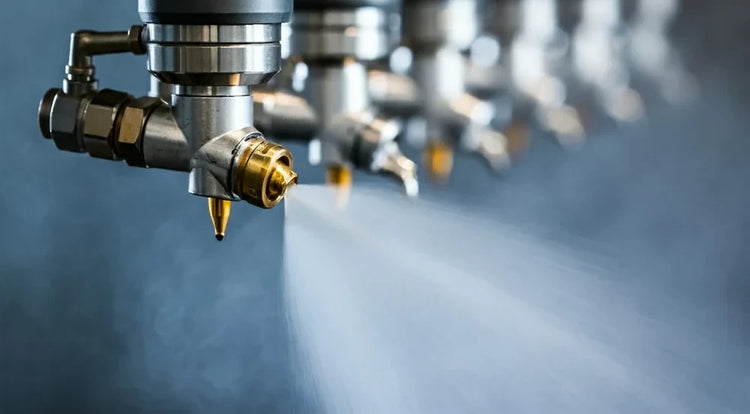

In the world of industrial manufacturing, compressed air is often referred to as the "fourth utility." It is powerful, versatile, and—if managed poorly—incredibly expensive.
If your facility is still using open-ended pipes or "homemade" blow-off solutions, you are likely venting profits directly into the atmosphere. This is where industrial air nozzles come in. In this guide, we’ll break down everything you need to know about these precision tools, from how they work to why they are essential for a safe, cost-effective workspace.
What is an Air Nozzle?
At its simplest, an air nozzle is a device designed to control the direction and velocity of compressed air as it exits a pipe or hose. Unlike a standard opening, an engineered air nozzle converts low-pressure volume into a high-velocity, high-impact concentrated stream.
The Science of Entrainment: How They Work
Most high-performance compressed air nozzles utilize a principle known as the Coanda effect. Instead of just pushing the air from the compressor, the nozzle's shape creates a vacuum that pulls in surrounding "ambient" air. This process is called entrainment.
-
Result: You get a high-volume blast of air while using significantly less compressed air from your tank.
-
Efficiency: Some air nozzles can achieve an amplification ratio of 25:1, meaning for every 1 unit of compressed air used, 25 units of total air are delivered to the target.
Key Benefits of Using Engineered Air Nozzles
Switching from "open air" blowing to engineered nozzles isn't just a technical upgrade—it’s a financial one.
1. Massive Energy Savings
Compressed air is expensive to produce. Engineered industrial air nozzles can reduce air consumption by up to 30% to 50%. For large facilities, this translates to thousands of dollars in energy savings annually.
2. Enhanced Workplace Safety (OSHA Compliance)
Open pipes pose two major risks: dead-end pressure and noise.
-
Dead-ending: If an open pipe is blocked by a worker's skin, it can force air into the bloodstream (embolism). Engineered nozzles are designed with bypass ports to ensure pressure never exceeds 30 PSI if dead-ended, keeping you OSHA-compliant.
-
Noise Reduction: Open air is loud. High-quality nozzles can reduce perceived noise levels by as much as 10 dB, protecting workers’ hearing.
3. Precision and Performance
Whether you are drying a bottle or ejecting a heavy part from a mold, air nozzles provide a consistent, laminar flow that "hugs" the surface, ensuring better moisture removal and debris clearing than a turbulent open pipe.
Common Industrial Air Nozzle Applications
Where exactly do these tools shine? Air nozzle uses span across almost every manufacturing sector:
-
Cooling: Rapidly lowering the temperature of extruded plastics or hot metal parts.
-
Drying: Removing water or chemical wash from products before labeling or packaging.
-
Cleaning: Blowing away dust, metal chips, or liquid debris from machinery and parts.
-
Part Ejection: Using a high-impact blast to move finished parts off a conveyor or out of a press.
-
Material Conveying: Moving small parts or pellets along a production line using air force.
Types of Compressed Air Nozzles
Choosing the right tool depends on your specific air nozzle applications.
| Nozzle Type | Best For... | Key Feature |
| Flat Air Nozzles | Wide surfaces / Conveyors | Broad, "curtain" of air. |
| Round Nozzles | Targeted spots / Holes | High-impact, concentrated force. |
| Air | Heavy-duty moving | Maximum entrainment for high thrust. |
| Flexible Stay-Put | Tight spaces | Can be bent and aimed without brackets. |
Air Nozzles vs. Spray Nozzles: What’s the Difference?
It is a common point of confusion, but the distinction is vital:
-
Air Nozzles: Designed exclusively for gases (compressed air, nitrogen). Their goal is velocity, impact, and entrainment of ambient air.
-
Spray Nozzles: Designed for liquids (water, chemicals, oil). Their goal is atomization, distribution, or coating.
While some "air atomizing" nozzles use both, a dedicated compressed air nozzle is strictly for blow-off and cooling applications.
Ready to Optimize Your Air System?
Stop wasting compressed air and start saving today. Browse our full range of high-efficiency Industrial Air Nozzles and find the perfect fit for your application.


