
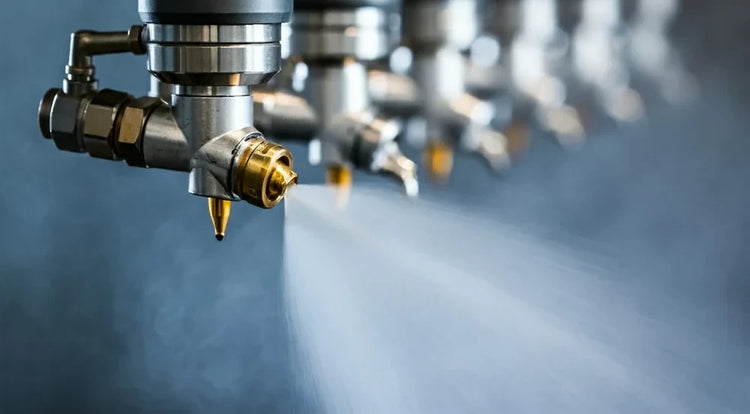
Cooling & Quenching Nozzles
Cooling and quenching nozzles atomize water or coolant into droplet sizes that absorb heat fast, through evaporation in gas-conditioning ducts, fine-mist sprays in cooling towers, or high-impact streams in metal quench lines. Droplet size, spray pattern, and flow rate determine how quickly heat moves from the substrate or gas stream into the spray. The collection below covers evaporative cooling, gas cooling and conditioning, adiabatic cooling, and direct-spray quenching applications, flat-fan, full-cone, hollow-cone, and fine-atomizing nozzles in 316L stainless, brass, PVDF, and polypropylene, sized for the temperature, flow, and chemistry of each process.


Guide
Cooling & Quenching Nozzles: Overview & Selection Tips
This Cooling & Quenching collection groups nozzles and assemblies commonly used for Cooling & Quenching tasks across industrial lines. It makes it easier to compare nozzle types, spray patterns, materials, and connection options in one place.
Start with the process objective, then narrow by flow rate, operating pressure, coverage target, fluid compatibility, and maintenance needs. Related applications often include Cooling & Quenching, Cleaning & Washing, Coating & Surface Treatment, and Humidification & Conditioning.
Key selection factors
- Compare nozzle types and assemblies commonly used for Cooling & Quenching.
- Related process areas include Cooling & Quenching, Cleaning & Washing, Coating & Surface Treatment, and Humidification & Conditioning.
- Focus on spray pattern and coverage style, flow rate, pressure, and coverage requirements.
- Material options may include 316L stainless steel, brass, 303/304 stainless steel, and polypropylene.
- Check inlet sizes such as 1/4 in., 1/8 in., 3/8 in., and 1/2 in. with NPT connections where available.
Common applications
- Cooling & Quenching
- Cleaning & Washing
- Coating & Surface Treatment
- Humidification & Conditioning
How to choose Cooling & Quenching
- Start with the required flow rate and operating pressure at the nozzle or assembly.
- Choose the spray pattern and coverage style that best matches the coverage, impact, atomization, or washdown result you need.
- Confirm material compatibility using options such as 316L stainless steel, brass, 303/304 stainless steel, and polypropylene.
- Finally, verify thread style and inlet size, including 1/4 in., 1/8 in., 3/8 in., and 1/2 in. with NPT connections where available.
Related collections
Cooling & Quenching | Cleaning & Washing | Coating & Surface Treatment | Humidification & Conditioning
What Cooling & Quenching Nozzles Do
Built for evaporative cooling, gas conditioning, and industrial quench applications
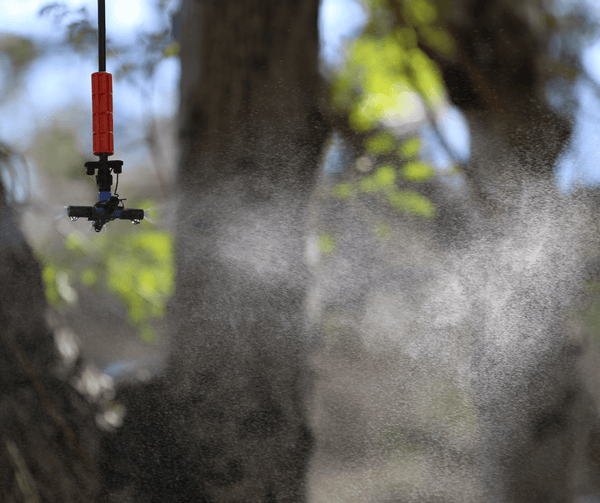
Spray Pattern
Multiple spray patterns
Available SKUs
4820 Products
Quality
Industrial Grade
Shipping
Ships Fast
How Spray Nozzles Control Cooling Rates
Droplet size, spray pattern, mass flow, and dwell time determine heat-removal rate
Operating Principle
A cooling or quench nozzle removes heat through one of three physical mechanisms. In evaporative cooling, fine droplets, typically 30 to 100 microns, fully evaporate inside the gas stream, absorbing the latent heat of vaporization (about 540 calories per gram of water at 100 °C) from the surrounding air. In direct-contact cooling, larger droplets wet the substrate or fill media and transfer heat by sensible heat capacity, with the cooled water carrying heat away from the surface. In quench cooling, high-impact streams or fine sprays at high mass flow rate pull heat out of a hot part fast enough to lock in a desired metallurgical structure. The nozzle's job in every case is to produce the right droplet size at the right flow rate, with a pattern that uniformly covers the gas volume, the fill media, or the part surface being cooled.
What to Compare
Five specs decide whether a nozzle is right for your cooling or quench line:
Droplet size (microns): under 100 µm for evaporative cooling and gas conditioning; 100-500 µm for cooling-tower fill and condensate sprays; 500-2,000 µm for direct quench. Smaller droplets evaporate faster but require higher operating pressure.
Capacity (GPH or GPM at operating PSI): size to the heat load (BTU/hr or kW), not just the nozzle's rated flow. For evaporative cooling, mass flow must match the moisture deficit of the inlet air; for quench, it must match the heat capacity of the part times the desired cooling rate.
Pressure (PSI): typical operating ranges: 30-60 PSI for gas conditioning and adiabatic cooling, 15-40 PSI for cooling-tower fill nozzles, 80-200+ PSI for fine-atomizing cooling sprays. Verify pressure at the nozzle under load, not at the pump at idle.
Materials: 316L stainless steel for water-side cooling and quench; PVDF or PEEK for de-ionized water and chemically active coolants; brass or 303 SS for cooling-tower service; ceramic seats for long life in particulate-loaded recirculating cooling water.
Spray pattern and angle: full-cone for volumetric gas cooling (90°-120°); hollow-cone for fine droplet evaporation (60°-90°); flat-fan for curtain-style quench and conveyor cooling (25°-110°); fine-atomizing for adiabatic and humidification (hollow cone or air-atomizing).
Installation & Maintenance
Three practical points cooling and quench-line operators ask about most:
Orientation and standoff: for evaporative cooling, orient the spray axis with the gas flow direction so droplets have maximum residence time before evaporating; for quench, orient perpendicular to the part with a standoff that avoids spray-overshoot on the part edge. Even 5° of drift can cause stripe-pattern hot spots on quenched parts and reduce evaporation efficiency by 10-20%.
Spacing and overlap: in cooling-tower manifolds and gas-conditioning ducts, overlap adjacent nozzles by 25-30% so the spray fully envelopes the gas volume with no untreated gaps; under-overlapping is the most common cause of inconsistent outlet temperature in industrial gas-conditioning systems.
Inspection and replacement: replace nozzles when measured flow drops 10% from baseline (calibrated bucket-and-stopwatch check, not a visual check). A worn nozzle in a cooling tower silently raises water consumption and electrical load by 15-25% before the spray pattern visibly fails; in a quench line, the same wear changes part hardness and dimensional consistency before any obvious symptom appears.
Cooling and Quenching Spray Applications
Applications include steel quenching, gas cooling, product line cooling, extrusion cooling, and heat treatment spray systems.
Cooling & Quenching
Control part temperature and process heat with spray coverage sized for the required cooling rate and heat removal.
Cleaning & Washing
Support rinsing, washdown, parts cleaning, and surface cleanup with coverage and impact matched to the soil load and line speed.
Coating & Surface Treatment
Apply coatings, chemicals, and pretreatment fluids with repeatable coverage and controlled transfer efficiency.
Humidification & Conditioning
Produce droplets suited to humidity control, evaporative conditioning, and air treatment tasks.
Selecting Nozzles for Cooling and Quenching
Match cooling rate requirements to spray density, droplet size, and coverage uniformity for consistent metallurgical or thermal outcomes.
Flow Rate & Pressure
Start with the flow rate you need at the operating pressure available at the nozzle or assembly.
Spray Pattern & Coverage
Choose the spray pattern and coverage style that best matches the coverage width, impact, atomization, or washdown result your process requires.
Materials & Connections
Select wetted materials compatible with the fluid, temperature, and wear conditions; common options may include 316L stainless steel, brass, 303/304 stainless steel, and polypropylene; common sizes include 1/4 in., 1/8 in., 3/8 in., and 1/2 in. with NPT connections where available.
Maintenance & Reliability
Consider clogging risk, wear life, ease of change-out, and the maintenance routine your process can realistically support.
Industries Using Cooling and Quenching Nozzles
Steel, aluminum, plastics, ceramics, power generation, and industrial heat treatment operations all use spray cooling nozzles.
Cooling and Quenching Nozzle FAQ
Answers to questions about cooling rate calculation, spray density, nozzle spacing, and achieving uniform quench performance.
Which spray nozzle is best for evaporative cooling?
For evaporative cooling, use a fine-atomizing nozzle that produces droplets under 100 microns at the operating pressure of your system. Hollow-cone and air-atomizing nozzles are the most common choices because they generate the fine droplet sizes needed for fast evaporation while keeping operating pressure manageable (60-120 PSI for hollow cone, 40-80 PSI plus 40-80 PSI compressed air for air-atomizing). Size mass flow to the moisture deficit of the inlet air, the difference between actual humidity and saturation at the inlet temperature. Use 316L stainless steel for de-ionized or recirculating cooling water; PVDF for chemically active coolants.
What nozzles are used for gas cooling and conditioning?
Gas cooling and conditioning systems, typically downstream of a kiln, furnace, or process duct, use fine-atomizing nozzles to drop the gas temperature before the gas enters a baghouse, scrubber, or precipitator. The standard configuration is a manifold of hollow-cone or fine-atomizing nozzles arranged on lances inside the duct, with 25-30% pattern overlap and droplets sized to fully evaporate before reaching the duct wall (typically under 50 microns). 316L stainless steel is the default body material because the duct gases often contain acid vapors and particulate. Pressure is matched to the duct's residence time, higher pressure for shorter ducts to force faster evaporation.
How do I size a spray nozzle for quench cooling?
Start with the heat load: how much energy (BTU/hr or kW) needs to leave the part in how much time. Convert that to the water mass flow rate the manifold must deliver, divide by the number of nozzles in the array, and pick a nozzle capacity that matches at your supply pressure. Then choose droplet size: for severe quench (fast cooling, hard parts) use larger droplets at high impact (500-2,000 µm at 80-200 PSI); for controlled quench (uniform cooling, distortion-sensitive parts) use medium droplets at moderate pressure (200-800 µm at 30-80 PSI). 316L stainless is standard; ceramic seats extend service life when quenching above 800 °C or when scaling is a concern.
What is the difference between cooling tower nozzles and gas-cooling nozzles?
Cooling tower nozzles distribute water across the top of the fill media, with droplet sizes of 200-500 µm and flow rates sized to the tower's L/G ratio. Most cooling-tower nozzles are large-orifice plastic or stainless full-cone nozzles operating at 5-20 PSI. Gas-cooling and gas-conditioning nozzles, by contrast, atomize water into a hot gas stream, droplet sizes are 30-80 µm at much higher pressures (60-200 PSI) so droplets fully evaporate inside the duct. Cooling tower nozzles do not work for gas conditioning because their droplets are too large to evaporate before hitting the duct wall; gas-conditioning nozzles do not work for cooling towers because their flow rates are too low to wet the fill.
What materials should I use for cooling and quenching nozzles?
Match material to fluid chemistry and temperature. 316L stainless steel handles most water-side cooling, quench water, and gas-conditioning service. Brass and 303 SS are common in cooling-tower distribution where chemistry is benign and cost matters. PVDF or PEEK is required for de-ionized water (to avoid metal leach) and for cooling lines using glycol, brine, or any chemically active coolant. Ceramic-seated nozzles last 5-10x longer than all-metal nozzles in any recirculating cooling water with particulate (cooling towers, quench tanks). For high-temperature gas conditioning above 400 °C, use a heat-resistant 310 stainless body with a ceramic insert.
How can I improve cooling efficiency in an existing system?
Three practical levers. First, verify nozzle flow against the original spec, a 10% flow drop costs 10-15% in heat-removal efficiency. Replace worn nozzles before efficiency loss compounds. Second, check pattern overlap, under-overlapping (less than 25% between adjacent nozzles) leaves hot spots and untreated gas pockets. Re-space the manifold or upgrade to a wider spray angle if needed. Third, audit droplet size against the application, many evaporative cooling systems are running nozzles with droplets too large for the duct residence time, sending unevaporated water down the duct as fallout. A quick droplet-size check (or upgrade to a finer-atomizing nozzle) often recovers 15-25% of lost cooling capacity. Our engineers can run a free system audit if you send us your current nozzle spec, manifold layout, and operating data.
Related Thermal Management Spray Products
Full cone, flat fan, and hollow cone nozzles in corrosion-resistant alloys serve cooling and quenching spray applications.

NPHU
Compare NPHU by spray performance, material compatibility, connection size, and application fit.

NP3U
Compare NP3U by spray performance, material compatibility, connection size, and application fit.

NPHV
Compare NPHV by spray performance, material compatibility, connection size, and application fit.

NPHVL
Compare NPHVL by spray performance, material compatibility, connection size, and application fit.

NPSJ
Compare NPSJ by spray performance, material compatibility, connection size, and application fit.

NPHSJ
Compare NPHSJ by spray performance, material compatibility, connection size, and application fit.
Need Help Selecting the Right Nozzle?
Our engineering team is ready to help you find the perfect spray solution for your application.