
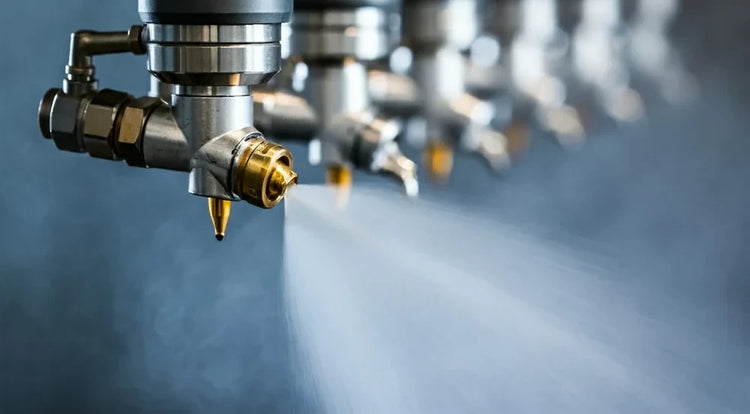

CIP Spray Ball Nozzles:
The Complete Guide to Tank Cleaning
Everything you need to know about selecting, operating, and maintaining CIP spray ball nozzles—for food, pharmaceutical, and industrial applications.
Key Takeaways
- CIP spray ball nozzles clean tank interiors without disassembly—saving labor, time, and chemical costs.
- Fixed (static) spray balls suit simple geometries; rotating designs excel in large or complex vessels with heavy soiling.
- Matching spray pattern, pressure, and flow rate to your tank geometry is the single biggest factor in cleaning performance.
- Modern nozzle designs significantly cut water and chemical consumption compared to older flood-fill methods.
- Regular inspection and seal replacement are the most cost-effective ways to extend nozzle lifespan.
- Automated CIP systems with PLCs and real-time sensors deliver consistent, repeatable results at scale.
Cleaning the interiors of process tanks is one of the most operationally critical—and often underappreciated—tasks in manufacturing. Whether you're processing food and beverages, formulating pharmaceutical compounds, or handling industrial chemicals, residue buildup inside vessels creates contamination risk, compromises product quality, and can trigger regulatory non-compliance.
CIP (Clean-In-Place) spray ball nozzles solve that problem directly. They circulate cleaning solution through a sealed system, reach every interior surface, and flush residues—all without manual entry or disassembly. This guide covers everything from the underlying physics to the practical decisions that determine whether your cleaning process is efficient, reliable, and cost-effective.
What Are CIP Spray Ball Nozzles?
A CIP spray ball nozzle is a cleaning device installed inside a tank or vessel that distributes cleaning solution across all interior surfaces under controlled pressure. The term "clean-in-place" means the equipment remains in its installed position throughout the cleaning cycle—no disassembly, no manual access, no production interruption beyond the cleaning window itself.
The nozzle is typically installed through the tank's top or side via a threaded or tri-clamp fitting. During a cleaning cycle, cleaning solution—water, caustic, acid rinse, or sanitizer—is pumped through the nozzle at a specified pressure and flow rate. The nozzle's geometry converts that flow into a spray pattern designed to cover the entire tank interior.
Core Features of a CIP Spray Ball System
| Component | Function | Critical Parameter |
|---|---|---|
| Spray Ball Nozzle | Distributes cleaning solution across tank interior | Spray pattern, orifice size, coverage diameter |
| Supply Pump | Delivers cleaning solution at required pressure | Flow rate (GPM / L/min), operating pressure (PSI / bar) |
| Piping & Valves | Routes solution to nozzle and recovers spent fluid | Sanitary connections, materials compatibility |
| Control System | Sequences wash, rinse, and sanitize cycles | Cycle timing, temperature monitoring, flow verification |
| Drain / Recovery Line | Removes spent cleaning solution | Gravity drainage vs. pumped recovery |
How CIP Spray Ball Nozzles Work
The mechanics are straightforward, but every detail of the process matters. Cleaning solution is pumped from a supply header into the nozzle's inlet fitting. Internal orifices—drilled at precise angles in a static ball, or directed by a rotating mechanism—convert that pressurized flow into spray streams that travel outward and downward to wet every surface inside the vessel.
Gravity pulls spent solution to the tank's lowest point, where it drains through a bottom outlet back to a recovery tank or directly to drain. The cycle then advances: typically a pre-rinse with warm water, a wash phase with cleaning chemistry, an intermediate rinse, a sanitize or sterilize phase where required, and a final rinse with clean water.
A Typical CIP Cleaning Sequence
- Drain: Residual product is removed from the tank prior to cleaning.
- Pre-Rinse: Warm water flushes loose soils and reduces cleaning chemical demand.
- Wash: Caustic or acid cleaning solution circulates through the spray ball, impacting all surfaces to dissolve and dislodge residues.
- Intermediate Rinse: Fresh water displaces and dilutes the cleaning chemical before the next phase.
- Sanitize / Sterilize: A sanitizer or hot water rinse reduces microbial load to required levels.
- Final Rinse: Potable or purified water clears all residual chemistry, leaving the tank ready for the next production run.
Browse NozzlePro's Tank Cleaning Collection. Static spray balls, rotary spray heads, and specialty CIP nozzles engineered for every vessel geometry and cleaning challenge.
Fixed vs. Rotating Spray Ball Nozzles
The single most common decision point in CIP nozzle selection is whether to use a fixed (static) spray ball or a rotating spray head. Each design reflects a different philosophy about how to deliver cleaning energy to tank surfaces—and the right choice depends on your specific application.
Fixed Spray Ball
- No moving parts—inherently reliable
- Lower maintenance requirements
- Works well at lower flow rates
- Easy to validate and inspect
- Relies on dense orifice pattern for coverage
- Higher flow demand to achieve impact
- Can miss complex geometries at low pressure
Rotating Spray Head
- Full 360° sweep with targeted jet impact
- More effective on heavy soiling and large tanks
- Lower total liquid consumption for equivalent coverage
- Reaches complex angles and baffles
- Requires regular bearing and seal inspection
- Rotation must be verified during validation
- Slightly higher upfront cost
"Static spray balls shine in small, simple vessels where repeatability and minimal maintenance matter most. Rotating heads earn their place wherever geometry is complex, tanks are large, or soiling is heavy enough that impact force—not just coverage—is the critical variable."
When to Use Each Design
| Scenario | Recommended Type | Rationale |
|---|---|---|
| Small tanks under 500 gallons, light soiling | Static spray ball | Simple, validated, no rotation verification needed |
| Large fermentation or blending vessels | Rotating spray head | Greater coverage diameter with lower total flow |
| Heavy residues (pastes, syrups, starches) | Rotating spray head | Impact force of directed jet displaces viscous soils |
| Pharmaceutical or biotech vessels | Static spray ball (typically) | Ease of validation; no bearings to trap contamination |
| Dairy and beverage tanks with agitators | Rotating spray head | Navigates baffles and internal geometry |
How to Choose the Right CIP Nozzle
Getting the selection right the first time saves significant time, cost, and rework. Here are the five variables that should drive your decision:
1. Tank Volume and Geometry
Tank size directly dictates the required coverage diameter of your spray ball. Most manufacturers publish coverage radius data at specified flow rates. A tall, narrow vessel behaves very differently from a wide, shallow one—and a vessel with internal agitators, baffles, heating coils, or dip tubes presents obstacles that a static ball may not reliably reach. For those configurations, a rotating head or multiple static units positioned strategically is often the better solution.
2. Soil Type and Cleaning Duty
Light water-soluble soils can be cleared by a static ball at modest pressure. Viscous, dried-on, or polymerized residues require the mechanical impact of a directed jet—typically from a rotating design operating above 15 PSI. When in doubt, err toward more impact force: it is easier to dial back pressure than to redesign a cleaning system that cannot reliably remove soiling.
3. Available Flow Rate and Pressure
Every spray ball has an optimal operating window—a pressure and flow range within which it achieves its designed pattern and impact. Under-supplying flow to a rotating head prevents the bearing from spinning consistently. Over-pressuring a static ball wastes energy and chemicals without improving cleaning. Always confirm your pump's capacity against the nozzle's specification sheet before ordering.
4. Material Compatibility
Most CIP spray balls are manufactured from 316L stainless steel, which is compatible with standard caustic and acid cleaning chemistries. PTFE seats, EPDM O-rings, and Viton seals handle most sanitizers. If your process involves aggressive solvents or oxidizing agents, verify material compatibility for every wetted component—including seals and bearings—before specifying a nozzle.
5. Industry Hygiene Requirements
In regulated industries, spray ball design may need to satisfy specific hygienic design criteria—smooth surfaces, crevice-free connections, self-draining installation angles, and the ability to disassemble for inspection without tools. Always confirm your nozzle's design characteristics align with your facility's quality and validation requirements.
Need help matching a nozzle to your tank dimensions and flow parameters? Contact the NozzlePro team for application guidance.
Spray Patterns, Pressure & Flow Rate
Cleaning performance isn't just a function of having the right nozzle—it's a function of operating it correctly. Three interconnected variables determine whether your spray ball cleans effectively or simply wets surfaces without removing soiling.
Understanding Spray Coverage
A spray ball's coverage is defined by the geometry of its orifices: their number, diameter, and angular orientation. A well-designed ball produces overlapping spray streams that cover every point on the tank interior at least once per cleaning cycle. Gaps in coverage—often caused by under-pressure operation or incorrect nozzle positioning—create zones where soil accumulates undetected between visual inspections.
For spherical or dished-bottom tanks, a centered 360-degree spray ball typically achieves full coverage. For tanks with flat bottoms, significant internal obstructions, or high aspect ratios (tall and narrow), supplemental nozzles or an off-center installation may be required.
The Pressure–Flow Trade-Off
| Operating Condition | Effect on Cleaning | Practical Consequence |
|---|---|---|
| Below minimum pressure | Reduced spray throw; droplets fall short of tank walls | Incomplete coverage; potential residue zones |
| Optimal pressure range | Full coverage; designed spray pattern achieved | Efficient cleaning; designed chemical consumption |
| Above maximum pressure | Misting or atomization; loss of impact force | Wasted energy; reduced cleaning efficiency |
For larger vessels where CIP alone can leave stagnant zones in the bulk liquid, eductor nozzles can drive liquid circulation and accelerate the rinse cycle—without adding pumps or complexity to your system.
Industry Applications
CIP spray ball nozzles serve a remarkably broad range of industries, each with distinct cleaning demands, regulatory contexts, and equipment configurations.
Food & Beverage Processing
In food manufacturing, rotating spray heads are the predominant choice for vessels that process sauces, dairy products, juices, syrups, and sauces—applications where product residues tend to be viscous or adhesive. Cleaning frequency is high, and the consequences of inadequate cleaning range from spoilage and off-flavors to potential pathogen contamination. Explore NozzlePro's collections for food and beverage, dairy, and meat and poultry facilities.
Brewing & Winemaking
Fermenters, brite tanks, and blending vessels in breweries and wineries present particular challenges: variable tank sizes, often-complex internal geometry, and soiling that ranges from yeast cake to tartrate deposits. Rotating spray heads sized to the vessel diameter provide the coverage and impact needed. See NozzlePro's brewery and winery spray nozzles collection.
Pharmaceutical & Nutraceutical
Pharmaceutical vessel cleaning operates under strict validation requirements. Static spray balls are often preferred because their fixed orifice geometry is inherently easier to validate—there are no moving parts to verify and no bearings that could harbor contamination. Installation angle, drain position, and surface finish all factor into hygienic design assessments. Visit the NozzlePro pharmaceutical spray nozzles page for application-specific guidance.
Chemical Processing
Chemical processing vessels may contain aggressive cleaning environments—strong acids, concentrated caustics, or oxidizing agents that would rapidly degrade standard nozzle materials. Selecting the correct alloy and seal chemistry is non-negotiable. Chemical processing nozzles from NozzlePro are specified for compatibility with a wide range of industrial cleaning chemistries.
Bakery, Confectionery & Sauce Production
Sticky, sugar-laden, or fat-rich residues are among the most demanding soils for any CIP system. High-temperature wash cycles combined with rotating spray heads at sufficient pressure are typically required to achieve acceptable cleanliness. See bakery and confectionery washdown nozzles and the disinfection and sanitization collection.
Water & Chemical Efficiency
CIP spray ball systems have become one of the primary levers for sustainability improvement in process industries. Compared to older manual or flood-fill cleaning methods, modern precision spray balls dramatically reduce the volume of water and cleaning chemistry required per cycle.
| Metric | Traditional Flood-Fill Method | Modern CIP Spray Ball |
|---|---|---|
| Water per Cycle | High — fill tank to coverage level | Low — only supply line and spray volume |
| Chemical Consumption | Proportional to water volume | Significantly reduced |
| Cleaning Time | Long fill, soak, and drain cycles | Shorter spray-and-drain cycles |
| Repeatability | Operator-dependent | Consistent when operating parameters are fixed |
| Labor Cost | High (manual entry or monitoring) | Low (automated operation) |
Features That Drive Efficiency Gains
- Precision orifice sizing delivers cleaning solution exactly where needed, eliminating overspray and runoff waste.
- Low-friction bearing systems in rotating heads enable full rotation at lower operating pressures, reducing pump energy consumption.
- Self-draining installation angles remove spent solution quickly, shortening cycle duration and reducing chemical carryover.
- Closed-loop CIP recovery systems capture and reuse rinse water and cleaning chemistry across multiple cycles.
- Automated control reduces operator error and prevents unnecessary repeat cycles from incomplete cleaning detection.
Ready to Upgrade Your CIP System?
Explore NozzlePro's full tank cleaning portfolio—static spray balls, rotating spray heads, and eductor mixing nozzles for every vessel type and cleaning challenge.
Shop Tank Cleaning Nozzles All Cleaning NozzlesMaintenance & Troubleshooting
CIP spray ball nozzles are engineered for demanding, high-frequency use—but like all precision components, they require systematic care to deliver consistent performance. Most operational problems trace back to a small number of causes that are straightforward to prevent and correct.
Most Common Issues and Solutions
| Problem | Likely Cause | Corrective Action |
|---|---|---|
| Clogged orifices | Particulate in supply water or chemical carryover | Disassemble; clear with soft brush or low-pressure air; inspect supply filtration |
| Uneven spray pattern | Partial clog, worn orifice, or incorrect pressure | Inspect orifices for enlargement or blockage; confirm operating pressure is within spec |
| Rotation failure (rotating heads) | Worn bearings, insufficient pressure, chemical degradation | Replace bearing assembly; verify minimum operating pressure; check chemical compatibility |
| Leakage at fittings | Worn O-rings or gaskets; loose connections | Replace seals; tighten fittings to manufacturer torque spec; inspect thread condition |
| Coverage gaps in tank | Nozzle position, insufficient pressure, or tank geometry obstruction | Reposition nozzle; increase supply pressure; consider supplemental nozzles |
Maintenance Best Practices
Inspect After Every Cycle
Post-cycle inspection catches clogging and seal wear before they compromise the next cleaning run. A quick visual check takes seconds.
Flush with Clean Water
After each cleaning cycle, flush with potable water to prevent chemical residues from crystallizing inside orifices between runs.
Replace Seals Proactively
Don't wait for a seal to fail. Replace O-rings and gaskets on a scheduled interval rather than reactively—seal replacement is far cheaper than a contamination event.
Verify Rotation Periodically
For rotating heads, confirm full rotation at operating pressure. A quick stroke-count check during the wash phase confirms the bearing is functioning as designed.
Keep a Maintenance Log
Document every inspection, replacement, and anomaly. A maintenance record makes it far easier to identify patterns and schedule preventive work ahead of failures.
Stock Critical Spares
Keep a supply of O-rings, gaskets, and bearing kits on hand. Having the right seal ready eliminates unnecessary production delays during a maintenance event.
Automation & CIP System Integration
Manual CIP operation—where operators control pump start/stop, valve sequencing, and cycle timing by hand—introduces inconsistency and leaves room for human error that affects cleaning validation. Modern automated CIP systems remove that variability entirely.
Key Components of an Automated CIP System
- Programmable Logic Controllers (PLCs) manage the complete cleaning sequence—pre-rinse, wash, intermediate rinse, sanitize, and final rinse—with precise timing and automatic phase transitions.
- Flow and pressure sensors confirm that supply conditions are within the validated operating window before and during each phase.
- Temperature monitoring verifies that wash and sanitize phases reach and maintain required temperatures for the specified dwell time.
- Automated valves sequence cleaning solution introduction and recovery without manual intervention, eliminating missequencing errors.
- Data logging and reporting creates an auditable record of every cleaning cycle—critical in regulated environments where cleaning validation records must be maintained.
Integrating New Nozzles into an Existing CIP Setup
When upgrading to a more capable spray ball design or adding nozzles to cover new vessel configurations, confirm three things before installation: that your existing pump can deliver the required flow rate and pressure at the new nozzle's specification; that supply piping diameter supports the flow without excessive pressure drop; and that drain capacity handles the increased liquid volume if you're adding nozzles to a larger or additional vessel.
For industrial environments requiring washdown beyond tank cleaning—including facility floors, equipment exteriors, and trucking fleets—explore NozzlePro's pressure washing nozzles and fleet wash nozzles.
Explore NozzlePro's Complete Cleaning Portfolio
From CIP spray balls and rotary heads to washdown and disinfection nozzles—NozzlePro supplies precision spray technology across every cleaning application.
Disinfection & Sanitization Specialty NozzlesFrequently Asked Questions
A CIP (Clean-In-Place) spray ball nozzle is a device installed inside a tank or vessel that distributes cleaning solution across all interior surfaces under controlled pressure—without requiring disassembly. It sprays liquid in a controlled pattern, typically 360 degrees, to wet and clean every surface as part of an automated cleaning sequence.
Fixed (static) spray balls have no moving parts and rely on a dense drilled-hole pattern to achieve full interior coverage. They are low-maintenance and well-suited to smaller, less complex vessels. Rotating spray heads spin under liquid pressure, sweeping the interior with a targeted jet for superior coverage and mechanical cleaning force—ideal for larger tanks, heavy residues, or geometrically complex vessels.
Start with tank volume and geometry, then factor in soil type (light rinse vs. heavy soiling), available pump pressure and flow rate, material compatibility with your cleaning chemistry, and any applicable industry hygiene requirements. Larger tanks and heavier soils generally favor rotating designs; smaller vessels with light soiling typically perform well with static spray balls. Contact NozzlePro's team if you'd like application-specific guidance.
CIP spray balls are standard equipment across food and beverage processing, brewing and winemaking, dairy production, meat and poultry facilities, pharmaceutical manufacturing, and chemical processing—anywhere vessel hygiene, repeatable cleaning, and regulatory compliance are required.
Best practice is to perform at minimum a visual inspection after every cleaning cycle, with a more thorough disassembly inspection on a weekly or monthly schedule depending on duty cycle and soil loading. Replace seals and O-rings at the first sign of degradation. Maintaining a service log makes it easier to identify patterns and schedule preventive maintenance ahead of failures.
Yes. Static spray balls are particularly common in pharmaceutical and biotech vessel cleaning because their fixed geometry simplifies cleaning validation. Validation typically involves establishing that the nozzle achieves full interior coverage at the specified operating conditions—pressure, flow, and temperature—and that cleaning reduces residue levels below the validated acceptance criteria. Your facility's quality team and equipment suppliers define the validation protocol; NozzlePro can provide product specifications and material documentation to support your process.
Get the Right CIP Nozzle for Your Application
NozzlePro carries a full range of static spray balls, rotating spray heads, and complete CIP accessories—ready to ship to your facility.
Browse Tank Cleaning Nozzles Contact Our Team


