
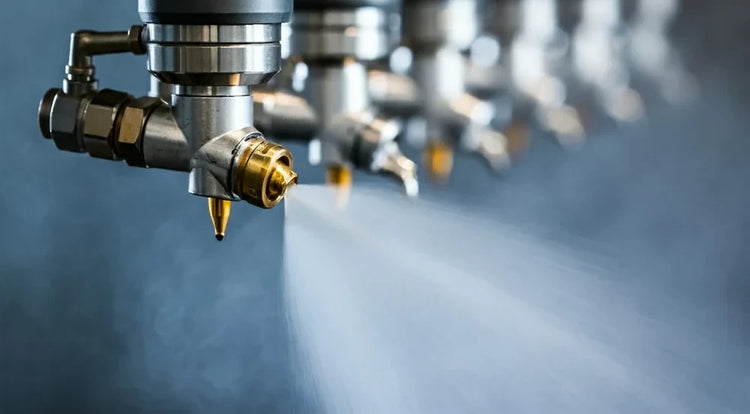
Food & Beverage Wash Systems
Industrial spray nozzles for conveyor washdown, CIP tank cleaning, disinfection, high-pressure cleaning, and produce washing — hygienic construction for food safety compliance
Every stage of food and beverage production touches a spray nozzle — pre-rinse, CIP, sanitization, product application, or final washdown. In regulated food environments, spray nozzle performance is not just an efficiency metric; it directly affects product safety, regulatory compliance, and audit results. A flat-fan nozzle with an enlarged orifice no longer delivers the impact and pattern uniformity needed for FSMA-compliant equipment cleaning. A CIP spray ball that doesn't cover the full vessel interior creates zones of soil accumulation that produce biofilm and cross-contamination risk.
NozzlePro supplies spray nozzles for every food and beverage wash application — sized to your pump, compatible with your chemistry, and built to the hygienic construction standards required for food contact environments. 316L stainless steel, electropolished finishes, crevice-free designs, and FDA-listed elastomers available throughout the range.
Food and beverage wash systems use spray nozzles matched to each cleaning task: flat-fan nozzles for conveyor belt washdown, equipment surface rinsing, and produce pre-rinse — delivering uniform sheeted coverage at controlled flow rates; tank cleaning nozzles (static spray balls and rotary jet cleaners) for CIP cleaning of tanks, vessels, and process equipment providing 360° interior coverage; fog and mist nozzles for disinfectant and sanitant application in enclosed rooms and airspace zones; full-cone nozzles for filling, rinsing, and applications requiring dense volumetric coverage; and high-pressure nozzles for removing tough soils, dried residue, and caked-on product from equipment before chemical sanitation. All food-grade nozzles should be 316L stainless steel with FDA-listed elastomers and crevice-free designs that can be fully cleaned in place.
Food & Beverage Wash System Nozzle Technologies
Shop by application — each matched to the hygiene standard, soil load, and chemical compatibility required
Nozzle Selection by Wash System Application
Match nozzle type to each food and beverage wash application — soil load, hygiene standard, and chemical requirement
| Application | Objective | Recommended Nozzle | Key Requirement | Shop |
|---|---|---|---|---|
| Conveyor Belt Washdown | Remove product residue and soil from belt surfaces between production runs | Flat-Fan | Uniform sheet coverage across full belt width; 316L SS for food contact | Flat-Fan → |
| Equipment Washdown | Clean floors, walls, tables, and equipment surfaces in production areas | Flat-Fan, Full-Cone | Crevice-free stainless nozzles; chemical resistance to caustic and acid cleaners | Cleaning & Washing → |
| CIP Tank & Vessel Cleaning | 360° automated cleaning of tanks, vessels, and process equipment interiors | Static Spray Ball, Rotary Jet | Complete internal surface coverage; validated spray coverage data available | Tank Cleaning → |
| Disinfection & Sanitization | Apply sanitant uniformly to food-contact surfaces and airspace | Flat-Fan, Fog & Mist | Compatible with PAA, quat, hypochlorite, and H₂O₂; PTFE/Viton seals | Disinfection → |
| High-Pressure Pre-Cleaning | Remove tough soils and dried residue before chemical sanitation | High-Pressure, TC Tips | Adequate impact for soil removal; stainless for repeated daily washdown service | High-Pressure → |
| Produce Pre-Rinse & Washing | Remove field soil, debris, and surface residue from fresh produce | Flat-Fan, Full-Cone | Gentle-to-moderate impact matched to product fragility; high-flow for throughput | Flat-Fan → |
| Filling & Product Application | Apply coatings, glazes, oils, or brines to food products on the line | Full-Cone, Fog & Mist | Precise low-flow dosing; FDA-listed wetted materials; consistent film uniformity | Full-Cone → |
| Cooling & Quenching | Rapid product cooling after cooking, pasteurization, or hot-fill processes | Full-Cone, Hollow-Cone | Uniform coverage for consistent cooling rates; stainless for hot water service | Cooling & Quenching → |
Food & Beverage Wash Applications in Detail
Application-specific nozzle guidance for the most common food and beverage cleaning scenarios
Conveyor & Equipment Washdown
Conveyor belts, slicing equipment, filling lines, and packaging machinery accumulate product residue, fats, proteins, and sugars throughout a production shift. Flat-fan nozzle bars positioned across the conveyor width deliver uniform sheet coverage that removes soil mechanically before chemical sanitation — reducing chemical contact time needed and improving sanitation validation results.
- Flat-fan manifold bars sized to belt width for full coverage
- 316L stainless with electropolished finish for food contact
- Crevice-free body designs to prevent biofilm harborage
- Compatible with caustic (pH 12–14) and acid (pH 2–3) CIP chemicals
CIP Tank & Vessel Cleaning
Process tanks, blending vessels, mix tanks, and storage vessels in food and beverage facilities must be cleaned and sanitized between batches and at shift end. Automated CIP spray devices eliminate manual confined space entry, reduce cycle time, and provide documented coverage for FSMA and HACCP validation requirements. Device type is selected from tank diameter, soil load, and available CIP pump flow and pressure.
- Static spray balls for tanks up to ~6 ft diameter with light soils
- Rotary spray heads for larger vessels and moderate soil loads
- High-impact rotary jet cleaners for large tanks with heavy residue
- Spray coverage maps and flow data available for validation documentation
Disinfection & Sanitization
Food processing facilities require scheduled surface and airspace sanitization using chemical agents that are highly corrosive to standard nozzle materials. Peracetic acid, sodium hypochlorite, hydrogen peroxide, and quaternary ammonium compounds each require specific nozzle materials — nozzles that are not chemical-compatible fail rapidly and introduce contamination risk from degraded metal or elastomer components.
- 316L SS with PTFE or Viton seals for PAA and H₂O₂ service
- Flat-fan for food-contact surface sanitant application
- Fog/mist for airspace, room, and enclosed equipment zone fogging
- Avoid brass and zinc in any sanitant contact application
High-Pressure Pre-Cleaning
Chemical sanitation only works on clean surfaces — soil load inactivates sanitants and provides physical protection to microorganisms. High-pressure pre-cleaning removes the bulk of food residue before chemical steps, reducing sanitant consumption and improving log-reduction results. In meat, poultry, and dairy facilities with heavy soil loads, inadequate pre-cleaning is the primary root cause of failing environmental monitoring results.
- 15°–25° flat-fan for equipment surface pre-cleaning impact
- Solid stream for heavy caked-on soil removal at close range
- TC orifice tips where mineral scale and abrasive soils are present
- Stainless construction for daily hot-water and chemical washdown
Produce Washing & Pre-Rinse
Fresh produce washing requires nozzles that deliver sufficient water flow and gentle-to-moderate impact to remove field soil, pesticide residue, and surface contamination without bruising or damaging fragile products. Leafy greens need high-volume, low-impact sheeting; root vegetables and brassicas tolerate more aggressive spray. Throughput — pounds per hour through the wash system — determines flow rate requirements at each nozzle position.
- Flat-fan bars for leafy greens — sheeting action with low impact
- Full-cone for broccoli, root vegetables, and hardy produce
- High-volume sizing to support production throughput requirements
- Stainless construction, easy strip-down for daily sanitation
Brewing, Dairy & Winery CIP
Fermentation tanks, bright beer tanks, dairy silos, and wine storage vessels have specific CIP requirements determined by the soil chemistry (yeast, proteins, sugars, milk fat) and vessel geometry. Nozzle selection must account for the vessel's cylindroconical shape, internal fittings, and the CIP chemical sequence — different nozzle coverage and impact requirements exist for the caustic wash, acid rinse, and sanitization stages.
- Rotary spray heads for fermenters, bright tanks, and dairy silos
- Static spray balls for smaller secondary storage vessels
- Materials documented for sanitary service — MTRs on request
- Hygienic connection standards compatible with existing CIP piping
Hygienic Nozzle Design Requirements for Food & Beverage
What makes a nozzle food-safe — beyond just stainless steel
- Crevice-Free Construction — Any internal crevice, thread gap, or recessed surface in a food-contact spray nozzle is a potential biofilm harborage site. Once biofilm establishes in a crevice, standard CIP chemical concentrations and contact times cannot reach and eliminate it. Food-grade nozzles must have smooth, fully drainable internal surfaces with no dead legs where liquid can pool between cleaning cycles.
- Surface Finish — Ra Values Matter — The internal surface roughness of a food-contact nozzle affects microbial adhesion and cleanability. Electropolished 316L stainless with Ra ≤ 0.8 µm (32 µin) is the standard for food-contact nozzle surfaces in regulated applications. Rougher surfaces allow microorganisms to attach more readily and resist CIP cleaning. Surface finish certificates are available on request for validation documentation.
- Material Compatibility with CIP Chemistry — Food facility CIP sequences typically involve hot caustic (NaOH, 0.5–2% at 60–80°C), acid rinse (phosphoric, nitric, or citric at pH 2–4), and sanitant application (PAA, hypochlorite, or quaternary ammonium). Every wetted material — stainless body, orifice insert, O-rings, and gaskets — must be verified compatible with the full CIP chemical sequence at the temperatures and concentrations used. Material incompatibility causes accelerated corrosion, elastomer degradation, and potential contamination.
- Full Drainability — Nozzles installed in CIP systems must drain completely when flow stops. Pooled cleaning solution or rinse water between cycles creates dilution and temperature gradients that reduce sanitant efficacy in subsequent cycles. Specify nozzles and manifold orientations that allow complete gravity drainage. For tank cleaning devices, verify drip-free design that prevents solution from pooling inside the device body when the CIP pump stops.
- Validation Documentation — FDA 21 CFR Part 110/117 (food) and 21 CFR Part 211 (pharma) require documented cleaning procedures with evidence of effectiveness. Spray coverage maps showing nozzle pattern geometry and flow rate vs. pressure data support cleaning validation and HACCP documentation maintained by the food safety team. NozzlePro provides material certifications, certificates of conformance, and technical data structured for validation use.
Why Choose NozzlePro for Food & Beverage Wash Systems?
Hygienic construction, application sizing, and the right nozzle for every stage of your wash system
Application Engineering for Food Safety Environments
Spray nozzle selection in food and beverage environments intersects with food safety, process efficiency, and regulatory compliance in ways that standard industrial nozzle selection does not. NozzlePro application engineers understand the specific demands of CIP systems, sanitation validation, and food-contact material requirements — and work with your process parameters to specify the correct nozzle type, material, and configuration for each application in your facility.
Hygienic Construction Standards: 316L stainless steel with electropolished finishes (Ra ≤ 0.8 µm available), crevice-free body designs, fully drainable geometry, and FDA-listed elastomers (EPDM, Viton, PTFE) throughout the range. Material certifications, mill test reports, and certificates of conformance provided on request for HACCP and FSMA documentation.
Chemical Compatibility Verified: Every wetted material in each nozzle is verified compatible with the CIP chemistries, sanitants, and operating temperatures used in food facility cleaning programs — including hot caustic, acid rinse, PAA, sodium hypochlorite, and quaternary ammonium sanitants at food-grade concentrations.
ISO 9001 Manufacturing: Consistent orifice tolerances across every production run ensure predictable flow rate and spray pattern performance — critical for CIP systems where nozzle performance is part of the validated cleaning procedure. Dimensional inspection data available on request.
Food & Beverage Industry Segments Served
Wash system nozzles for every food and beverage production environment
Meat & Poultry
High-pressure washdown, carcass rinsing, conveyor cleaning, and antimicrobial spray applications.
Meat & Poultry →Dairy Processing
Milk silo CIP, pasteurization tank cleaning, and hygienic washdown in dairy facilities.
Dairy →Breweries & Wineries
Fermenter and tank CIP, keg cleaning, and sanitation for brewing and winemaking.
Breweries & Wineries →Produce Processing
Fresh produce washing, pre-rinse, and cooling for fresh-cut and whole produce operations.
Food & Beverage →Bakery & Confectionery
Pan greasing, glaze application, and equipment washdown in baking and candy production.
Coating & Application →Beverage Bottling
Bottle rinsing, container washing, conveyor lubrication, and line sanitation.
Food & Beverage →Seafood Processing
High-flow washdown and sanitation for marine protein processing environments.
Cleaning & Washing →Food Ingredient Manufacturing
Tank cleaning and washdown for sugar, starch, oil, and ingredient processing.
Tank Cleaning →Frequently Asked Questions
Common questions about spray nozzles for food and beverage wash systems
What spray nozzles are best for conveyor belt washdown in food processing?
Flat-fan nozzles are the standard for conveyor belt washdown in food processing because they deliver uniform sheeted coverage across the full belt width at controlled flow rates. Nozzles are typically arrayed in manifold bars positioned above and below the belt, with spray angle and standoff distance selected to ensure overlapping coverage with no dry strips. For heavily soiled belts in meat, poultry, or dairy applications, 15°–25° flat-fan nozzles at higher pressure provide more impact energy for soil removal; for lighter soils in bakery or produce applications, 40°–65° angles at lower pressure provide adequate cleaning with less water use. All nozzles in food processing conveyor washdown service should be 316L stainless with electropolished finishes and FDA-listed elastomers.
What is CIP and what spray nozzles are used in CIP systems?
CIP (Clean-In-Place) is the automated internal cleaning of process equipment — tanks, pipes, heat exchangers, and vessels — without disassembly. CIP spray devices for tanks include static spray balls (for tanks up to ~6 ft diameter with light to moderate soils), rotary spray heads (for medium tanks with moderate soils, powered by CIP pump flow), and high-impact rotary jet cleaners (for large vessels and heavy soil loads). The device type is selected based on tank diameter, vessel geometry (baffles, agitators, internal coils), soil type and adhesion, and available CIP pump flow rate and pressure. For FSMA and HACCP compliance, spray coverage data and material certifications are available to support cleaning validation documentation.
What nozzle materials are required for food processing environments?
316L stainless steel (not 304) is required for food-contact spray nozzles because of its superior resistance to pitting corrosion in chloride-containing cleaning and sanitizing solutions (sodium hypochlorite, salt brines) and acidic CIP chemicals. Electropolished finishes to Ra ≤ 0.8 µm reduce microbial adhesion to nozzle surfaces and improve cleanability. Elastomers must be FDA-listed — EPDM for most alkaline CIP products; PTFE or Viton (FKM) for PAA, hydrogen peroxide, and solvent-containing sanitants. Brass, zinc die-cast, and aluminum should not be used in any food-contact or chemical-contact position — they corrode in alkaline and acid CIP environments and introduce heavy metal contamination risk.
How do spray nozzles support FSMA compliance in food facilities?
The FDA Food Safety Modernization Act (FSMA) requires food manufacturers to implement and document preventive controls — including cleaning and sanitation procedures — as part of their Food Safety Plan. Spray nozzles support FSMA compliance in several ways: hygienic construction (crevice-free, electropolished, fully drainable) prevents biofilm harborage sites that would otherwise create chronic microbiological contamination risk; documented spray coverage data confirms that CIP devices reach all internal tank surfaces during validated cleaning procedures; and material certifications provide the documented evidence that wetted materials are food-safe and appropriate for contact with the specific chemicals used in the cleaning program. NozzlePro provides documentation structured to support these requirements on request.
What is the correct nozzle for applying antimicrobial or sanitizing sprays to food-contact surfaces?
Flat-fan nozzles are the standard for applying sanitants to food-contact surfaces — conveyor belts, cutting boards, tables, and equipment surfaces — because they deliver uniform sheeted coverage that ensures consistent chemical concentration and dwell time across the full surface area. For airspace disinfection in enclosed rooms or cold storage areas, fog and mist nozzles (sub-50 µm droplets) are required to achieve airborne suspension of the disinfectant for surface settlement onto vertical walls, ceilings, and equipment undersides. In both cases, nozzle materials must be verified compatible with the specific sanitant: PTFE or Viton seals for peracetic acid and hydrogen peroxide; EPDM is inadequate for oxidizing sanitants and fails rapidly, releasing elastomer degradation products that contaminate the sanitant solution.
How often should food processing spray nozzles be inspected and replaced?
In food processing environments with daily CIP cycles, spray nozzles should be visually inspected and flow-verified at minimum monthly — weekly in high-production facilities with aggressive soil loads or harsh CIP chemistries. Replace nozzles when flow rate deviates more than 10% from rated value at design pressure — enlarged orifices from wear increase water consumption and reduce impact energy below effective cleaning thresholds. For CIP tank spray devices, annual inspection of the device mechanism (for rotary heads) and orifice condition is typical, with replacement when coverage maps from visual dye testing show incomplete internal tank coverage. Nozzle inspection and replacement records should be retained as part of the facility's FSMA Preventive Controls documentation.
Ready to Optimize Your Food & Beverage Wash System?
Share your application, soil load, pump specifications, CIP chemistry, and hygiene standard — we'll specify the right nozzle type, material, and configuration for every stage of your wash system.