
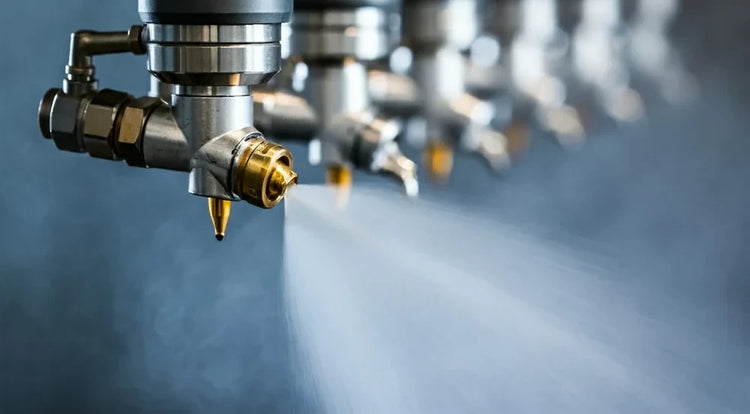

High Pressure Nozzles
Industrial high-pressure spray nozzles deliver concentrated impact force, fine atomization at long throw, or surface-cleaning energy that standard nozzles cannot match. From parts washing at 2,000 PSI to surface preparation at 10,000 PSI, the collection below covers the nozzle bodies, orifice sizes, materials, and spray patterns used in industrial cleaning, coating, and finishing operations. Every nozzle here is rated for continuous-duty industrial service, not consumer pressure-washer applications.


Guide
High Pressure Nozzles: Overview & Selection Tips
This High Pressure Nozzles collection helps engineers compare industrial spray options for Cleaning & Washing, Coating & Surface Treatment, and Pressure Washing. Use it to review spray coverage, pressure, material compatibility, and connection size across related series.
Start with the process result you need, then narrow by flow rate, operating pressure, coverage area, chemical compatibility, and maintenance access. Across the collection, materials may include hardened stainless steel; common inlet sizes include 1/4 in. and 1/8 in. with NPT connections where available; common industries include Automotive, Building Materials, Food & Beverage, and Mining.
Key selection factors
- Common applications include Cleaning & Washing, Coating & Surface Treatment, and Pressure Washing.
- Compare related series such as NPHP, NPHPV, NPHPS, NPHPF, and NPQC.
- Available materials may include hardened stainless steel.
- Check inlet sizes such as 1/4 in. and 1/8 in. with NPT connections where available.
- Frequently selected in Automotive, Building Materials, Food & Beverage, and Mining.
Common applications
- Cleaning & Washing
- Coating & Surface Treatment
- Pressure Washing
How to choose High Pressure Nozzles
- Start with the required flow rate and operating pressure at the nozzle or assembly.
- Choose the high pressure spray pattern that best matches the coverage, impact, atomization, or washdown result you need.
- Confirm material compatibility using options such as hardened stainless steel.
- Finally, verify thread style and inlet size, including 1/4 in. and 1/8 in. with NPT connections where available.
Related collections
Cleaning & Washing | Coating & Surface Treatment | Pressure Washing
What High-Pressure Spray Nozzles Are Used For
Industrial cleaning, surface preparation, and coating application above 1,000 PSI
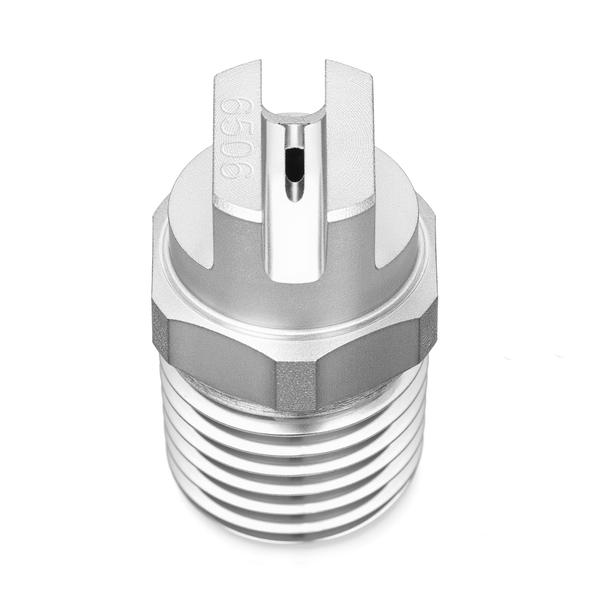
Spray Pattern
High Pressure
Available SKUs
1145 Products
Quality
Industrial Grade
Shipping
Ships Fast
How High Pressure Spray Nozzles Work
Pressure, orifice geometry, and material hardness drive performance and service life
Operating Principle
At pressures above 1,000 PSI, a spray nozzle's behaviour is dominated by orifice geometry and material wear. Pressurised liquid is forced through a precisely sized orifice - round for solid stream, slotted for flat-fan, swirled for cone patterns. Higher pressure produces faster particle velocity (more impact force for cleaning and stripping) and, in atomising designs, finer droplets (better coverage for coating). Flow scales as the square root of pressure: quadrupling pressure doubles flow through the same orifice, which is why oversized pumps are not a fix for an undersized nozzle. The nozzle's job is to deliver that energy in a stable, predictable pattern over thousands of operating hours, even as the orifice slowly wears.
What to Compare
Five specs decide whether a high-pressure nozzle is right for your application:
Orifice size - measured as K-factor or GPM at a reference pressure (usually 1,000 PSI). A K-1.0 nozzle flows 1 GPM at 1,000 PSI, 2 GPM at 4,000 PSI; flow scales with the square root of pressure
Material hardness - 316L stainless for clean water and low-particulate service; hardened tool steel for moderate slurry and 2,000-5,000 PSI duty; tungsten carbide or ceramic for abrasive, high-particulate, or 5,000+ PSI continuous duty
Spray pattern and angle - 0° solid stream for maximum impact and cutting; 15°-25° fan for surface stripping and parts washing; 40°-65° fan for washdown and rinse; cone patterns for atomisation in coating service
Connection and burst rating - threaded vs quick-disconnect; verify your manifold and fittings are rated to at least 4x operating pressure to handle pressure spikes
Standoff distance - high-pressure spray patterns develop fully at 6-24 inches from the nozzle face; closer or farther changes effective impact and pattern shape dramatically, so set standoff before sizing the nozzle
Installation & Maintenance
High-pressure nozzles wear faster than low-pressure equivalents - often 5-10x faster. Industrial operating practice:
Filter the supply - particles larger than 50 microns score the orifice and erode the spray pattern within hours; install an inline filter sized for your fluid and replace it on a fixed schedule, not on visible degradation
Verify pressure under load - a gauge reading at the pump means nothing if the manifold drops pressure to the nozzle; install a tee gauge upstream of the spray bar and read it under full load
Replace by flow, not by sight - measure flow with a bucket and stopwatch monthly; a worn nozzle silently increases consumption by 15-25% and reduces effective impact before the spray pattern visibly degrades
Match torque to material - over-torquing tungsten-carbide nozzles cracks the insert; under-torquing leaks at burst pressure; follow the manufacturer torque spec for the specific body material
Track service life - at 3,000 PSI on filtered clean water, a 316L body runs 1,500-3,000 hours; tungsten carbide at the same conditions runs 8,000-15,000 hours; abrasive service or 8,000+ PSI cuts these numbers 50-90%
High Pressure Nozzle Applications
These Nozzles are essential for waterjet cutting, descaling, hydroblasting, and aggressive surface preparation tasks.
Cleaning & Washing
Support rinsing, washdown, parts cleaning, and surface cleanup with coverage and impact matched to the soil load and line speed.
Coating & Surface Treatment
Apply coatings, chemicals, and pretreatment fluids with repeatable coverage and controlled transfer efficiency.
Pressure Washing
Deliver concentrated impact for heavy soil removal, equipment cleanup, and demanding washdown tasks.
Selecting High Pressure Spray Nozzles
Consider rated pressure, orifice material hardness, jet geometry, and connection type for your high pressure application.
Flow Rate & Pressure
Start with the flow rate you need at the operating pressure available at the nozzle or assembly.
Spray Pattern & Coverage
Choose the high pressure spray pattern that best matches the coverage width, impact, atomization, or washdown result your process requires.
Materials & Connections
Select wetted materials compatible with the fluid, temperature, and wear conditions; common options may include hardened stainless steel; common sizes include 1/4 in. and 1/8 in. with NPT connections where available.
Maintenance & Reliability
Consider clogging risk, wear life, ease of change-out, and the maintenance routine your process can realistically support.
Industries Using High Pressure Nozzles
Steel processing, paper mills, food production, and maintenance operations depend on high pressure nozzles for critical cleaning tasks.
High Pressure Nozzle FAQ
Answers to key questions about high pressure nozzle materials, pressure ratings, and maintenance under demanding conditions.
What is the difference between industrial and consumer high-pressure spray nozzles?
Consumer pressure-washer nozzles are typically polypropylene or brass, rated for 2,000–4,000 PSI intermittent duty, and use a colour-coded quick-disconnect system (red 0°, yellow 15°, green 25°, white 40°). Industrial high-pressure nozzles use hardened stainless steel, tungsten carbide, or ceramic; carry continuous-duty ratings to 10,000+ PSI; and are sized to specific manifold and pump systems rather than universal quick-disconnect. Pattern consistency, orifice life, and burst-pressure margin are all an order of magnitude higher in industrial-grade nozzles, which is why they are specified for production cleaning, coating, and surface-preparation lines.
What pressure range counts as "high pressure" for industrial spray nozzles?
In industrial spray-nozzle terminology, high-pressure service typically starts at 1,000 PSI and runs to 10,000+ PSI. Below 1,000 PSI, standard 316L stainless-steel nozzle bodies have effectively indefinite service life on clean water. Above 1,000 PSI, orifice wear, seat damage, and pattern drift become operational concerns that drive material upgrades to hardened steel, tungsten carbide, or ceramic, plus scheduled flow inspection. Ultra-high-pressure service (above 10,000 PSI) - hydroexcavation, concrete cutting, deep cleaning, uses a separate class of nozzle bodies with reinforced connections and burst-pressure ratings above 30,000 PSI.
Which high-pressure spray nozzle is best for industrial parts cleaning?
For industrial parts cleaning between 2,000 and 5,000 PSI, choose 316L stainless or tungsten-carbide-tipped flat-fan nozzles at a 15°–25° spray angle. The hardened tip handles particulate-laden recirculated solution; the flat-fan pattern delivers even impact across the part surface. Solid-stream (0°) nozzles cut faster but leave stripes; full-cone wastes energy by spraying around the part. Size the GPM to your pump capacity and standoff distance, and verify the spray bar is plumbed with a filter ahead of the nozzles to extend orifice life.
Can these nozzles be used on a contractor or homeowner pressure washer?
No - these nozzles are sized for industrial manifold flow rates, typically 5–50 GPM, while consumer and contractor pressure washers produce 2–6 GPM. Connecting an industrial nozzle to a consumer pressure washer will starve the orifice, produce a weak distorted pattern, and waste both pressure and flow. If you need a nozzle for a consumer or contractor pressure washer, choose a 1/4-inch quick-disconnect colour-coded nozzle sized to your washer's GPM rating. If you are building an industrial wash station from the pump up, the nozzles in this collection are designed for that.
How long should an industrial high-pressure nozzle last?
Service life depends on operating pressure, fluid cleanliness, and duty cycle. As a baseline at 3,000 PSI on filtered clean water, a 316L stainless nozzle lasts 1,500–3,000 hours of continuous operation. Tungsten carbide at the same conditions runs 8,000–15,000 hours. Abrasive service (slurry, particulate, blasting media) or pressures above 8,000 PSI can cut these numbers by 50–90%. The most reliable wear indicator is flow rate at reference pressure, a 10% rise in flow at the same supply pressure means the orifice has worn enough to justify replacement, even if the spray pattern still looks acceptable.
Related High-Intensity Spray Products
Solid stream nozzles and tank cleaning nozzles complement high pressure systems for thorough industrial cleaning.

NPHP
Compare NPHP by spray performance, material compatibility, connection size, and application fit.

NPHPV
Compare NPHPV by spray performance, material compatibility, connection size, and application fit.

NPHPS
Compare NPHPS by spray performance, material compatibility, connection size, and application fit.

NPHPF
Compare NPHPF by spray performance, material compatibility, connection size, and application fit.

NPQC
Compare NPQC by spray performance, material compatibility, connection size, and application fit.

NP-TC
Compare NP-TC by spray performance, material compatibility, connection size, and application fit.
Need Help Selecting the Right Nozzle?
Our engineering team is ready to help you find the perfect spray solution for your application.