
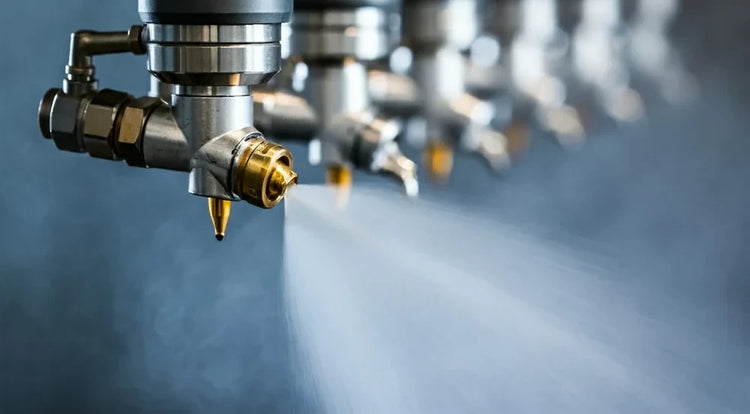

This guide covers the spray nozzle types used in industrial process, cleaning, cooling, coating, and tank-cleaning applications, the categories you'll specify when selecting nozzles for manufacturing, food and beverage processing, chemical processing, pharmaceutical production, and industrial maintenance. We compare flat fan, hollow cone, full cone, solid stream, air-atomizing, and pneumatic nozzles by spray pattern, droplet size, pressure range, and best-fit applications.
For agricultural sprayer nozzle selection (boom sprayers, drift reduction, herbicide and pesticide delivery), see our dedicated guide to air-assisted nozzles for agricultural spraying, the principles are similar but the selection criteria, pressure ranges, and regulatory considerations are different enough to warrant separate treatment.
Last updated: 2026-05-13 by NozzlePro engineering.
Table of Contents
- Quick Classification of Spray Nozzle Types
- Flat Fan Spray Nozzles
- Hollow Cone Spray Nozzles
- Full Cone Spray Nozzles
- Solid Stream Spray Nozzles
- Air-Atomizing Spray Nozzles
- Specialty Industrial Nozzles
- How to Choose the Right Spray Nozzle Type
- Critical Spray Nozzle Performance Characteristics
- Industrial Applications of Spray Nozzles
- A Note on Agricultural Spray Nozzles
- Recent Developments in Industrial Spray Nozzle Technology
- Frequently Asked Questions About Spray Nozzle Types
- Conclusion
Key Takeaways
- Choosing the right spray nozzle type depends on factors like droplet size, spray angle, and flow rate.
- Nozzle identification codes help you match the right nozzle to your job, so it's good to know how to read them.
- Hydraulic nozzles (like flat fan, hollow cone, and full cone) each have specific uses and benefits.
- Modern spray nozzles now feature advanced materials making them more reliable and easier to monitor.
Quick Classification of Spray Nozzle Types
Most nozzles fall into these core spray patterns:
| Nozzle Type | Pattern Shape | Typical Use | Notes |
|---|---|---|---|
| Flat fan spray nozzle | Line/fan | Washing, coating, rinsing | Needs overlap (tapered) |
| Full cone spray nozzle | Solid circle | Cooling, washing | More impact than hollow cone |
| Hollow cone spray nozzle | Ring | Gas cooling, scrubbing, fine coverage | Finer droplets |
| Solid stream / jet spray nozzle | Tight jet | Descaling, cutting, blasting | Highest impact |
| Air atomizing spray nozzle | Mist | Coating, humidification | Needs compressed air |
| Tank cleaning spray nozzle | Rotating patterns | CIP, tanks | Coverage-focused |
Whether you're searching for a specific spray pattern or need help navigating our complete range, our industrial spray nozzles collection offers precision-engineered solutions for every application.
Flat Fan Spray Nozzles
Flat fan nozzles release a thin, even sheet of liquid across a set width, providing reliable coverage for large surfaces or rows. Within the major nozzle families, flat fan spray nozzles dominate cleaning, coating, and rinsing lines, their uniform tapered-edge pattern overlaps cleanly across a conveyor or wash bar.
Key Points:
- Tapered flat fans need overlap between spray patterns for even coverage
- Even flat fans don't need overlap and are good for targeted bands
- Common uses: surface coating, conveyor cleaning, cooling, rinsing
| Feature | Tapered Flat Fan | Even Flat Fan |
|---|---|---|
| Overlap Needed | Yes | No |
| Typical Application | Broad-line coverage | Row banding |
| Drop Size | Small–medium | Medium |
For NozzlePro's full inventory of flat fan spray nozzles across pressure ranges, materials, and connection types, browse the collection page.
Hollow Cone Spray Nozzles
Hollow cone nozzles produce a spray pattern shaped like a ring, a hollow core with most droplets at the edges. This design is ideal for gas cooling, scrubbing, and rinse-aid distribution where sheeting action at the perimeter matters more than uniform center-fill coverage.
- Creates fine to medium droplets
- Well-suited for cooling towers, scrubbers, and chemical gas-liquid contact
- Effective where droplets need to concentrate at the spray perimeter
Browse hollow cone spray nozzles by spray angle and flow rate to find the right design for your application.
Full Cone Spray Nozzles
Full cone nozzles deliver a filled circular spray pattern with droplets distributed evenly throughout the cone. This type suits situations where thorough wetting is needed — washing, cooling, fire protection, and chemical treatment.
| Attribute | Hollow Cone | Full Cone |
|---|---|---|
| Pattern Shape | Ring/hollow cone | Solid/full cone |
| Droplet Distribution | Edges | Even throughout |
| Typical Use | Gas cooling, scrubbing | Cleaning, cooling, washing |
- Effective for dust suppression, cooling equipment, and rinsing tanks
- Better suited for processes where thorough, full-surface contact is required
- Used across general industrial and process applications
See full cone spray nozzles for the complete range of patterns and pressure capabilities.
Solid Stream Spray Nozzles
Solid stream nozzles produce a tight, concentrated jet, the highest-impact pattern available from a hydraulic nozzle. These are the right choice when mechanical force is the primary mechanism: descaling, cutting, blasting, and high-pressure spot cleaning of hardened deposits.
- Delivers maximum impact energy per unit of flow
- Used in descaling lines, cutting applications, and high-pressure washdown
- Not suited for broad area coverage, pattern is intentionally concentrated
For high-impact and concentrated-jet applications, see solid stream spray nozzles.
Air-Atomizing Spray Nozzles
Air-atomizing nozzles blend liquid and compressed air to create a fine mist, producing droplets much smaller than hydraulic atomizing nozzles — typically 10 to 100 microns. This gives precise control over droplet size for demanding applications like humidification, evaporative cooling, spray drying, and fine coating.
| Nozzle Type | Pressure (psi) | Typical VMD (microns) |
|---|---|---|
| Air Atomizing | 10 | 20 |
| Flat Fan (hydraulic) | 40 | 260 |
| Hydraulic Atomizing | 100 | 375 |
NozzlePro's air-atomizing nozzles include both internal and external mixing designs across stainless steel and brass options.
Internal Mixing Air-Atomizing Nozzles
Internal mixing air-atomizing nozzles combine liquid and compressed air inside the nozzle body before discharge, producing the finest droplet sizes available from a non-ultrasonic design, typically 10 to 50 microns. The internal mixing chamber gives precise control over droplet uniformity, which is critical for applications like fuel oil atomization, humidification, evaporative cooling, and gas conditioning where droplet consistency drives process efficiency. The trade-off is that fluid pressure must roughly match air pressure at the mix point, so they're not ideal for low-pressure or gravity-fed liquid feeds. NozzlePro's complete atomizing nozzles guide covers the engineering math behind internal mixing in more detail.
External Mixing Air-Atomizing Nozzles
External mixing nozzles introduce liquid and compressed air outside the nozzle body, at the discharge point. This makes them tolerant of a wider range of liquid pressures, viscosities, and slurry-bearing fluids, anything that would clog or wear an internal mixing chamber. Droplet sizes are slightly larger and less uniform than internal mixing (typically 20–100 microns), but the design is far more forgiving and is the right choice for applications like spray drying with viscous feedstock, coating with slurry-bearing paints, and chemical injection where the liquid line is not pressurized at process levels.
Impinging Air-Atomizing Nozzles
Impinging air-atomizing nozzles use two or more colliding air or liquid jets to break the liquid into droplets through the kinetic energy of the impact, rather than relying purely on shear at the air-liquid interface. The impinging geometry produces very fine droplets at lower air consumption than equivalent internal or external mixing designs, and is the standard choice for applications where compressed-air cost is a primary operating expense, high-throughput coating lines, large-area gas conditioning, and continuous humidification systems. For sizing the air-to-liquid ratio in an impinging or any air-atomizing design, use the spray nozzle flow rate calculator.
Specialty Industrial Nozzles
Twin-Fluid Spray Nozzles
Twin fluid (or two-fluid) nozzles are a specific subset of air-atomizing nozzles that use both compressed air and liquid for spraying. This type is especially effective when:
- A wide operational range from ultra-fine mist to larger drops is required
- Viscous or temperature-sensitive materials must be sprayed
- Applications call for flexibility without swapping hardware
Industries using twin fluid atomizing nozzles benefit from adjustable droplet size and the ability to manage more challenging spray tasks without downtime.
High-Precision Chemical Application Nozzles
In modern industrial settings, exact placement of chemicals or lubricants is critical. Specialty precision nozzles offer:
- Narrow, pinpoint patterns to target small areas
- Reduced drift and overspray, limiting waste and environmental exposure
- Consistent metering for dosing accuracy, especially in lab or cleanroom processes
Tank-Cleaning Spray Nozzles (Static and Rotating)
Tank-cleaning nozzles are designed for internal washdown of process vessels, tanks, totes, and IBCs, applications where stationary external-spray patterns leave shadow zones that allow product residue or microbial growth to accumulate. Two main families exist: static spray balls, which use perforated hemispherical or full-sphere heads to flood the tank wall at low pressure (typically 30–50 psi), and rotating tank-cleaning heads, which use the kinetic energy of the cleaning fluid to spin one or more jets in a programmed coverage pattern at higher impact pressures (50–500 psi). Static designs are simpler, cheaper, and ideal for clean-in-place (CIP) chemistry-driven cleaning where impact isn't the primary mechanism. Rotating designs are required when soils need mechanical impact, burnt-on residues, hardened deposits, or post-process build-up. See tank-cleaning spray nozzles for the full NozzlePro lineup.
Eductor Nozzles
Eductor nozzles are a unique design used inside a fluid bath or tank rather than spraying into open air. The nozzle uses a high-velocity motive jet to entrain and circulate the surrounding bath fluid through a venturi geometry, producing a mixing or agitation flow that's typically 4–5 times the nozzle's own through-flow. Eductors are the standard solution for keeping plating baths, parts-washer immersion tanks, and CIP loops in continuous motion without requiring external recirculation pumps, saving capital cost, energy, and floor space. They're also used for tank destratification and for keeping chemical concentrations uniform in storage tanks. See eductor nozzles for sizing and material options.
How to Choose the Right Spray Nozzle Type
Key Selection Criteria
Start with the process objective, what you need the spray to do, not what the spray should look like. Then narrow by five parameters in this order:
- Flow rate at your operating pressure
- Spray pattern that matches the surface geometry
- Wetted material compatible with your fluid and temperature
- Connection size that fits your manifold
- Droplet-size requirement for the process (broad cleaning tolerates large droplets; coating and conditioning need fine atomization)
Most selection mistakes happen when buyers start from pattern shape instead of process objective.
| Pressure (psi) | Flow Rate (gpm) | Typical Droplet Size (µm) |
|---|---|---|
| 20 | 0.3 | 400 |
| 40 | 0.4 | 250 |
| 80 | 0.6 | 165 |
To size flow rate against operating pressure for your specific application, use the spray nozzle flow rate calculator.
Reading Spray Nozzle Numbers & Codes
Most manufacturers label nozzles with angle + flow + material codes. This code helps users quickly identify:
- Nozzle type (e.g., flat fan, full cone)
- Orifice size (affects flow rate)
- Spray angle (degree of coverage)
- Construction material (critical for harsh chemicals)
For example, a nozzle marked "11002-VP" breaks down to:
- 110° spray angle
- 02 = flow rate (in gpm at standard pressure)
- VP = material or manufacturer code
Matching Nozzle Types to Specific Applications
| Application | Recommended Nozzle Type |
|---|---|
| Conveyor washing / coating lines | Flat Fan |
| Cooling, fire protection | Full Cone |
| Gas cooling, scrubbing | Hollow Cone |
| Descaling, high-impact cleaning | Solid Stream |
| Humidification, fine coating | Air-Atomizing |
| Internal vessel / tank washdown | Tank-Cleaning (static or rotating) |
| In-bath agitation | Eductor |
Critical Spray Nozzle Performance Characteristics
Droplet Size and Distribution
The size of droplets your nozzle produces shapes everything, from how a chemical hits a surface to whether it drifts. Larger droplets (200+ microns) deliver more impact but less surface contact area, making them ideal for cleaning and dust suppression. Smaller droplets (10–100 microns) provide much higher surface contact area, making them ideal for coating, humidification, and evaporative cooling.
| Nozzle Pressure (psi) | Typical Droplet Size (microns) |
|---|---|
| 20 | 500–700 |
| 40 | 300–500 |
| 80 | 150–300 |
For atomizing and air-atomizing applications, you can estimate the droplet size your nozzle will produce at a given pressure and flow with the droplet size calculator.
Spray Angle and Coverage
The angle at which the nozzle sprays affects the width and depth of coverage:
- Wide angles give broad, shallow coverage, good for blanket-coverage applications
- Narrow angles reach further and hit smaller targets, useful for spot treatments
- Consistent overlap is necessary to avoid dry or over-wet patches
Flow Rate and Operating Pressure
Flow rate tells you how much liquid comes out per unit of time. Pressure works with flow to define spray energy and reach:
- Higher pressure: smaller drops, but risk of drift
- Lower pressure: larger drops, less drift, but reduced atomization
- Low-pressure, high-volume for large area coverage
- High-pressure, low-volume for fine mist or tight targets
Industrial Applications of Spray Nozzles
Industrial Cleaning & Washdown Systems
Cleaning applications demand the right balance between impact force and coverage to remove residues without wasting water or energy.
- Flat fan nozzles are used for conveyor and surface cleaning where even, overlapping coverage is required
- Full cone nozzles provide thorough wetting for general washdown and internal equipment rinsing
- Solid stream or jet nozzles are selected for high-impact cleaning tasks involving hardened deposits or scale
For nozzles specifically selected for cleaning and washdown service across patterns and materials, see our industrial spray nozzles for cleaning and washing collection.
Cooling, Quenching, and Heat Control
Spray cooling relies on uniform liquid distribution and consistent droplet size to control temperature effectively.
- Full cone spray patterns are widely used for uniform cooling across large surfaces
- Hollow cone nozzles produce finer droplets for faster evaporation and improved heat transfer
- Material selection and nozzle durability are especially important in high-temperature environments
Cooling and quenching applications most often use hydraulic atomizing nozzles selected for high pressure and abrasion-resistant materials.
Coating, Lubrication, and Chemical Application
Applications involving coatings, lubricants, or chemicals require precise droplet control and consistent spray geometry.
- Air atomizing nozzles are used where fine droplets and controlled application are critical
- Flat fan spray patterns support uniform coating thickness in linear or continuous processes
- Stable spray patterns reduce overspray, material waste, and rework
For food and beverage process applications specifically (FDA, USDA, 3-A compliant materials), see food and beverage washdown nozzles.
CIP Systems & Tank Cleaning
Tank and equipment cleaning systems depend on spray coverage geometry and impact energy.
- Static spray devices are used for light-duty rinsing and sanitation
- Rotary spray heads and rotary jet nozzles deliver higher-impact cleaning for larger tanks and heavy residues
- Proper spray overlap and rotation prevent shadow zones and incomplete cleaning
Both static and rotating tank cleaning spray nozzles are available for vessel and tote washdown.
Fire Protection & Dust Suppression
- Full cone nozzles are commonly used in fire protection and deluge systems
- Hollow cone and fogging nozzles are used for dust suppression where fine droplets bind airborne particles
- Consistent spray performance is critical for regulatory compliance and system effectiveness
Mining & Material Handling
Mining operations require spray nozzles that can perform reliably in abrasive, high-dust, and high-wear environments. Full cone and hollow cone nozzles are commonly used for dust control and material handling, while specialized designs are selected for washdown, cooling, or chemical application depending on the process. Explore our mining nozzles collection for nozzle options designed for demanding industrial environments.
A Note on Agricultural Spray Nozzles
This guide covers the spray nozzle types used in industrial settings, manufacturing, processing, cleaning, and infrastructure applications. Agricultural spray nozzles share many of the same underlying patterns (flat fan, hollow cone, full cone) but are selected against different criteria: drift reduction, droplet-size regulations for herbicide and pesticide application, and the specific pressure/flow ranges produced by boom sprayers and aerial application equipment. If you're selecting nozzles for crop spraying, drone application, or vineyard sprayers, see our guide to air-assisted nozzles for agricultural spraying, the rest of this article focuses on industrial use.
Recent Developments in Industrial Spray Nozzle Technology
Industrial spray nozzle design has seen meaningful, established changes in three areas worth noting for selection decisions:
Advanced Materials
Hardened stainless steel grades, ceramic-tip inserts, and silicon carbide nozzles have become widely available for abrasive-fluid service. These materials extend wear life from hundreds of hours (standard stainless) to thousands of hours in slurry, abrasive cleaning, or particulate-bearing service, justifying their higher up-front cost in continuous-duty applications.
| Material Type | Core Benefit | Common Use Case |
|---|---|---|
| Hardened Stainless Steel | Extended wear life in abrasive service | Slurry, descaling, mining |
| Ceramic-Tip Inserts | High abrasion resistance | High-pressure abrasive fluids |
| Silicon Carbide | Maximum hardness, chemical resistance | Corrosive + abrasive combined service |
| Engineered Plastics | Lightweight, corrosion-resistant | Food, beverage, light chemical |
Engineered Spray Patterns and Adjustable Designs
Modern nozzle catalogs include patterns engineered for specific cleaning, coating, and conditioning duty cycles, narrower-angle flat fans for line coverage, ultra-fine air-atomizing nozzles for evaporative cooling, and adjustable-pattern designs for variable-process lines. The trade-off remains the same: more pattern flexibility per nozzle, slightly less pattern consistency than a single-purpose design.
Process Monitoring and Performance Validation
For high-stakes industrial applications, real-time flow-rate monitoring at the nozzle (rather than at the pump) has become practical with inexpensive in-line flow sensors. Pair monthly flow-rate readings against a baseline-at-install measurement to catch orifice wear and clogging before they affect process quality.
Frequently Asked Questions About Spray Nozzle Types
What are the main types of industrial spray nozzles?
The main industrial spray nozzle types are flat fan (used for line coverage and rinses), hollow cone (gentle area sheeting and rinse-aid distribution), full cone (uniform area coverage with moderate impact), solid stream (concentrated high-impact spot cleaning and dust suppression), and air-atomizing (fine droplets for spray drying, humidification, and coating). Specialty types include tank-cleaning nozzles (for internal vessel washdown), eductor nozzles (for in-bath agitation), and twin-fluid designs.
How do I choose the right spray nozzle type for an industrial application?
Start with the process objective, what you need the spray to do, not what the spray should look like. Then narrow by five parameters in this order: flow rate at your operating pressure, spray pattern that matches the surface geometry, wetted material compatible with your fluid and temperature, connection size that fits your manifold, and droplet-size requirement for the process. Most selection mistakes happen when buyers start from pattern shape instead of process objective.
What's the difference between flat fan, full cone, and hollow cone nozzles?
Flat fan nozzles produce a narrow, elliptical pattern best for overlapping line coverage, rinsing belts, conveyors, and flat surfaces. Full cone nozzles produce a uniform circular pattern with droplets distributed across the full footprint, best for area coverage where uniform impact matters. Hollow cone nozzles produce a circular pattern where droplets concentrate at the ring perimeter rather than the center, best for sheeting action, rinse-aid distribution, and gas-liquid contact applications like cooling towers and scrubbers.
What spray nozzle types are best for cleaning and washdown applications?
The right choice depends on the soil and the surface. Flat fan and solid stream nozzles are used for high-impact spot cleaning of stubborn residue. Full cone and hollow cone nozzles are used for general washdown and rinse cycles. Static and rotating tank-cleaning nozzles are required for internal vessel washdown where stationary patterns leave shadow zones. For a complete cleaning-application overview, see our industrial spray nozzles for cleaning and washing collection.
What's the difference between air-atomizing and hydraulic atomizing nozzles?
Hydraulic atomizing nozzles use only the liquid's own pressure to break it into droplets, simple, no compressed air required, droplet size typically 50–500 microns. Air-atomizing nozzles add a compressed-air stream to shear the liquid into much finer droplets, typically 10–100 microns, at the cost of compressed-air consumption. Use hydraulic atomizing when droplet size below 100 microns isn't required; use air-atomizing for spray drying, humidification, fine coating, or evaporative cooling where droplet uniformity drives process efficiency.
What does a spray nozzle code or part number mean?
Spray nozzle codes encode the nozzle's design family (a 2–4 letter prefix), spray angle (a 2-digit number for flat fan and cone patterns), and orifice size (a number that maps to flow rate at the reference pressure, typically 40 psi). For example, in a NozzlePro NPP-50-100 part number, "NPP" indicates the flat-fan family, "50" indicates a 50-degree spray angle, and "100" indicates the orifice size code that corresponds to 1.0 GPM at the reference pressure. Manufacturer code formats vary, but the underlying logic, pattern + angle + size, is consistent.
How does droplet size affect spray nozzle performance?
Droplet size determines what the spray actually does at the target surface. Larger droplets (200+ microns) deliver more impact per droplet but less surface contact area, making them ideal for high-impact cleaning, washdown, and dust suppression. Smaller droplets (10–100 microns) provide much higher surface contact area, making them ideal for coating, humidification, gas conditioning, and evaporative cooling. Droplet size scales inversely with both nozzle pressure and the air-to-liquid ratio (in air-atomizing designs).
How often should industrial spray nozzles be replaced?
Service life depends on material, pressure, and the abrasiveness of the spray fluid, not calendar time. Hardened-stainless nozzles in clean-water service can run 2,000–10,000 hours before pattern degradation; standard stainless in caustic CIP service typically runs 500–2,000 hours; brass in light-duty washdown runs 1,000–4,000 hours. Most industrial users find scheduled replacement on a usage-hour basis costs less per year than reactive replacement after a quality failure. Establish a baseline flow rate at install and check monthly, a 10% flow increase usually signals orifice wear.
Can different spray nozzle types be combined in one system?
Yes. Many industrial systems use multiple nozzle types in a single header or in sequential stages, a high-impact solid-stream pre-rinse to dislodge heavy soil, followed by full-cone or flat-fan nozzles for area coverage, finished with an air-atomizing or hollow-cone rinse for residual removal. Matching the right nozzle to each stage is one of the highest-leverage process optimizations in industrial cleaning and coating lines.
Where can I find a flow rate or droplet size calculator for spray nozzle selection?
NozzlePro publishes free engineering calculators for each step of spray nozzle selection: the spray nozzle flow rate calculator for sizing GPM against operating pressure, the droplet size calculator for estimating atomization at given pressure and flow, the nozzle velocity calculator for impact-force estimation, and the spray coverage calculator for area-coverage sizing.
Conclusion
Choosing the right spray nozzle type comes down to understanding your process first — the surface geometry, the fluid properties, the operating pressure, and what you need the spray to accomplish. Flat fan, full cone, hollow cone, solid stream, air-atomizing, and specialty industrial nozzles each serve distinct functions, and selecting the right one at each stage of a system is one of the highest-leverage decisions in industrial process design.
If you're unsure where to start, use NozzlePro's spray nozzle flow rate calculator to size your application, or browse by nozzle type using the collection links throughout this guide.


