
Humidificación y
Control Atmosférico en Salas Blancas
La humedad relativa en un entorno de fabricación farmacéutica no es un parámetro de confort, es una variable de proceso y seguridad que afecta directamente la calidad del producto, la seguridad del personal y el rendimiento del equipo. Demasiado baja: se acumula carga electrostática en los equipos de manipulación de polvos, causando segregación de polvos, ensuciamiento de equipos y, en áreas de fabricación de OSD donde hay polvo fino de API, el potencial de ignición de polvo combustible. Demasiado alta: los API higroscópicos absorben humedad, alterando los valores de ensayo y los perfiles de disolución; las prensas de tabletas se bloquean por el recubrimiento; los adhesivos de los envases fallan. La humedad correcta en cada punto de la instalación se define en el plan de monitoreo ambiental y es impuesta por el sistema de humidificación.
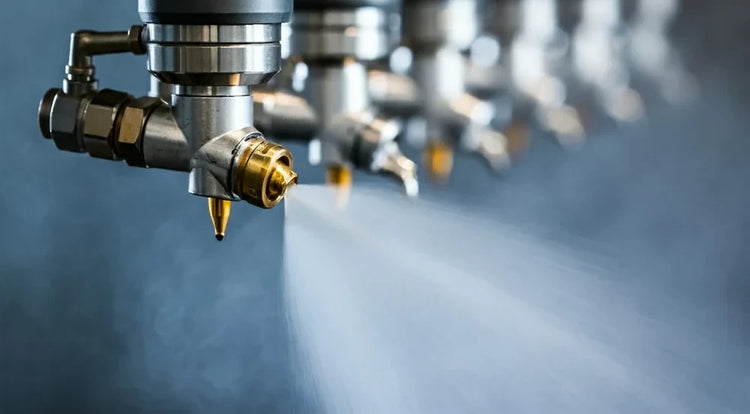
La humidificación industrial agrega humedad al aire para lograr una humedad relativa objetivo. Esa definición sencilla oculta las restricciones adicionales que la humidificación farmacéutica debe satisfacer simultáneamente. El agua utilizada debe ser Agua Purificada (AP) o Agua para Inyección (WFI) —no agua del grifo, no agua ablandada, no agua de ósmosis inversa— porque las gotas aerosolizadas producidas por la boquilla de humidificación se convierten en parte del ambiente de aire clasificado. Cualquier contaminación microbiana en el suministro de agua se aerosoliza directamente en el aire del área de fabricación. Cualquier contenido mineral en el agua se deposita en las superficies de los equipos, los materiales de empaque y, potencialmente, en el producto.
Los materiales de la boquilla deben ser compatibles con los estándares de construcción de sistemas de AP y WFI: acero inoxidable 316L electropulido a Ra ≤ 0.4 µm, sin patas muertas en el colector de suministro donde el agua pueda estancarse y favorecer la formación de biopelículas. El tamaño de gota producido debe ser lo suficientemente pequeño como para evaporarse antes de llegar a cualquier superficie; las gotas que se depositan en el equipo, el producto o el empaque crean puntos húmedos que son sitios de crecimiento microbiano y contaminación visible. Y el sistema debe responder a las señales de control de humedad sin sobrepasar, porque un sobrepaso por encima del 65% de HR en una sala OSD es una excursión ambiental que requiere una entrada de investigación en el registro de monitoreo ambiental.
Disipación estática, refrigeración evaporativa, humidificación de zona estéril y manejo de API higroscópicos
Disipación electrostática en la manipulación de polvos
Salas OSD, salas de molienda y áreas de manipulación de APIEl procesamiento de polvos farmacéuticos —molienda, mezcla, granulación y llenado— genera carga electrostática en las partículas de polvo mediante carga triboeléctrica: cada colisión de partícula a partícula y de partícula a superficie del equipo transfiere carga, y a baja humedad relativa no hay suficiente humedad superficial para proporcionar la vía de migración de iones necesaria para disipar esa carga a tierra. El resultado son nubes de polvo cargadas que se adhieren a las paredes del equipo en lugar de fluir libremente, polvo cargado que se segrega por tamaño de partícula a medida que las fuerzas electrostáticas superan la mezcla impulsada por la gravedad, y —en los casos más graves— nubes de polvo cargadas en presencia de una fuente de ignición que presentan un riesgo de explosión de polvo combustible.
Mantener la HR por encima del 40% proporciona suficiente humedad en todas las superficies no metálicas para crear conductividad superficial que drena la carga acumulada a tierra continuamente. Por debajo del 35% de HR, la generación de carga del procesamiento de polvos supera significativamente la disipación, y los equipos de manipulación de polvos —tolvas, conductos, carcasas de mezcladores y equipos de llenado— acumulan carga que puede alcanzar decenas de kilovoltios en relación con la tierra. El sistema de humidificación es el control de ingeniería principal para este peligro, y la boquilla que mantiene la humedad de la habitación es el hardware en el centro de ese control.
Refrigeración evaporativa — Gestión de carga térmica
Prensas de tabletas, granuladores, sartenes de recubrimiento y empaque de alta velocidadLos equipos de fabricación farmacéutica de alta velocidad generan cargas térmicas sustanciales en un entorno de sala limpia acondicionada. Una sola prensa de tabletas de alta velocidad que funciona a 300,000 tabletas por hora genera 10–30 kW de calor debido a la fricción de la matriz de compresión y las pérdidas del motor. Una fila de ocho prensas de tabletas en una sala de compresión OSD genera 80–240 kW de carga térmica total que el sistema HVAC debe rechazar, típicamente en el aire de retorno que fluye en condiciones de diseño de 18–22°C. Cuando el margen de capacidad de enfriamiento del HVAC es insuficiente para manejar las cargas térmicas máximas durante la operación de verano —una condición común en instalaciones diseñadas con especificaciones mínimas— la temperatura de la sala se eleva por encima del rango de operación validado, lo cual es tanto una desviación GMP como un riesgo para la calidad del producto en operaciones de compresión sensibles a la temperatura.
El enfriamiento evaporativo mediante una fina neblina de agua proporciona una eliminación de calor suplementaria con un costo de capital y operativo sustancialmente menor que la adición de capacidad de refrigeración mecánica al sistema HVAC. Cuando las gotas de agua de 5–15 µm se evaporan en el aire de la sala, cada gramo de agua que se evapora absorbe aproximadamente 2,260 julios de calor latente del aire —un mecanismo de enfriamiento altamente eficiente que reduce la temperatura de bulbo seco del aire sin agregar agua líquida al ambiente de la sala. El efecto de enfriamiento se logra completamente en la fase aérea; ninguna agua líquida entra en contacto con las superficies del equipo o el producto.
Humidificación de Zonas Estériles
Áreas de llenado aséptico, suites de liofilización y zonas de soporte de Grado BLa humidificación en áreas de llenado aséptico y zonas de soporte estériles de Grado B opera bajo restricciones de calidad de material y agua más estrictas que la humidificación de áreas OSD. El Anexo 1 de las GMP de la UE exige que los entornos de Grado A y Grado B mantengan los recuentos de partículas dentro de los límites de clasificación ISO 14644-1; cualquier sistema de humidificación que agregue partículas al entorno de aire clasificado es una desviación de las GMP. La boquilla de humidificación y su colector de suministro son instalaciones permanentes dentro o adyacentes al área clasificada; cada componente debe ser no desprendedor de partículas en las condiciones de servicio y compatible con WFI en todo momento.
Manipulación de API higroscópicos y áreas controladas de baja humedad relativa
Suites deshumidificadas para API sensibles a la humedad y operaciones de empaqueNo todas las áreas de fabricación farmacéutica requieren humidificación; el desafío opuesto existe para los API altamente higroscópicos y las formas farmacéuticas sensibles a la humedad que requieren procesamiento por debajo del 30-35% de HR. Tabletas efervescentes, formulaciones dispersables, sistemas de administración de fármacos activados por humedad y muchos productos liofilizados se procesan en suites deshumidificadas donde el sistema HVAC está diseñado para lograr y mantener condiciones de baja humedad. En estas áreas, el sistema de humidificación desempeña un papel secundario: agregar pequeñas cantidades controladas de humedad durante la entrada del personal y el arranque del equipo para evitar una acumulación excesiva de estática en las condiciones iniciales de muy baja humedad antes de que el equipo y el personal alcancen el equilibrio térmico con la sala.
Carga electrostática en el procesamiento de polvos farmacéuticos: la física, los riesgos y el umbral de HR
El umbral del 40% de HR para la disipación electrostática en las áreas de manipulación de polvos farmacéuticos no es un número regulatorio arbitrario; es el punto en el que la humedad superficial de los materiales no metálicos se vuelve suficiente para crear una vía continua de migración de iones que drena la carga triboeléctrica a tierra más rápido de lo que el procesamiento del polvo la genera. Comprender el mecanismo explica por qué una HR por debajo de este umbral es un problema de seguridad del proceso, no solo una preocupación por la calidad del producto.
Carga triboeléctrica en el procesamiento de polvos
Cuando dos materiales con diferentes afinidades electrónicas entran en contacto y luego se separan, los electrones se transfieren del material de menor afinidad al material de mayor afinidad. En el procesamiento de polvos farmacéuticos, este ciclo de contacto y separación ocurre con alta frecuencia: cada partícula que impacta una pared de tolva metálica, un revestimiento de bolsa de polietileno, una carcasa de mezclador de acero inoxidable o otra partícula transfiere carga. A altas tasas de procesamiento —una operación de molienda que produce 100 kg/hora de API micronizado genera millones de contactos partícula-superficie por segundo— la carga se acumula en la nube de polvo y en las superficies del equipo más rápido de lo que puede disiparse a través de las vías de conducción disponibles.
Con una HR superior al 40%, delgadas películas de humedad cubren las superficies no metálicas con una capa de agua que proporciona conductividad iónica; los iones móviles (principalmente H⁺ y OH⁻ de la humedad superficial) migran bajo el campo eléctrico creado por la carga acumulada, transportando la carga a tierra a través de la red de películas de humedad. Por debajo del 35% de HR, estas películas de humedad se adelgazan hasta el punto en que su conductividad iónica disminuye drásticamente; la tasa de disipación de carga cae por debajo de la tasa de generación y la carga se acumula. El parámetro crítico no es el nivel de carga absoluto, sino la relación entre la tasa de generación y la tasa de disipación: en una operación de molienda de alto rendimiento por debajo del 35% de HR, esta relación puede producir tasas de acumulación de carga que alcanzan niveles incendiarios a los pocos minutos del inicio.
Muchos API y excipientes farmacéuticos entran en las categorías de polvo combustible de la OSHA cuando se encuentran en forma de partículas finas. La lactosa, el almidón, la celulosa, muchos compuestos API y algunos polímeros de recubrimiento son combustibles en forma de polvo con tamaños de partícula inferiores a 500 µm. La energía mínima de ignición (MIE) de las nubes de polvo farmacéutico fino puede ser tan baja como 1-10 milijulios, un rango dentro del cual se puede producir una descarga electrostática de una nube de polvo cargada a una superficie conectada a tierra. Mantener la HR por encima del 40% en las áreas de manipulación de polvo es una medida de prevención de explosiones clasificada según la NFPA 654 (Norma para la Prevención de Incendios y Explosiones de Polvo en la Fabricación, Procesamiento y Manejo de Sólidos Particulados Combustibles), así como una medida de control de calidad del producto. Los ingenieros de HVAC e instalaciones que especifican sistemas de humidificación para áreas de manipulación de polvo OSD deben verificar la clasificación de polvo combustible de los API y excipientes procesados en esas áreas.
Tamaño de la gota de la boquilla y el requisito de evaporación antes de la sedimentación
El requisito funcional para una boquilla de humidificación de área farmacéutica —que las gotas se evaporen completamente antes de asentarse en cualquier superficie— determina el tamaño máximo de gota admisible en las condiciones de funcionamiento. En las condiciones típicas de fabricación farmacéutica (20 °C, temperatura del aire de suministro con altura de techo de 18 a 22 m, velocidad del aire ambiente de 0.3 a 0.5 m/s), el tiempo de evaporación de una gota de agua de diámetro d en aire en calma escala aproximadamente como d² — una gota de 20 µm se evapora en aproximadamente 0.5 segundos, mientras que una gota de 50 µm tarda aproximadamente 3 segundos. A una velocidad del aire ambiente de 0.3 m/s, una gota de 50 µm se asienta 0.9 metros antes de evaporarse, lo suficiente como para depositarse en una tolva de prensa de comprimidos o en la superficie de la maquinaria de envasado.
El tamaño máximo de gota permitido está, por lo tanto, limitado por la altura del techo por encima del equipo, la velocidad del aire ambiente y la temperatura y humedad en la boquilla. Las boquillas atomizadoras de aire NozzlePro para humidificación de áreas farmacéuticas producen un Dv90 (el diámetro de gota por debajo del cual se contiene el 90% del volumen) inferior a 15-20 µm en condiciones de funcionamiento estándar, lo que está dentro de la ventana de evaporación para entornos de fabricación farmacéutica. Especificar la presión de funcionamiento de la boquilla y la relación aire-agua sin verificar el tamaño de gota resultante en las condiciones reales de la sala no es una especificación adecuada para un sistema de humidificación de área clasificada.
- Colocar los sensores de HR en el punto de interés, en el equipo de procesamiento de polvo, no en la rejilla de retorno de aire; la HR del aire de retorno de HVAC es un promedio de todo el volumen de la sala y se retrasa minutos con respecto a los cambios localizados de HR en el equipo; un sensor en la prensa de tabletas o mezcladora proporciona una respuesta de control más rápida y evita tanto los eventos estáticos de baja HR como las excursiones de humedad de alta HR en el producto
- Verificar la conductividad del agua purificada (PW) en la conexión de suministro de la boquilla, no en la tubería principal, ya que la conductividad del PW puede aumentar entre la tubería principal y una ramificación de humidificación debido al estancamiento del agua en la línea de la ramificación; monitorear la conductividad en el punto de la ramificación para confirmar que se mantiene la calidad del PW hasta la boquilla.
- Sanitizar el colector de suministro de humidificación en el mismo horario que el circuito de distribución de PW; la rama de humidificación es una extensión del sistema de PW; si el circuito principal se sanitiza semanalmente con agua caliente, el colector de humidificación debe incluirse en ese ciclo de sanitización; un colector sanitizado en un horario diferente al del circuito principal crea un riesgo de reinoculación de la carga biológica en el punto de reconexión.
- Incluir el sistema de humidificación en el programa de monitoreo ambiental: el muestreo de aire periódico aguas abajo de las boquillas de humidificación durante la operación es la prueba práctica de que el sistema no está agregando carga biológica al aire del área clasificada; un recuento de placas positivo de una muestra tomada en la zona de pulverización de la boquilla que excede los límites de alerta activa una investigación microbiana de la fuente de agua y la condición de la boquilla.
Gestión de la carga térmica sin refrigeración mecánica: cómo funciona el enfriamiento evaporativo en un área farmacéutica clasificada
Los sistemas HVAC farmacéuticos están diseñados para cargas de enfriamiento definidas, pero la generación de calor del equipo de fabricación cambia con las campañas de productos, las velocidades de producción y las adiciones de equipos. El enfriamiento evaporativo proporciona un rechazo de calor suplementario flexible y de bajo capital que los ingenieros de HVAC pueden implementar sin modificar la planta HVAC principal.
La psicrometría del enfriamiento evaporativo suplementario en una sala farmacéutica
El principio de funcionamiento es psicrométrico: la evaporación adiabática de agua en aire no saturado reduce la temperatura de bulbo seco mientras que la temperatura de bulbo húmedo permanece constante. En un área de fabricación farmacéutica a 20 °C y 45% de HR, la temperatura de bulbo húmedo es aproximadamente 13.5 °C y el punto de rocío es aproximadamente 8 °C. La evaporación de agua en este aire mueve la condición a lo largo de la línea de bulbo húmedo: la temperatura disminuye a medida que aumenta la humedad, y cada gramo de agua evaporada elimina aproximadamente 2.26 kJ del aire como calor latente.
El límite práctico para el enfriamiento evaporativo en la habitación es la temperatura de bulbo húmedo; la temperatura de bulbo seco no puede caer por debajo de la temperatura de bulbo húmedo solo por evaporación. En el ejemplo de 20 °C/45% de HR, el enfriamiento evaporativo máximo disponible es de aproximadamente 6.5 °C de reducción de la temperatura de bulbo seco, lo que se logra aumentando la humedad del 45% al 100% de HR. En la práctica, el límite superior de humedad del área farmacéutica del 60-65% de HR significa que el rango de enfriamiento evaporativo disponible es de aproximadamente 2-3 °C de reducción de la temperatura de bulbo seco, modesto pero suficiente para absorber las cargas de calor máximas del equipo sin elevar la temperatura de la habitación por encima del rango de operación validado.
El interbloqueo del límite máximo de HR es un requisito GMP
Un sistema de enfriamiento evaporativo que opera hasta que la temperatura de la habitación alcanza el punto de ajuste, sin considerar el límite de HR, excederá el límite superior de humedad durante eventos de alta carga de calor. Una lectura de HR superior al 65% en un área de fabricación farmacéutica es una excursión de monitoreo ambiental que requiere una entrada de investigación que documente la causa, la duración y la evaluación del impacto en cualquier producto en el área en ese momento. El interbloqueo entre el control de pulverización de enfriamiento evaporativo y el sensor de HR de la habitación no es una ingeniería opcional; es la medida de control que evita que una acción de gestión de temperatura genere una excursión de humedad en el registro de monitoreo ambiental. Las boquillas atomizadoras de aire NozzlePro son compatibles con válvulas de control neumáticas y solenoides de encendido/apagado estándar; la lógica de control se implementa en el sistema de gestión de edificios, no en el hardware de la boquilla.
- Calcular la tasa máxima de pulverización a partir de la depresión del bulbo húmedo disponible y la tasa de cambio de aire de la habitación antes de especificar el número y tamaño de las boquillas; sobredimensionar el sistema de enfriamiento evaporativo produce una rápida sobrecarga de HR; la tasa máxima de pulverización continua es la tasa que aumenta la HR en no más del 5% de HR por hora a la tasa de cambio de aire de diseño, con el interbloqueo de HR proporcionando la protección final.
- Utilizar ciclos de pulverización pulsados en lugar de un funcionamiento continuo para un control preciso de la temperatura; una boquilla que funciona con un ciclo de trabajo del 50% (alternando 30 segundos encendida, 30 segundos apagada) suministra la mitad de agua por hora que un funcionamiento continuo manteniendo una HR constante; la frecuencia de los pulsos se puede ajustar mediante el sistema de gestión del edificio para ajustar la salida de enfriamiento sin necesidad de un funcionamiento de boquilla de presión variable que altere el tamaño de la gota.
- Verificar que la presión y el caudal de suministro de PW sean estables en la conexión de la boquilla de humidificación durante los períodos de máxima demanda de HVAC; la presión de la tubería principal de PW puede disminuir durante los períodos de alta demanda cuando varias ramas están activas simultáneamente; una caída de presión en la conexión de la boquilla de humidificación cambia la relación aire-agua de atomización de la boquilla y desplaza el tamaño de la gota hacia arriba, lo que puede producir gotas lo suficientemente grandes como para asentarse en las superficies del equipo.
- Documentar las activaciones del sistema de enfriamiento evaporativo en el registro de la instalación: cada evento de activación, su duración y las lecturas de HR y temperatura al inicio, pico y final del evento forman la base para demostrar el control ambiental en el área en cualquier momento dado; este registro se revisa durante las inspecciones de la FDA y las GMP de la UE como evidencia de que los parámetros ambientales se mantuvieron dentro de los rangos validados durante la producción.
Selección de boquillas de humidificación por clasificación de área y función
Póngase en contacto con NozzlePro con la clasificación de su sala, la altura del techo, la tasa de cambio de aire, la calidad del suministro de agua y el punto de ajuste de HR. La selección de boquillas de humidificación farmacéutica está limitada por la física de evaporación de las gotas y los requisitos de materiales del área clasificada, no solo por el caudal.
| Área y función | Tipo de boquilla | Tamaño de la gota | Requisito crítico | Suministro de agua |
|---|---|---|---|---|
| Compresión/mezcla OSD — disipación estática (Grado C/D) | Atomización por aire, alta presión | Dv90 <15 µm | Evaporación completa antes de la sedimentación; sensor de HR a nivel del equipo; suministro de agua purificada (PW); colector sin puntos muertos | Agua purificada (PW) |
| Sala de molienda/micronización — control de polvo estático y combustible | Atomización por aire, alta presión | Dv90 <15 µm | Cumplimiento de NFPA 654; verificar la clasificación de polvo combustible del API; HR mantenida por encima del 40% continuamente durante las operaciones | Agua purificada (PW) |
| Suite de prensa de tabletas — enfriamiento evaporativo suplementario | Atomización por aire, control pulsado | Dv90 <15 µm | Interbloqueo de límite superior de HR obligatorio; calcular la tasa máxima de pulverización a partir de la depresión de bulbo húmedo disponible; boquilla sobre la fuente de calor en el flujo de aire de retorno | Agua purificada (PW) |
| Soporte para área de llenado aséptico Grado B — humidificación de zona estéril | Atomización por aire, totalmente metálica de acero inoxidable 316L | Dv90 <10 µm | Suministro de WFI; componentes que no desprenden partículas; sanitizado con el circuito de WFI; cumplimiento del recuento de partículas Grado A/B | Agua para inyección (WFI) |
| Área de carga del liofilizador: control de humedad durante la transferencia | Atomización por aire, dosificación precisa | Dv90 <10 µm | HR estrictamente controlada durante la transferencia de viales para evitar la cristalización prematura del producto parcialmente congelado; suministro de WFI; sin humectación de superficie | Agua para inyección (WFI) |
| Envasado / operaciones secundarias (Grado D) | Atomización por aire o ultrasónica | Dv90 <20 µm | Evitar fallos en el sellado de blísteres por baja HR; suministro de agua purificada (PW); evitar una humidificación excesiva que cause fallos en la adhesión de etiquetas en cajas de cartón | Agua purificada (PW) |
| Exclusa de baja HR en suite — control estático de entrada de personal | Atomización por aire, aplicación dirigida | Dv90 <15 µm | Disipación estática localizada en el punto de vestimenta; no eleva la HR de la sala por encima del límite de procesamiento del producto; suministro de PW; cuerpo de acero inoxidable 316L | Agua purificada (PW) |
Materiales para la humidificación farmacéutica
Acero inoxidable 316L electropulido a Ra ≤ 0.4 µm en todo el circuito de suministro de PW/WFI. Sellos de PTFE o silicona para compatibilidad con WFI. Sin puntos muertos en el colector de suministro. Todos los materiales del cuerpo de la boquilla deben ser no desprendibles de partículas en entornos de Grado A/B.
La humedad controla los peligros. La boquilla controla la humedad.
La carga estática en las suites de polvo, la sobrecarga de calor en las salas de compresión y el cumplimiento del recuento de partículas en las áreas clasificadas tienen un sistema de humidificación en el centro. Póngase en contacto con NozzlePro con la clasificación de su sala, la altura del techo, la tasa de cambio de aire, la calidad del suministro de agua y el rango de punto de ajuste de HR.