
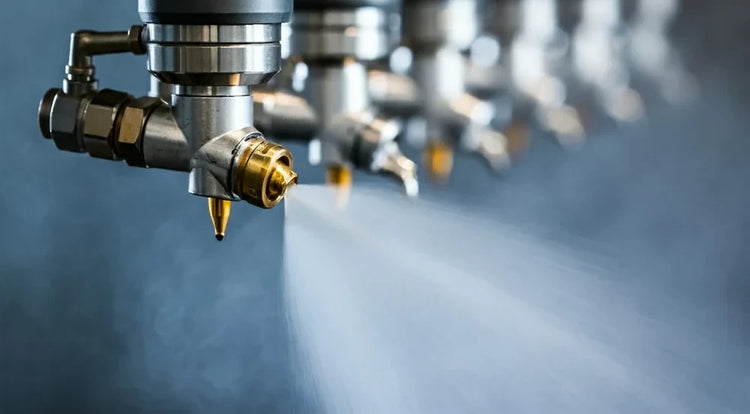
Nozzles for Steel & Metals
Compare spray nozzles and assemblies used in Steel & Metals by application fit, material compatibility, pressure, and service requirements.


Guide
Steel & Metals Nozzles: Overview & Selection Tips
This Steel & Metals collection highlights spray nozzles and assemblies commonly selected for Steel & Metals operations. It helps engineers compare process fit, spray performance, material options, and maintenance requirements.
Common spray tasks in this environment include Cleaning & Washing, Coating & Surface Treatment, Cooling & Quenching, and Humidification & Conditioning. Final selection depends on chemistry, pressure, coverage requirements, and how easily the Nozzle or assembly can be maintained on the line.
Key selection factors
- Common spray tasks in this industry include Cleaning & Washing, Coating & Surface Treatment, Cooling & Quenching, and Humidification & Conditioning.
- Compare spray performance, chemical compatibility, and maintenance fit for the production environment.
- Material options may include 316L stainless steel, brass, 303/304 stainless steel, and hardened stainless steel.
- Check inlet sizes such as 1/4 in., 1/8 in., 3/8 in., and 1/2 in. with NPT connections where available.
Common applications
- Cleaning & Washing
- Coating & Surface Treatment
- Cooling & Quenching
- Humidification & Conditioning
How to choose Steel & Metals
- Start with the required flow rate and operating pressure at the nozzle or assembly.
- Choose the spray pattern and coverage style that best matches the coverage, impact, atomization, or washdown result you need.
- Confirm material compatibility using options such as 316L stainless steel, brass, 303/304 stainless steel, and hardened stainless steel.
- Finally, verify thread style and inlet size, including 1/4 in., 1/8 in., 3/8 in., and 1/2 in. with NPT connections where available.
Related collections
Cleaning & Washing | Coating & Surface Treatment | Cooling & Quenching | Humidification & Conditioning
High-Performance Spray Nozzles for Steel and Metals Processing
Steel industry spray nozzles withstand extreme heat, scale, and abrasive conditions to deliver consistent performance in mills and foundries.

Spray Pattern
Multiple spray patterns
Available SKUs
6604 Products
Quality
Industrial Grade
Shipping
Ships Fast
Spray Nozzles in Steel and Metals Processing
Descaling, quenching, and cooling Nozzles operate at high pressures and temperatures to remove scale and control metal properties during rolling.
Operating Context
Steel & Metals operations use spray solutions for tasks such as Cleaning & Washing, Coating & Surface Treatment, Cooling & Quenching, and Humidification & Conditioning.
What to Compare
Compare spray performance, material compatibility, including 316L stainless steel, brass, 303/304 stainless steel, and hardened stainless steel, and connection details such as 1/4 in., 1/8 in., 3/8 in., and 1/2 in. with NPT connections where available.
Selection Guidance
Start with the process objective, then narrow by chemistry, coverage, pressure, and maintenance access for the equipment on your line.
Steel and Metals Spray Applications
Applications include high-pressure descaling, continuous caster cooling, rolling mill quenching, and heat treatment line spraying.
Cleaning & Washing
Support rinsing, washdown, parts cleaning, and surface cleanup with coverage and impact matched to the soil load and line speed.
Coating & Surface Treatment
Apply coatings, chemicals, and pretreatment fluids with repeatable coverage and controlled transfer efficiency.
Cooling & Quenching
Control part temperature and process heat with spray coverage sized for the required cooling rate and heat removal.
Humidification & Conditioning
Produce droplets suited to humidity control, evaporative conditioning, and air treatment tasks.
Selecting Nozzles for Steel and Metals
Steel mill Nozzles must handle high pressures, elevated temperatures, and scale-laden water — material and orifice design are critical.
Flow Rate & Pressure
Start with the flow rate you need at the operating pressure available at the nozzle or assembly.
Spray Pattern & Coverage
Choose the spray pattern and coverage style that best matches the coverage width, impact, atomization, or washdown result your process requires.
Materials & Connections
Select wetted materials compatible with the fluid, temperature, and wear conditions; common options may include 316L stainless steel, brass, 303/304 stainless steel, and hardened stainless steel; common sizes include 1/4 in., 1/8 in., 3/8 in., and 1/2 in. with NPT connections where available.
Maintenance & Reliability
Consider clogging risk, wear life, ease of change-out, and the maintenance routine your process can realistically support.
Steel and Metals Industries Using Spray Nozzles
Integrated steel mills, mini mills, aluminum rolling, copper smelting, and metal casting operations all depend on industrial spray nozzles.
Steel Industry Spray Nozzle FAQ
Common questions about descaling nozzle pressures, quench cooling uniformity, wear resistance, and maintenance in steel mill environments.
What spray tasks are common in Steel & Metals?
Steel & Metals operations commonly use spray solutions for Cleaning & Washing, Coating & Surface Treatment, Cooling & Quenching, and Humidification & Conditioning.
Which nozzle types are common in Steel & Metals?
The best Nozzle type depends on whether the process needs wide coverage, high impact, fine atomization, targeted rinsing, or easier maintenance access.
How do I choose Spray Nozzles for Steel & Metals?
Start with the exact process step, then narrow by flow rate, operating pressure, fluid chemistry, coverage target, and maintenance requirements.
What spray pattern works best in Steel & Metals?
The best spray pattern and coverage style depends on the process result you need, the available pressure, and how the spray has to interact with the part, surface, or environment.
What materials should I consider for Steel & Metals?
Material selection should match chemistry, temperature, abrasion, and hygiene requirements; common options may include 316L stainless steel, brass, 303/304 stainless steel, and hardened stainless steel.
What inlet sizes and connections are common in Steel & Metals?
Common options vary by series, but many lines compare sizes such as 1/4 in., 1/8 in., 3/8 in., and 1/2 in. with NPT connections where available.
How do pressure and flow affect Nozzle selection in Steel & Metals?
Flow rate and pressure determine coverage, impact, and droplet formation, so they should be defined before the final series is chosen.
Which processes in Steel & Metals are most likely to need maintenance-focused Nozzle choices?
Processes with abrasive media, sticky fluids, scale buildup, or limited access usually benefit from designs that are easier to service or replace.
How can I reduce clogging and wear in Steel & Metals spray systems?
Match material and orifice design to the fluid and contamination level, then verify filtration, cleaning practices, and replacement intervals.
When should I contact NozzlePro about Steel & Metals applications?
Reach out when the process has tight performance requirements, difficult chemistry, sanitation demands, or multiple candidate Nozzle types to compare.
Related Heavy-Duty Spray Products
High pressure, flat fan, and full cone nozzles in hardened alloys are the standard Nozzle types in steel processing systems.

NPHU
Compare NPHU by spray performance, material compatibility, connection size, and application fit.

NP3U
Compare NP3U by spray performance, material compatibility, connection size, and application fit.

NPHV
Compare NPHV by spray performance, material compatibility, connection size, and application fit.

NPHVL
Compare NPHVL by spray performance, material compatibility, connection size, and application fit.

NPQV
Compare NPQV by spray performance, material compatibility, connection size, and application fit.

NPSJ
Compare NPSJ by spray performance, material compatibility, connection size, and application fit.

NPHSJ
Compare NPHSJ by spray performance, material compatibility, connection size, and application fit.

NPQU
Compare NPQU by spray performance, material compatibility, connection size, and application fit.
Need Help Selecting the Right Nozzle?
Our engineering team is ready to help you find the perfect spray solution for your application.