

Key Takeaways:
-
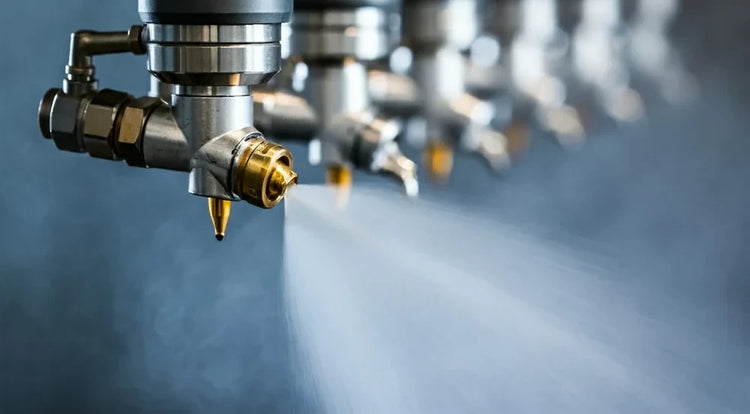
Spray pattern geometry and droplet size directly impact efficiency, chemical usage, cooling rates, and production costs across industrial applications
-
Different nozzle types create distinct patterns: flat fan nozzles for targeted coverage, full cone nozzles for impact cleaning, and hollow cone spray nozzles for fine misting
-
Droplet size is controlled by pressure, nozzle design, and air assistance, with air atomizing nozzles producing the finest droplets for precision coating
- Matching the right spray pattern to your process prevents common issues like uneven distribution, excessive chemical waste, and inadequate coverage
Why Spray Pattern & Droplet Size Matter in Industrial Applications
Most engineers focus on industrial spray nozzle material but overlook pattern geometry and droplet spectrum. The spray pattern controls where your liquid goes, while droplet size determines what happens when it gets there. Get either wrong, and you waste chemicals, burn energy, or produce inconsistent results.
At NozzlePro, we've seen companies cut chemical usage by 30% just by switching spray patterns. Understanding these fundamentals will save you money whether you're cleaning tanks, cooling steel, or coating products.
The Science Behind Spray Patterns
What Is a Spray Pattern?
A spray pattern is the liquid's "footprint." Main patterns include flat fan (narrow sheet), full cone (solid circular coverage), hollow cone (ring-shaped), solid stream (concentrated jet), and fine mist (tiny suspended droplets). The pattern determines coverage width and distribution uniformity.
How Spray Patterns Are Created (Nozzle Internal Engineering)
Orifice shape determines initial breakup. Swirl chambers in hollow cone nozzles spin liquid before exit. Pressure drop tears liquid into droplets. Air mixing in air atomizing nozzles uses compressed air for ultra-fine particles, giving control independent of liquid pressure.
Visualizing Common Spray Patterns
A flat fan nozzle creates a curtain of liquid. A full cone nozzle produces a filled circle. A hollow cone nozzle makes a donut shape. Understanding these geometries helps calculate nozzle spacing for complete coverage.
Understanding Droplet Size (Droplet Spectrum)
What Is Droplet Size & Why Does It Matter?
Engineers measure droplet distribution using Dv0.1, Dv0.5 (median), and Dv0.9 values. Droplet size controls evaporation speed, impact force, surface coverage, and airborne behavior. Coatings need uniform small droplets. Dirty tanks need larger droplets with momentum.
Factors That Influence Droplet Size
Pressure is primary—higher PSI creates smaller droplets. Flow rate changes velocity through the orifice. Nozzle type matters enormously. Air assistance fine-tunes atomization. Fluid viscosity and temperature affect breakup resistance.
Typical Droplet Size Ranges for Nozzle Types
Flat fan nozzles produce 200-500 microns for controlled impact. Full cone nozzles create 400-1000 microns for heavy cleaning. Hollow cone spray nozzles generate 100-300 microns for cooling. Air atomizing nozzles deliver 10-100 microns for coating. Fogging nozzles create 5-50 microns for dust suppression.

How Spray Pattern Impacts Industrial Performance
1. Cleaning Efficiency (Impact Force & Coverage)
Larger droplets from full cone and fan spray nozzles carry more kinetic energy, hitting surfaces harder. A full cone nozzle provides 360-degree coverage for CIP and tank cleaning. A flat fan gives targeted linear coverage.
2. Cooling & Humidification (Evaporation Efficiency)
Fine mist from hollow cone and air atomizing nozzles absorbs heat quickly through high surface area. Tiny droplets evaporate almost instantly, making them ideal for cooling applications.
3. Chemical Coating & Lubrication (Uniformity = Quality)
Air atomizing nozzles produce consistent, fine droplets that create smooth, even layers, reducing waste, improving finish quality, and lowering reject rates.
4. Dust Suppression & Airborne Particle Control
Fog nozzles producing 50-150 micron droplets bind airborne dust optimally. Too large and droplets fall; too small and they drift.
5. Fire Protection Applications
Full cone spray nozzles deliver predictable, overlapping patterns meeting fire code requirements where reliability matters most.
Key Engineering Variables That Influence Spray Pattern & Droplet Size
1. Pressure (PSI)
Higher pressure creates smaller droplets, wider angles, and higher flow. Most industrial spray nozzles operate between 40-100 PSI. Air atomizing nozzles work at lower liquid pressures (10-30 PSI).
2. Spray Angle
Angles range from 15 to 120 degrees. Narrow angles concentrate flow for reach. Wide angles provide faster nearby coverage.
3. Flow Rate
Higher flow creates slightly larger droplets and more impact but each nozzle has an optimal range.
4. Distance from Target (Standoff Distance)
As distance increases, coverage grows, impact decreases, and droplets have more time to evaporate or drift.
5. Fluid Properties
Higher viscosity resists breakup, requiring higher pressure, air atomizing nozzles, or specialized designs. Temperature affects viscosity and atomization.
Accurately calculating flow rate ensures your spray system operates at peak efficiency. Try our flow rate calculator to determine the optimal settings for your cleaning application.
Matching Spray Pattern to Industrial Applications
Cleaning (Surface, CIP, and Tank Cleaning)
For cleaning, you need impact and coverage. Recommended nozzle types:
-
Full cone nozzles for tank interiors and 3D surfaces
-
Flat fan nozzles for conveyor belts and flat walls
- Rotating nozzles for large tank diameters
The goal is to deliver enough force to dislodge deposits while covering every surface. Calculate your impact force requirements based on the type of soil you're removing.
Cooling, Humidification & Evaporative Processes
For maximum evaporation efficiency:
-
Hollow cone nozzles for general cooling (100-300 microns)
-
Misting nozzles for evaporative cooling (20-100 microns)
- Air atomizing nozzles for precision humidification (10-50 microns)
The finer your droplets, the faster they evaporate and absorb heat. But remember: ultra-fine droplets drift easily, so factor in air currents and ventilation.
Coating, Chemical Application & Adhesives
Coating quality demands uniformity. Air atomizing nozzles are the gold standard because they give you independent control over liquid and air pressure, allowing you to dial in exactly the droplet size and flow rate you need.
For lower-volume applications, precision fan spray nozzles can work, but you sacrifice some uniformity. Match your nozzle selection to your quality requirements and production speed.
Agriculture & Sprayer Systems
Farm sprayers typically use flat fan nozzles for row crops and hollow cone nozzles for orchards. The canopy density and target (leaves vs. soil) determines which pattern works best.
Drift is a major concern, so droplet size matters. Too fine, and wind carries chemicals away. Too coarse, and you get poor leaf coverage.
Dust Control & Fogging Systems
Dust suppression systems need fogging nozzles that produce 50-150 micron droplets. These bind airborne particles without creating puddles or wet surfaces.
Position nozzles to create a curtain of mist at dust generation points (conveyor transfer points, crushers, loading zones). The mist should be dense enough to capture particles but not so heavy that it creates visibility issues or wet floors.
Also read: Drone Spraying Nozzles: The Future of Farming
Common Spray Pattern Problems & How to Fix Them

Uneven Spray Distribution
Causes include worn orifices, clogged passages, and misalignment. Solutions: install proper filtration, establish replacement intervals, and check alignment.
Droplet Size Too Large or Small
Wrong pressure or nozzle type causes issues. Measure actual operating pressure. Switch to air atomizing nozzles for finer droplets when pressure increases aren't feasible.
Streaking, Banding, or Weak Coverage
Wrong spray angle or insufficient overlap causes gaps. Recalculate coverage at actual standoff distance. Most applications need 100% overlap.
How to Select the Right Spray Pattern & Droplet Size
Step 1: Define Your Process Objective
Identify whether you need cleaning (impact and coverage), cooling (evaporation), coating (uniformity), or humidification (airborne mist).
Step 2: Determine Required Droplet Spectrum
Small (10-100 microns) for coating, medium (100-400 microns) for cooling, or large (400-1000 microns) for cleaning.
Step 3: Select Pattern Geometry
Flat fan for linear targets, full cone for 3D surfaces, hollow cone for misting, or solid stream for impact.
Step 4: Verify Flow, Pressure & Coverage Specs
Calculate required flow, available pressure, nozzle spacing, and total nozzles needed. NozzlePro's engineering team provides specification sheets and verification.
When to Use Advanced Nozzles (Air Atomizing, Two-Fluid, Precision Nozzles)
Standard hydraulic spray nozzles work great for most applications. But some processes demand more:
Ultra-fine atomization: When you need droplets under 50 microns consistently, air atomizing nozzles are your only practical option. They can produce 10-20 micron droplets without requiring extreme liquid pressure.
Low pressure, high precision: If your liquid supply pressure is limited (gravity feed, low-pressure chemical tanks), air atomizing spray nozzles let you achieve fine atomization using compressed air energy instead of liquid pressure.
Controlled coating: Two-fluid nozzles give you independent control over liquid flow and atomizing air, so you can optimize both coverage rate and droplet size independently. This level of control is essential for high-quality finishing operations.
Viscous fluids: Thick adhesives, lubricants, or heavy oils won't atomize well in standard nozzles. Air assistance provides the energy needed to break up viscous fluids into usable droplets.
Maintenance Tips to Maintain Spray Pattern & Droplet Quality
Even the best nozzle won't perform if it's worn or dirty. Follow these maintenance practices:
Scheduled cleaning: Remove nozzles monthly (or more often in dirty environments) and clean passages with appropriate solvents or ultrasonic cleaners. Never use metal tools that could scratch precision orifices.
Flow-rate tests: Measure actual flow at operating pressure quarterly. A 10-15% increase in flow typically indicates wear that's affecting spray quality. Most performance degradation happens before you can see obvious wear with your eyes.
Nozzle wear indicators: Track operating hours or gallons sprayed. Establish replacement intervals based on nozzle material:
-
Brass: shortest life, good for clean fluids and light duty
-
Stainless steel: 3-5x longer than brass, handles moderate abrasion
- Carbide: 10-20x longer than brass, essential for abrasive slurries
Filtration: Install and maintain adequate filtration. A $50 filter protects thousands of dollars worth of nozzles. Use 50-100 mesh (depending on smallest nozzle orifice) and check pressure drop across filters to know when to clean or replace them.
For more detailed troubleshooting guidance, see our air nozzle maintenance guide.
A Few Case Study Examples

Case Study 1: A food processing plant was using flat fan nozzles for CIP tank cleaning. Switching to properly sized full cone nozzles reduced cleaning cycle time by 40% while using 25% less water and chemicals. The nozzles provided better impact force and complete 3D coverage that flat fans couldn't match.
Case Study 2: A steel mill was experiencing inconsistent cooling rates with full cone nozzles. Replacing them with hollow cone spray nozzles producing 150-micron droplets improved evaporation efficiency by 30%, resulting in more uniform product properties and reduced water consumption.
Case Study 3: An automotive parts manufacturer struggled with coating defects (runs, sags, thin spots) using hydraulic nozzles. Upgrading to air atomizing nozzles with 40-micron droplets cut reject rates from 8% to under 2%, paying for the new system in less than six months through reduced material waste alone.
Conclusion
Spray pattern determines where liquid goes; droplet size determines what happens when it gets there. Match both to your process to minimize waste, reduce energy consumption, improve quality, and cut downtime.
At NozzlePro, we help engineers solve spray challenges with the right nozzle technology, pattern geometry, and droplet optimization.
Contact NozzlePro's technical engineering team today to identify the ideal spray pattern and droplet size for your system.


