
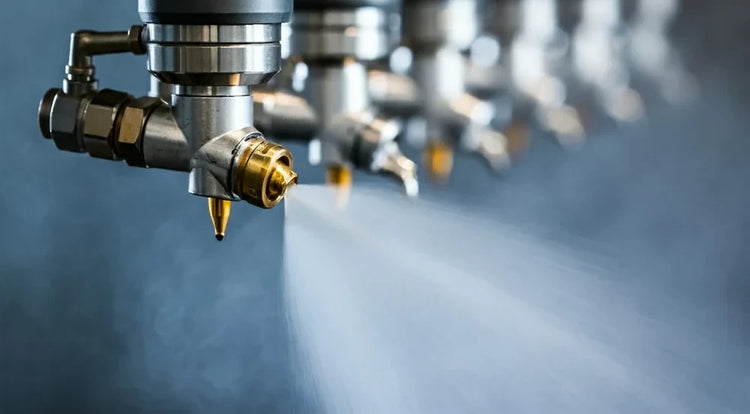

If you've ever walked past an outdoor misting system on a hot day and felt that instant relief, you already understand the basic idea behind evaporative cooling. But in industrial settings, getting that cooling effect right is a lot more nuanced than just spraying water into the air. The nozzle you choose, the droplet size it produces, and how the system is set up all play a massive role in whether your setup actually works or just wastes water and energy.
Evaporative cooling and humidification nozzles are used across a surprising range of industries. Data centres rely on them to manage heat loads without massive energy bills. Greenhouses use them to keep crops happy during summer. Textile manufacturers depend on precise humidity control to keep fibres from breaking. Food processing facilities use misting to maintain freshness. If any of these sound familiar, this guide is for you.
We'll walk through the science, the nozzle types, how to optimise your system, and how to pick the right setup for your specific needs. For a broader overview of spray patterns, see our spray nozzle types guide.
Key Takeaways
-
Droplet size is the single biggest factor in evaporative cooling efficiency. Smaller droplets evaporate faster and cool more effectively.
-
Different applications need different nozzle types. Dry fog nozzles work for data centres; hydraulic nozzles suit greenhouses and outdoor cooling.
-
Water quality directly affects nozzle performance and lifespan. High mineral content speeds up clogging and wear.
- Regular maintenance and proper nozzle placement can dramatically reduce water waste and improve system output.
How Evaporative Cooling Works: The Science Behind Misting Systems

The Physics of Evaporative Heat Transfer
When water evaporates, it absorbs heat from the surrounding air. This is called the latent heat of vaporisation, and it's the reason you feel cold when you step out of a pool on a breezy day. In industrial misting systems, this same principle is applied at scale.
The process is called adiabatic cooling. Water is broken into tiny droplets and released into an airstream. As those droplets evaporate, they pull thermal energy out of the air, dropping the temperature without any refrigeration equipment needed. Psychrometric principles help engineers calculate exactly how much cooling is possible based on air temperature and relative humidity. The drier the air, the more cooling potential you have.
Why Droplet Size Determines Efficiency
This is where it gets interesting. The smaller the water droplet, the faster it evaporates, and the more cooling you get per litre of water used. It comes down to surface area. A fine mist spray nozzle producing droplets at 50 microns gives you dramatically more surface area than a nozzle spraying at 300 microns, even with the same water volume.
Engineers often reference Sauter Mean Diameter (SMD) as a standard way to describe average droplet size in a spray. A lower SMD generally means better evaporation efficiency for cooling applications. Calculate optimal droplet size using our droplet size calculator.
Flash Evaporation vs Gradual Cooling
There are two broad approaches to evaporative cooling systems. Dry fog systems produce droplets under 10 microns that evaporate almost instantly before they can wet any surface. These are ideal for sensitive environments like data centres or cleanrooms. Larger droplet systems (50 microns and above) are better for outdoor cooling or greenhouse environments where some surface wetting is acceptable or even desirable.
Choosing between them depends on your environment, your surfaces, and how much control you need.
Types of Nozzles for Evaporative Cooling and Humidification
1. Hydraulic (Pressure) Atomising Nozzles
Hydraulic nozzles use water pressure alone to break liquid into droplets. As pressure increases, droplets get smaller. These are the workhorses of most outdoor and greenhouse misting systems, typically producing droplets in the 50 to 200 micron range.
Pros: Simple to install, no air supply needed, low operating cost, widely available
Cons: Larger droplets than air atomising systems, can cause wetting at lower pressures, wear over time affects droplet size
Best for: outdoor misting, greenhouse humidification, dust suppression, direct cooling applications.
2. Air Atomising (Pneumatic) Nozzles
Air atomising nozzles mix compressed air and water inside or outside the nozzle body. The collision between the two fluids breaks water into extremely fine droplets, typically 10 to 50 microns. This makes them excellent humidification nozzles for precision applications.
Learn more about air atomizing spray nozzles for precision applications.
Pros: Finest droplets of any conventional nozzle, excellent for dry fog applications, precise humidity control
Cons: Requires a compressed air supply, higher operating cost, more complex setup
Best for: cleanrooms, data centers, dry fog systems, industrial humidification systems requiring tight humidity control.
Ultrasonic and Specialty Nozzles
Ultrasonic nozzles use high-frequency vibration to atomise water into ultra-fine mist. They can produce droplets well under 10 microns, but they come with trade-offs: lower flow rates and significantly higher upfront cost. They make sense in lab environments or very small-scale precision applications, but for most industrial humidification systems, conventional air atomising nozzles offer better value.
Nozzle Type Comparison Matrix
|
Nozzle Type |
Typical Droplet Size |
Operating Pressure |
Best Applications |
Relative Cost |
|
Hydraulic hollow cone |
50–150 microns |
3–70 bar |
Outdoor cooling, dust suppression |
Low |
|
Hydraulic full cone |
100–200 microns |
2–50 bar |
Greenhouse, washdown |
Low |
|
Air atomising internal mix |
10–50 microns |
1–7 bar (air) |
Dry fog, cleanroom |
Medium |
|
Air atomising external mix |
20–80 microns |
1–5 bar (air) |
Industrial humidification |
Medium |
|
Dry fog nozzles |
Under 10 microns |
High pressure + air |
Data centres, textile mills |
High |
Optimising Misting System Efficiency

Getting the right nozzle is only half the battle. How you run and configure your system determines whether you're getting real cooling mist system efficiency or just expensive water waste.
Droplet Size Optimisation
Think of it as a Goldilocks problem. Too large and droplets fall before evaporating, causing drips and wet floors. Too small and you're spending a lot on compressed air for marginal gains. A general rule of thumb: outdoor cooling in dry climates works well with 50 to 100 microns. Greenhouses can go up to 150 microns. Data centres and textile mills want under 30 microns. The right nozzle droplet size for cooling depends on your ambient humidity too. In already humid environments, you need finer droplets to get any evaporation at all.
Nozzle Placement and Spacing
Poor placement is one of the most common reasons misting systems underperform. Nozzles placed too far apart leave dead zones. Too close together and you get over-saturation and dripping. As a starting point, mount nozzles so their spray patterns overlap by about 15 to 20 percent at the target zone. Mounting height matters too. Higher placement gives droplets more time to evaporate, which is great for dry fog systems but can reduce the cooling effect at occupant level.
Pressure and Flow Rate Optimisation
Running at higher pressure generally produces finer droplets, but it also increases energy use and nozzle wear. There's usually a sweet spot where you get acceptable droplet size without burning through nozzles or pumping costs. Use our flow rate calculator to determine optimal operating parameters for your setup.
Water Quality Considerations
This one gets overlooked a lot. High mineral content in your water leaves deposits inside nozzle orifices over time, gradually reducing flow rate and disrupting the spray pattern. Hard water areas typically need filtration down to at least 50 microns, and for fine mist spray nozzles producing very small droplets, you often need reverse osmosis treatment. Poor water quality is probably the single biggest cause of spray nozzle efficiency loss in misting systems over time.
5 Questions to Optimise Your Misting System
-
What is your target droplet size for the application?
-
What is the ambient humidity range?
-
What coverage area do you need?
-
What is your water quality (TDS level)?
- What are your energy constraints?
Industrial Applications for Evaporative Cooling Nozzles

1. Data Centre and Server Room Cooling
Adiabatic cooling is increasingly popular in data centres because it dramatically cuts energy use compared to traditional HVAC. The critical requirement here is absolutely no surface wetting. That means dry fog nozzles producing sub-10 micron droplets, with precise control over humidity levels (typically 40 to 60 percent RH). The ASHRAE guidelines for data centre humidity are a good reference point for system designers.
2. Greenhouse and Agricultural Humidification
Plants need consistent humidity to thrive, and heat events can devastate crops within hours. Evaporation cooling nozzle systems let growers maintain ideal conditions without drenching plants. The right nozzle depends on the crop. Leafy greens tolerate more moisture than fruiting plants, which can develop mould if leaves stay wet.
3. Textile and Paper Manufacturing
Humidity control in textile mills directly affects yarn strength, breakage rates, and static electricity. Paper manufacturing has similar sensitivities around moisture content. Industrial humidification systems in these settings typically target very precise humidity ranges, often within 5 percent RH, which means fine mist spray nozzles and tight controls.
4. Food Processing and Cold Storage
Misting keeps fresh produce looking good and reduces shrinkage in cold rooms. Food-safe material requirements are non-negotiable here. Stainless steel construction and NSF-compliant materials are standard. See our food and beverage spray nozzle solutions for compliant options.
5. Outdoor Cooling and Dust Suppression
Outdoor dining areas, event spaces, and construction sites all benefit from misting. The same system that keeps guests cool can suppress dust on a demolition site. For dust control applications, explore our dry fog dust suppression solutions.
Application Requirements Matrix
|
Application |
Ideal Droplet Size |
Humidity Target |
Key Nozzle Features |
Recommended Type |
|
Data centres |
Under 10 microns |
40–60% RH |
No wetting, precision control |
Dry fog / air atomising |
|
Greenhouses |
50–150 microns |
60–85% RH |
Corrosion resistance, reliability |
Hydraulic hollow cone |
|
Textile mills |
10–30 microns |
Application-specific |
Consistent fine mist |
Air atomising |
|
Food processing |
30–80 microns |
Application-specific |
Food-safe materials |
Hydraulic or air atomising |
|
Outdoor cooling |
50–100 microns |
Ambient |
High flow, UV resistance |
Hydraulic hollow cone |
The same fine-droplet fogging principle behind evaporative cooling powers dust suppression with dry fog, where sub-10-micron droplets capture airborne particles and drop them out of the air without wetting the work surface.
How to Select the Right Humidification Nozzle
Step 1: Define Your Cooling or Humidity Requirements
Start with what you actually need. What temperature drop are you targeting? What humidity range must you maintain? How large is the area? Getting these numbers down first saves a lot of time and prevents expensive mistakes later.
Step 2: Calculate Required Flow Rate and Coverage
Basic psychrometric calculations can tell you how much water needs to evaporate to achieve your target temperature drop. The Engineering Toolbox psychrometric calculator is a handy free resource. For complex or large-scale applications, our nozzle experts can help with complex calculations.
Step 3: Match Nozzle Type to Application Constraints
Run through the key variables: Do you need dry fog (no wetting)? If yes, go air atomising or dry fog nozzle. Do you have compressed air available? If not, hydraulic nozzles are your path. What's your energy budget? What are the space and maintenance access constraints?
Step 4: Consider Material and Durability
Stainless steel is the go-to for anything corrosive, food-related, or high-temperature. Brass works well for standard applications with clean water. PTFE-tipped nozzles handle chemically aggressive environments. If your water is hard, look for nozzles with hardened orifice inserts.
Maintenance Best Practices for Misting Nozzles
Common Causes of Efficiency Loss
The most common culprits are mineral buildup narrowing the orifice, physical wear from abrasive particles in the water, seal degradation causing internal leaks, and clogging from debris. Each of these gradually shifts your droplet size upward and reduces flow, quietly killing your mist spray nozzle efficiency without obvious symptoms.
Cleaning and Inspection Schedule
For most systems with reasonably clean water, a monthly visual inspection and quarterly deep clean is a starting point. High-mineral water or continuous operation calls for monthly cleaning. Ultrasonic cleaning is the most thorough method. Chemical soaking with a descaling solution works well for mineral deposits. See our guide on how to clean spray nozzles for step-by-step instructions.
When to Replace vs Repair
If flow rate has deviated more than 10 to 15 percent from spec, or if the spray pattern is visibly uneven, it's usually more cost-effective to replace the nozzle than to try nursing it along. Worn orifices cannot be restored to original tolerance by cleaning. The IIAR industrial maintenance guidelines offer good frameworks for replacement decision-making in industrial settings.
Conclusion and Next Steps
Getting evaporative cooling right comes down to understanding what your application actually needs and matching every element of your system to those requirements. The right nozzle droplet size, the right nozzle type, good placement, clean water, and regular maintenance add up to a system that performs efficiently for years rather than one that limps along wasting water and energy.
Whether you're cooling a data centre, humidifying a textile mill, or keeping outdoor diners comfortable, misting nozzle selection is the foundation everything else is built on. Start with your requirements, work through the selection steps, and don't skip maintenance.
Ready to move forward? Explore our full evaporative cooling nozzle collection or browse our complete range of fog and mist spray nozzles. If your application is complex or you're not sure where to start, contact our nozzle experts for application support. We're here to help.
FAQs
1. What is the best droplet size for evaporative cooling?
It depends on the application. For data centres and dry fog systems, you want under 10 microns. For outdoor cooling and greenhouses, 50 to 150 microns usually hits the sweet spot. The key is choosing a droplet size that evaporates completely in your environment without causing surface wetting.
2. How do I know if I need hydraulic or air atomising nozzles?
If you need very fine droplets (under 50 microns) and have compressed air available, air atomising nozzles are the better choice. If you want a simpler, lower-cost setup for outdoor or greenhouse use, hydraulic nozzles work well. The main trade-off is droplet size versus system complexity.
3. How often should misting nozzles be cleaned?
For most systems, monthly visual checks and quarterly deep cleans are a reasonable baseline. If you have hard water or run your system continuously, monthly cleaning is safer. You'll know it's time to clean when you see uneven spray patterns or reduced flow.
4. Does water quality really affect nozzle performance that much?
Yes, significantly. Hard water causes mineral deposits that clog and narrow orifices over time. This shifts droplet size, reduces flow rate, and eventually ruins the nozzle. Proper filtration, and sometimes reverse osmosis treatment, is essential for fine mist systems and pays for itself in extended nozzle life.
5. Can I use the same misting system for both cooling and humidification?
Often yes, but the targets are different. Cooling aims to maximise evaporation for temperature drop, while humidification aims to raise moisture levels without over-wetting. You may need to adjust pressure, nozzle type, or placement depending on which goal you're prioritising at a given time.


