
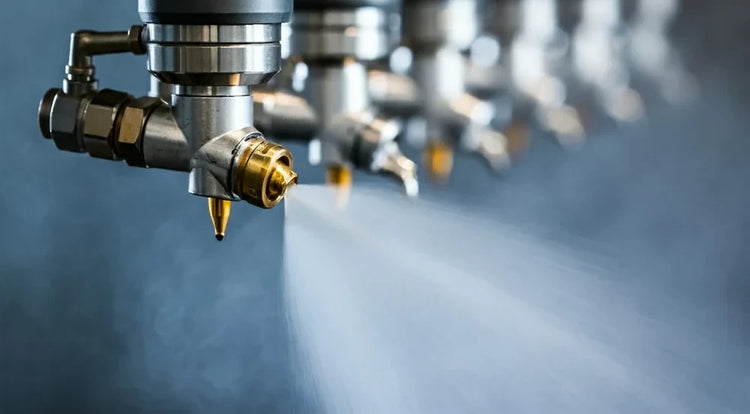
Spray Nozzles for Food & Beverage Processing
Hygienic, precision spray solutions for bottling and packaging, dairy, meat and poultry, bakery and confectionery, and breweries and wineries — engineered for sanitation, consistency, and line efficiency

Food and beverage processing operates under regulatory frameworks — USDA, FDA, FSMA, HACCP, 3-A Sanitary Standards — that make spray nozzle material and design choices compliance decisions, not just purchasing decisions. A nozzle body with an internal crevice that traps product residue is a potential Listeria harborage point. A nozzle seal material incompatible with the CIP chemistry used to clean it corrodes under cleaning conditions and contaminates the next production run. A CIP spray ball that doesn't achieve complete vessel coverage leaves zones of inadequate cleaning that accumulate biofilm.
NozzlePro supplies hygienic spray nozzles for all food and beverage sub-industries — 316L stainless with electropolished internal surfaces, food-grade PTFE and EPDM seals, and crevice-free designs that pass 3-A audit requirements. Application-specific recommendations matched to your production environment, chemistry, and cleaning protocol.
Food and beverage processing uses spray nozzles matched to each sub-industry and application: bottling and packaging uses flat-fan and solid stream nozzles for bottle rinsing, fog/mist for sterilant application, and air nozzles for pre-label blow-off and conveyor lubrication; dairy processing uses rotary jet and spray ball devices for tank and vessel CIP, high-pressure flat-fan for plant washdown, and full-cone or flat-fan for product cooling and coating; meat and poultry uses flat-fan for carcass washing, fog/mist for pathogen control and odor management, and full-cone for chilling sprays; bakery and confectionery uses hydraulic atomizing nozzles for edible oil, glaze, and egg wash application, fog/mist for moisture conditioning, and humidification nozzles for process environment control; and breweries and wineries uses rotary jet cleaners for fermentation tank and brite tank CIP, high-impact nozzles for floor and equipment washdown, and air nozzles for bottle and can blow-off. All food and beverage nozzles require 316L stainless bodies, electropolished internal surfaces, food-grade seals (EPDM or PTFE), and crevice-free designs compatible with CIP cleaning chemistries.
Food & Beverage Nozzle Collections
Shop by application or nozzle type — all linked directly to collections
Food & Beverage Sub-Industry Spray Solutions
Application-specific nozzle recommendations for each food and beverage production environment
Beverage Bottling & Packaging
| Application | Recommended Nozzle |
|---|---|
| Bottle Rinsing | Flat-Fan + solid stream tips |
| Sterilization | Fog & Mist |
| Pre-Label Blow-Off | Air Nozzles |
| Conveyor Lubrication | Air Nozzles (low-drip dosing) |
| Adhesive / Anti-Slip | Hydraulic Atomizing |
Higher throughput · Consistent sterilization · Lower chemical use
Dairy Processing
| Application | Recommended Nozzle |
|---|---|
| Tank & Vessel CIP | Spray Balls & Rotary Jet |
| Plant Washdown | High-Pressure flat-fan |
| Humidity Control | Humidification |
| Product Cooling | Full-Cone |
| Surface Coating | Flat-Fan |
Improved sanitation · Extended shelf life · Regulatory alignment
Meat & Poultry Processing
| Application | Recommended Nozzle |
|---|---|
| Carcass Washing | Flat-Fan |
| Pathogen Control | Fog & Mist |
| Chilling Sprays | Full-Cone |
| Odor Control | Fine Mist |
| Equipment CIP | Tank Cleaning |
Safer operations · Better quality · Reduced contamination risk
Bakery & Confectionery
| Application | Recommended Nozzle |
|---|---|
| Edible Oil / Glaze / Egg Wash | Hydraulic Atomizing |
| Moisture Conditioning | Fog & Mist |
| Pan / Mold Release | Flat-Fan |
| Humidity Control | Humidification |
| Conveyor Cleaning | High-Impact Flat-Fan |
Consistent finish · Better texture · Less coating waste
Breweries & Wineries
| Application | Recommended Nozzle |
|---|---|
| Fermentation Tank CIP | Rotary Jet Cleaners |
| Brite Tank & Vessel CIP | Spray Balls |
| Floor & Equipment Washdown | High-Impact sprays |
| Bottle / Can Blow-Off | Air Nozzles |
| Sanitize & Rinse | Fog/Mist & Flat-Fan |
Improved hygiene · Faster production · Less downtime

Hydraulic Atomizing vs. Fog & Mist — When to Use Each
Two distinct atomizing technologies for different food and beverage application objectives
Hydraulic Atomizing (Pressure-Only)
Fine droplets without compressed air — tight droplet bands, low drift, easy cleanup, food-safe materials throughout
- Best for: Edible oils, glazes, egg wash, release agents, adhesives, anti-slip coatings, mold release
- Droplet size: 100–300 µm — fine but not ultra-fine, controlled by orifice size and pressure
- Tuning: Adjust orifice size and line pressure; select food-grade body material and seals for your specific coating agent
- Advantage: No compressed air system required; simpler installation; lower operating cost per unit output
Fog & Mist (Ultra-Fine)
Maximum surface area and suspended coverage — ideal for sterilants, humidity control, and pathogen management
- Best for: Disinfection and sanitizer application, humidification, pathogen control, odor management, light product conditioning
- Droplet size: 10–100 µm — suspended droplets that remain airborne for extended contact time
- Tuning: Use enclosures or shields to contain drift; validate droplet size against sanitizer label requirements; verify evaporation vs. surface wetting objective
- Advantage: Maximum surface contact area per unit of liquid; effective for irregular surfaces and inaccessible areas
Hygienic Nozzle Material Selection
Match body, seal, and surface finish to your food contact zone, cleaning chemistry, and regulatory requirements
| Material | Food Contact Zone Use | CIP Chemistry Resistance | Key Consideration |
|---|---|---|---|
| 316L Stainless (electropolished) | All food zones including direct product contact and CIP circuits | Caustic (NaOH), acid (nitric, phosphoric), peracetic acid, chlorine sanitizers at standard concentrations | Ra ≤0.8 µm required for 3-A compliance in direct-contact zones; verify chloride limits for high-chlorine CIP |
| PTFE Body / Lining | Aggressive acid and solvent contact; release agent and oily product applications | Broadest chemical resistance including high-concentration acids and oxidizing agents | Non-stick surface aids cleanability; not suitable for high-pressure mechanical cleaning — lower pressure limit than stainless |
| EPDM Seals | Standard food-grade seal for most aqueous food processing environments | Excellent resistance to caustic, acid, and steam; good with PAA sanitizers | Avoid with oils, fats, and petroleum-based products — EPDM swells in hydrocarbon contact |
| PTFE / White PTFE Seals | Edible oil, fat, solvent-based coating, and release agent service | Broadest chemical resistance of any seal material; inert to virtually all food processing chemicals | Harder than EPDM — requires more consistent face pressure for leak-free sealing; preferred for FDA 21 CFR compliance |
| Viton (FKM) Seals | Alcohol-based sanitizers, ethanol, acidified environments | Good acid resistance; excellent with alcohol sanitizers used in wine and spirits production | Better hydrocarbon resistance than EPDM; verify compatibility with specific sanitizer chemistry |
Hygienic Nozzle Selection Principles
Engineering and compliance factors for food and beverage spray nozzle specification
- Hygienic Design Is a Regulatory Requirement, Not a Preference — In direct food contact and food zone spray applications, nozzle design must meet 3-A Sanitary Standards or equivalent hygienic design criteria: crevice-free internal geometry with no dead legs or trapped volumes; 316L stainless with electropolished surfaces (Ra ≤0.8 µm) that resist biofilm attachment; food-grade seal materials verified compatible with both the food product and the CIP chemistry; and disassembly for inspection and cleaning without special tools. A nozzle that cannot be adequately cleaned in place is a HACCP critical control point failure — not a maintenance issue.
- CIP Chemistry Compatibility Must Be Verified for Both Body and Seal — The most common nozzle failure mode in food processing is seal degradation from CIP chemistry rather than from the food product itself. Standard CIP programs in dairy and meat processing use caustic (NaOH, pH 12–14) followed by acid (phosphoric or nitric, pH 2–3) followed by sanitizer (peracetic acid, chlorine, or quaternary ammonium). Each stage attacks different seal materials — EPDM performs well in caustic and acid; PAA sanitizers at high concentrations can degrade standard EPDM; chlorine concentration and temperature determine whether 316L stainless is adequate or whether duplex stainless is required. Verify both body and seal material against your specific CIP chemistry program before selection.
- Static vs. Rotary CIP Device Selection Determines Cleaning Validation — In fermentation tanks, dairy silos, and other large vessels, the choice between static spray balls and rotary jet cleaners determines whether the vessel can be cleaning-validated under FSMA requirements. Static spray balls provide rinsing and low-impact wetting of vessel surfaces — adequate for moderate soil loads and vessels with unobstructed geometry. Rotary jet cleaners provide high-impact, mechanically scrubbing coverage across the full vessel interior — required for heavy soil loads, vessels with internal fittings (agitators, coils, baffles), and applications where cleaning validation data is required to demonstrate complete soil removal. Selecting a static device for a heavy-soil application is a cleaning validation failure regardless of chemistry and temperature.
- Conveyor Lubrication Nozzle Selection Affects Product Quality and Food Safety — Conveyor lubrication in bottling and can-filling lines applies lubricant to the conveyor surface to reduce chain wear and prevent container tipping. Over-application creates lubricant puddles that contaminate container bases and label adhesion surfaces; under-application increases chain wear and jam frequency. Air nozzles with precision metered dosing provide the controlled, intermittent application required to maintain the lubricant film without pooling — continuous flow nozzles over-apply by design. Food-grade lubricant and food-grade nozzle materials are required in any zone where containers contact the conveyor with open tops or unsealed bases.
- Pathogen Control Spray Efficacy Depends on Droplet Size and Contact Time — Antimicrobial misting systems in meat and poultry processing for Listeria and Salmonella control require fog/mist nozzles producing droplets in the 50–150 µm range that remain airborne long enough to contact all exposed surfaces in the spray zone. Droplets that are too coarse settle immediately onto floors rather than contacting wall and equipment surfaces where pathogen harboring occurs. The antimicrobial agent concentration and contact time required for the target organism under the process temperature conditions must be validated — nozzle selection determines the droplet distribution that makes this validation achievable.
Why Choose NozzlePro for Food & Beverage?
Hygienic design, regulatory compliance, and application expertise across all food sectors
Hygienic by Design — Compliance by Specification
Food and beverage spray nozzle selection requires more than flow rate and spray angle matching — it requires material verification against food contact regulations, CIP chemistry, and hygienic design standards. NozzlePro application engineers specify nozzles with the full compliance picture in mind: 3-A hygienic design requirements, FDA 21 CFR material compliance for direct food contact, EHEDG guidelines for European dairy operations, and USDA/FSIS requirements for meat and poultry.
Hygienic Stainless Configurations: 316L stainless nozzle bodies with electropolished internal surfaces available for direct food contact applications. Ra values supplied on request for audit documentation. Crevice-free body designs without internal dead legs or trapped volumes that could harbor product residue or microorganisms.
CIP-Compatible Seal Selection: EPDM, PTFE, and Viton seal options specified to your CIP chemistry program — not just the food product. The most common source of nozzle failure in food processing is seal degradation from cleaning chemistry, not from product contact. We verify both.
Application Consultation: Share your production environment, food product, CIP chemistry program, regulatory framework, and throughput targets — we'll specify the right nozzle type, body material, seal, and surface finish for each stage of your process.
Frequently Asked Questions
Common questions about spray nozzles for food and beverage processing
What material should food and beverage spray nozzles be made from?
316L stainless steel is the standard for food and beverage spray nozzle bodies in direct food contact and CIP circuit applications — it provides corrosion resistance to most CIP chemistries, can be electropolished to Ra ≤0.8 µm required for 3-A compliance, and meets FDA 21 CFR material requirements. PTFE body nozzles are used for aggressive acid, solvent, and oily product contact where stainless may corrode or react. Seal materials must be selected for compatibility with both the food product and the CIP chemistry — EPDM is the standard for aqueous dairy and beverage processing; Viton for alcohol-containing products and spirits CIP; PTFE for edible oil, fat, and solvent-based coatings. Always verify seal material against both the process stream and the cleaning program — seal degradation from CIP chemistry is the most common nozzle failure mode in food processing.
What is the fastest way to CIP a fermentation tank or dairy silo?
Rotary jet cleaners sized for the vessel diameter, soil type, and available CIP pump flow and pressure provide the most effective and water-efficient cleaning of large fermentation tanks and dairy silos. The device is sized from three parameters: vessel diameter (determines required throw distance), soil adhesion (heavy beer stone or milkstone requires higher impact than light product residue), and available pump GPM at operating pressure (determines which rotary jet device models can be supplied adequately). For vessels with internal fittings — agitators, coils, baffles, distribution arms — 3D orbital rotary jet devices that sweep in multiple axes are required to eliminate shadow zones that static spray balls or single-axis rotary devices cannot reach. Static spray balls are adequate for clean-in-place rinse cycles and light-soil vessels; they are not adequate for cleaning-validation purposes in heavy-soil applications.
Which nozzle is best for applying edible coatings, glazes, and egg wash in bakery production?
Hydraulic atomizing nozzles are the standard for edible coating, glaze, and egg wash application in bakery and confectionery production. They atomize viscous food materials using line pressure alone — no compressed air required — producing a fine, controlled droplet spectrum that builds uniform film thickness across the product surface. The key selection parameter is liquid viscosity: as the coating becomes more viscous (thick glazes, high-solids egg wash), a larger orifice is required to avoid nozzle blockage and maintain the spray pattern. Nozzle body and seal materials must be verified food-grade and compatible with the specific coating formulation — some edible coating agents contain alcohol, acidulants, or other components that degrade standard seal materials. Clean nozzles immediately after each production run — food coating materials polymerize and crystallize rapidly in nozzle orifices if allowed to dry in place.
How do I choose between bottle rinsing nozzle configurations in beverage bottling?
Bottle rinsing nozzle selection depends on whether you're rinsing the bottle interior, exterior, or both, and whether the rinse medium is water, sanitizer, or inert gas (nitrogen or CO₂). For interior bottle rinsing, upward-directed flat-fan or solid stream nozzles positioned on a manifold aligned with the inverted bottle position are standard — the bottle is inverted over the nozzle, the nozzle fires upward into the bottle interior, and the rinse drains by gravity. Solid stream nozzles provide targeted impact cleaning of the bottle interior; flat-fan provides broader coverage with less impact. For exterior rinsing, low-angle flat-fan nozzles provide coverage of the bottle body and neck. In PET bottle blowing operations, high-pressure air nozzles are used before filling to clear particulate from the new bottle — these are air nozzle applications, not liquid spray. Select stainless bodies with food-grade seals for all rinse media contact positions.
What spray nozzle is used for Listeria control misting in meat and poultry processing?
Antimicrobial misting systems for Listeria monocytogenes control in ready-to-eat meat and poultry processing environments use fog/mist nozzles producing 50–150 µm droplets of an approved antimicrobial agent — typically lactic acid, peracetic acid, or acidified sodium chlorite at approved label concentrations. The droplet size range is critical: droplets must be fine enough to remain airborne in the processing environment long enough to contact all exposed surfaces (walls, equipment, floor/wall junctions, overhead structures) where Listeria harborage occurs; droplets that are too coarse settle immediately to the floor without contacting elevated harborage sites. The misting system nozzle manifold must be designed to create a continuous antimicrobial atmosphere in the target zone during the post-lethality exposure window — manifold coverage, nozzle spacing, and operating parameters must be documented in the HACCP plan and validated against environmental monitoring data.
Ready to Optimize Your Food & Beverage Spray System?
Share your sub-industry, application stage, food product, CIP chemistry, regulatory framework, and line speed — we'll specify the right nozzle with full compliance and hygienic design documentation.