
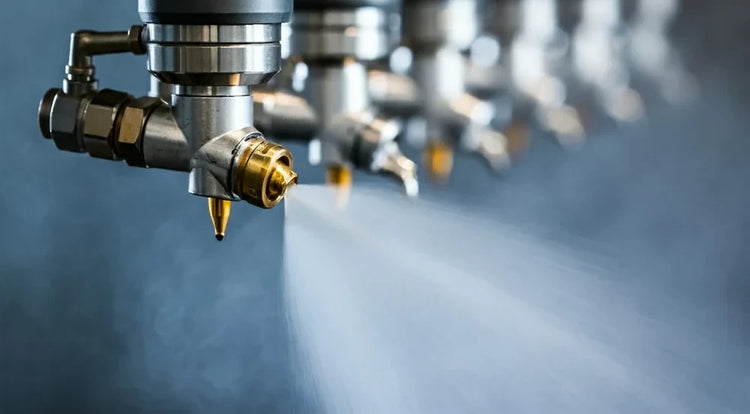
Brewery & Winery Spray Nozzles
Sanitary CIP spray balls, CIP balls, tank cleaning nozzles, bottle rinsing nozzles, air knife blow-off nozzles, foaming and sanitizing nozzles, and washdown nozzles — 3-A compliant electropolished 316L stainless steel construction for craft breweries, production breweries, boutique wineries, and high-volume wine production

Brewing and winemaking share a fundamental spray system requirement that separates them from most industrial applications: the surfaces being cleaned are in direct contact with a food product whose quality depends entirely on microbiological cleanliness. A CIP spray ball that provides 95% vessel coverage does not produce 95% quality — it produces a persistent contamination site in the 5% shadow zone that re-inoculates every batch that ferments in that vessel until the dead zone is found and cleaned. Lactobacillus and Pediococcus biofilms established in CIP shadow zones on fermentation vessel surfaces are among the most difficult brewery contamination problems to eradicate because the cleaning system that created them continues to miss them every cycle.
NozzlePro supplies CIP spray balls, CIP balls, rotary tank cleaning nozzles, and fixed spray arrays for fermentation vessels, brite beer tanks, wine tanks, brew kettles, and kegs — in 3-A sanitary electropolished 316L stainless steel construction with documented flow performance. ISO 9001 certified manufacturing. We supply the hardware and flow data to support your cleaning validation program; your quality team executes the coverage verification studies and ATP testing per your site protocols.
Breweries and wineries use spray nozzles across six critical sanitation and production applications: fermentation vessel and tank CIP cleaning uses rotary CIP spray balls or CIP balls (10–100 GPM, 15–50 PSI) for 360° coverage removing proteins, hop oils, tannins, tartrates, and yeast — complete documented coverage is the prerequisite for validated cleaning; bottle and can rinsing uses inverted full-cone nozzles (0.1–0.5 gal per container, 15–40 PSI) with 0.45 µm filtered water immediately before filling; air knife drying uses high-velocity flat-fan air nozzles (15,000–30,000 FPM, 5–15 PSI) to remove surface water before labeling preventing label adhesion failure; foaming and sanitizing uses foam-generating hollow-cone nozzles (10:1–30:1 expansion) applying cleaning and sanitizing solutions to floors, walls, and equipment with extended contact time and visual coverage verification; equipment washdown uses adjustable flat-fan nozzles (5–20 GPM, 40–100 PSI, hot water capable) for daily production area sanitation; and vessel spray cooling uses full-cone or hollow-cone nozzles (20–50 GPM per vessel, 15–40 PSI) for evaporative cooling supplementing glycol jackets during active fermentation. All brewery and winery spray nozzles contacting product or process surfaces require 3-A sanitary construction: electropolished 316L SS to Ra <32 µin, self-draining design, crevice-free connections — no NPT threads, no gasket grooves, no dead legs.
Brewery & Winery Nozzle Collections
Shop by application or nozzle type
Brewery & Winery Spray Applications
Application-specific nozzle recommendations for every production and sanitation requirement
Fermentation Vessel & Tank CIP — Spray Balls
Rotary CIP spray balls and static CIP ball arrays (10–100 GPM, 15–50 PSI) deliver 360° coverage in fermentation tanks, brite beer tanks, wine storage tanks, and brew kettles removing proteins, hop oils, tannins, tartrates, and yeast residues. The CIP spray ball size and mounting position must be calculated for the specific vessel geometry — a spray ball that provides complete coverage in a short-aspect-ratio wine tank will leave shadow zones in the cone bottom and dome top of a tall beer fermentation cylinder. Rotary CIP spray balls (using spray reaction force to rotate the spray head at 15–50 PSI) provide dynamic coverage ideally suited to tall vessels and complex geometries; static fixed spray arrays work for shorter vessels. All CIP spray balls and tank cleaning nozzles in direct product contact service: 3-A sanitary electropolished 316L SS, Ra <32 µin, self-draining, tri-clamp connections.
CIP Spray Balls & Tank CleaningBottle, Can & Keg Rinsing
Inverted full-cone nozzles (1–4 per container, 15–40 PSI, 0.1–0.5 gal per container) remove dust, foreign material, residual sanitizer, and particulates immediately before filling. Inverted orientation is critical — it allows 95–99% drainage of rinse water by gravity before the container is righted for filling, preventing dilution of the finished product. Rinse water quality requirement: 0.45 µm absolute filtered water at minimum; sterile filtered or ozonated water for sensitive beer styles (lagers, pilsners, wheat beers) or premium wine where any microbial carry-over affects flavor development. Keg rinsing and sanitizing requires higher-pressure internal spray (40–80 PSI) to reach all interior surfaces — CIP spray ball inserts sized for the keg diameter and positioned centrally for complete coverage.
Full-Cone NozzlesAir Knife Drying & Blow-Off
High-velocity flat-fan air nozzles and air knife systems (15,000–30,000 FPM air velocity, 5–15 PSI, 15–50 SCFM per nozzle) remove surface water from bottles, cans, and filled containers before labeling, printing, or case packing. Residual water on containers causes label adhesion failure (labels lifting or wrinkling within hours of application), ink smearing on direct-print cans, and cardboard case deterioration during storage. Air amplification designs using 1 CFM compressed air to entrain 10–40 CFM ambient air reduce compressor energy 80–90% versus conventional compressed air nozzles. Ionising air knives neutralize static charges on plastic bottles and cans — static attracts dust and causes label misalignment on high-speed packaging lines. Operating noise: engineered air knives 65–75 dBA versus 90–100+ dBA from conventional air nozzles.
Air NozzlesFoaming & Sanitizing Systems
Foam-generating hollow-cone nozzles convert liquid cleaners and sanitizers into stable foam (10:1–30:1 expansion ratio) for floors, walls, equipment exteriors, and production area surfaces. Foam provides two advantages that spray cannot: extended contact time on vertical and overhead surfaces (foam clings for 5–15 minutes; spray runs off immediately) and visual coverage verification (white foam confirms where treatment has been applied). Extended contact time is the mechanism that makes foaming effective — alkaline cleaners need 5–15 minutes at concentration to break down proteins and hop resins; sanitizers (quaternary ammonium, peroxyacetic acid) need 30 seconds to 2 minutes at correct concentration. Foam expansion also reduces chemical product consumption 70–90% versus direct spray application at equivalent cleaning performance. Chemical selection: alkaline (pH 12–14) for organic soil; acid (pH 2–4) for beer stone and tartrates; sanitizer for microbiological control.
Sanitisation NozzlesEquipment Washdown & Daily Sanitation
Adjustable flat-fan nozzles on wall-mounted or ceiling hose reels (5–20 GPM, 40–100 PSI, hot water to 180°F) provide daily end-of-shift sanitation across all production surfaces. Moderate pressure (60–80 PSI) balances cleaning effectiveness against aerosol creation — pressure above 100 PSI generates fine mist that spreads organic material and microorganisms to previously clean surfaces and ceiling structures, creating airborne contamination sources. Spray station spacing at 50–75 foot intervals ensures all production areas within reach. Sanitary hose materials: FDA-compliant EPDM or silicone resisting microbial growth in persistently wet environments — avoid PVC hoses that leach plasticisers and degrade under repeated hot water exposure. Quick-connect sanitary fittings allow operators to switch between water, foam, and sanitizer applications at each station.
Cleaning & WashingVessel Spray Cooling & Temperature Control
Full-cone or hollow-cone nozzles (20–50 GPM per vessel, 15–40 PSI) applied to the exterior of fermentation vessels provide evaporative cooling supplementing glycol jackets — particularly useful during peak fermentation activity when heat generation exceeds jacket capacity. Evaporative cooling absorbs 1,000 BTU per pound of water evaporated, providing 2–5× more cooling capacity per unit area than jacket cooling alone and enabling faster temperature response (1–3°F per hour versus 0.3–1°F per hour jacket-only). Water recirculation systems (collect, filter, re-spray) reduce fresh water consumption 75–85% from spray cooling operation. Spray cooling also serves as backup during glycol chiller failures — maintaining fermentation temperature during equipment downtime prevents heat-stressed fermentation producing fusel alcohols, ethyl acetate, and other off-flavor compounds.
Cooling & QuenchingNozzle Configuration Reference — Brewery & Winery Applications
Recommended nozzle type, operating parameters, and sanitary construction requirements by application
| Application | Nozzle Type | Pressure / Flow | Sanitary & Key Note |
|---|---|---|---|
| Fermentation Vessel / Tank CIP | Rotary CIP Spray Ball or Static Array | 10–100 GPM, 15–50 PSI, 360° coverage | 3-A sanitary, electropolished 316L SS Ra <32 µin, tri-clamp connections; spray ball size and mount position calculated for vessel H:D ratio — wrong sizing creates shadow zones that persist every cleaning cycle |
| Bottle / Can Rinsing | Inverted Full-Cone Nozzles | 0.1–0.5 gal/container, 15–40 PSI, 1–4 nozzles/container | 0.45 µm absolute filtered rinse water; inverted orientation for 95–99% drainage before filling; sterile water for lagers, pilsners, and premium wine |
| Air Knife Drying | Air Knife / Flat-Fan Air Nozzle | 15,000–30,000 FPM, 5–15 PSI, 15–50 SCFM | Air amplification 10:1–40:1 reduces compressor energy 80–90%; ionising version for static-sensitive plastic bottles and cans; 65–75 dBA noise vs. 90–100+ dBA conventional air nozzles |
| Foaming & Sanitizing | Foam-Generating Hollow-Cone | 10:1–30:1 expansion, 5–15 min dwell time | Visual coverage verification from white foam; 70–90% less chemical vs. direct spray; alkaline (pH 12–14) for organics, acid (pH 2–4) for beer stone/tartrates, sanitizer for microbiological control |
| Washdown / Daily Sanitation | Adjustable Flat-Fan — hose reel | 5–20 GPM, 40–100 PSI, hot water to 180°F | 60–80 PSI recommended — above 100 PSI creates aerosols spreading contamination; FDA EPDM or silicone hose; hose reels at 50–75 ft spacing; quick-connect sanitary fittings |
| Keg Interior Cleaning — CIP Ball | Rotary or Fixed CIP Ball | 5–30 GPM, 40–80 PSI, tri-clamp entry | CIP ball sized for keg diameter, centrally positioned for complete coverage; higher pressure than tank CIP to reach keg bottom and walls via small opening; 316L SS sanitary body |
| Vessel External Spray Cooling | Full-Cone or Hollow-Cone | 20–50 GPM/vessel, 15–40 PSI | Evaporative cooling 1,000 BTU/lb — 2–5× jacket capacity; water recirculation system reduces fresh water use 75–85%; provides backup cooling during glycol chiller downtime |
Brewery & Winery Facility Types Served
Spray solutions for every scale of brewing and winemaking operation
Craft Breweries (5–100 BBL)
Fermentation vessel and brite tank CIP spray balls, brew kettle cleaning, keg CIP ball rinsing and sanitizing, bottling line rinsing and drying, floor and equipment washdown, yeast propagation vessel CIP.
Production Breweries (100–500 BBL)
Large vessel CIP spray ball arrays, heat exchanger spray cleaning, automated bottling and canning line rinsing at high speed, COP tank cleaning, cellar foam and spray systems, wastewater pH neutralisation spray.
Regional & National Breweries (500+ BBL)
Centralised CIP with distribution manifolds, high-speed packaging line rinsing (200–600 CPM), air knife drying for labels and cases, facility-wide washdown systems, barrel and cask CIP for specialty programs, spray cooling for capacity-constrained fermentation.
Boutique Wineries (1,000–20,000 Gal)
Barrel cleaning spray wands, tank CIP spray balls for stainless and concrete vessels, crush pad washdown, press interior and exterior cleaning, bottling line rinsing, barrel room humidification spray.
Production Wineries (20,000–500,000 Gal)
Large tank CIP spray ball arrays, automated bottle rinsing inline with filling, COP cleaning for destemmer, crusher, press, and filter equipment, barrel washing tunnel spray, cooling spray for temperature control.
Estate & Premium Wineries
Gentle cleaning spray for delicate equipment, premium bottle rinsing for high-value product, cave and aging room humidification (60–80% RH), ultra-sanitary cleaning maintaining barrel character, visitor center sanitation maintaining brand image.
Brewery & Winery Nozzle Selection Principles
What determines correct specification across brewing and winemaking applications
- CIP Spray Ball Coverage Is a Binary Sanitation Requirement — Complete or Not — CIP spray ball coverage in fermentation vessels and tanks does not produce proportional sanitation quality. A spray ball that provides 95% vessel interior coverage produces 100% contamination risk — the 5% shadow zone is a persistent residue accumulation site that re-inoculates every batch fermented in that vessel. Lactobacillus and Pediococcus establish biofilms in CIP shadow zones within 2–3 cleaning cycles; once established, these biofilms are resistant to standard CIP chemistry and require manual intervention to remove. The correct approach is to verify complete coverage before any vessel goes into production service using a dye study or riboflavin fluorescence test (a simple, low-cost procedure your quality team can execute in 30 minutes), and to use the spray ball sizing and positioning guidelines appropriate for the vessel geometry. NozzlePro provides flow performance data and recommended spray ball sizing for vessel diameter and height; your quality team executes the coverage verification.
- CIP Spray Ball and CIP Ball Selection Depends on Vessel Geometry — Not Just Vessel Volume — The critical dimension for CIP spray ball selection is the vessel height-to-diameter (H:D) ratio, not vessel capacity. A 30-barrel vessel with H:D ratio of 3:1 (tall and narrow) requires a different spray ball specification than a 30-barrel vessel with H:D ratio of 1.5:1 (short and wide) — even though both contain the same volume. Tall vessels with H:D >2:1 almost always require rotary CIP spray balls (which use spray reaction force to rotate the spray head, providing dynamic coverage at different angles over time) because the spray throw distance from a central mount cannot reach both the cone bottom and the dome top with adequate impact force simultaneously from a static device. Short vessels with H:D <1.5:1 can often be cleaned effectively with a static fixed spray array. Mount position also matters: a CIP ball mounted too low misses the upper dome; mounted too high misses the cone bottom and lower sidewall transition. When in doubt, a dye study on the actual vessel with the proposed spray ball confirms coverage before committing to the installation.
- Washdown Pressure Above 100 PSI Creates Aerosols That Spread Contamination — The most common mistake in brewery and winery washdown system design is specifying too much pressure. Above 100 PSI, water impacting hard surfaces (stainless vessel sides, tiled floors, stainless equipment legs) generates fine aerosol droplets that remain airborne for 15–30 minutes and travel 15–30 feet from the impact point. These aerosols contain whatever microorganisms are in the washdown water and on the surface being cleaned — typically organic matter from wort, juice, or yeast. High-pressure washdown in one area of the brewery actively spreads contamination to adjacent open fermenters, yeast propagation vessels, and packaging equipment. The correct washdown pressure is 60–80 PSI — sufficient for mechanical cleaning of production surfaces without aerosol generation. If organic soil requires higher-energy removal, use a physical tool (brush, squeegee) before water application rather than increasing spray pressure.
- Bottle Rinsing Water Quality Determines Sanitizer Taste Threshold Avoidance — Residual sanitizer in bottle interiors after a sanitizing step is removed by the final water rinse before filling — but the effectiveness of that rinse depends on the rinse water volume delivered, the number of nozzle positions, and critically, whether the rinse water itself contains any dissolved minerals that will remain on the glass after evaporation. Quaternary ammonium compounds (quats) have flavor thresholds in beer as low as 5–10 ppb — concentrations that are difficult to detect by sensory evaluation during production but are detectable by consumers, particularly in delicate styles (pilsners, lagers, light wheat beers). Adequate rinsing with 0.1–0.5 gallons of 0.45 µm filtered water per container removes quats below threshold. However, if the rinse water itself is hard (above 150 ppm TDS), the calcium and magnesium carbonate deposits left on the glass interior after the rinse water evaporates can adsorb traces of sanitizer from the subsequent filling, producing flavor carry-over at the point of consumption that the filling-line sample cannot detect because the deposit forms during final drying, not at fill.
- 3-A Sanitary Construction Is a Product Safety Requirement — Not a Premium Option — 3-A sanitary construction requirements (electropolished 316L SS to Ra <32 µin, drainable design, crevice-free connections, self-draining passages, no NPT threads in product contact zones) exist because each omitted feature creates a specific microbiological harborage mechanism. NPT threaded connections create spiral crevices in the thread form that are impossible to clean in place — one contaminated NPT fitting on a CIP return line can inoculate every vessel on that circuit. Rough surface finish above Ra <32 µin creates micro-crevices that bacteria physically inhabit and cannot be displaced by CIP chemistry. Undrained horizontal passages in spray ball bodies accumulate rinse water after every CIP cycle, creating a stagnant liquid environment ideal for bacterial growth between cycles. Each of these failure modes produces the same outcome: a persistent contamination source that is invisible to visual inspection and undetectable by standard surface swab testing, but detectable in the finished product when contamination reaches the consumer. Specify 3-A sanitary construction for all spray nozzles, spray balls, and associated fittings in product contact zones as a baseline, not as an upgrade.
Why Choose NozzlePro for Breweries & Wineries?
3-A sanitary construction, ISO 9001 certified supply, and application engineering for every production and sanitation position
CIP Spray Balls, Sanitary Nozzles & Application Support — ISO 9001 Certified
NozzlePro supplies CIP spray balls, rotary tank cleaning nozzles, and sanitary spray equipment in 3-A compliant electropolished 316L stainless steel construction with documented flow performance data. ISO 9001 certified manufacturing ensures consistent orifice dimensions and surface finish batch-to-batch — when you replace a worn CIP spray ball with a new one from NozzlePro, it delivers the same flow and coverage as the original.
CIP Spray Ball Sizing Guidance: We provide spray ball sizing recommendations based on your vessel diameter, height-to-diameter ratio, and available CIP pump flow rate. This is engineering guidance to help you select the correct device — your quality team verifies coverage with a dye study or riboflavin test on the actual vessel before validating the CIP procedure. NozzlePro does not execute cleaning validation or issue GMP documentation.
Sanitary Material Documentation: 316L SS material certifications with heat and lot traceability, electropolished surface finish reports (Ra measurements), and dimensional inspection data available for all CIP spray balls and sanitary nozzles — formatted to support your quality team's equipment qualification and vendor documentation requirements.
Broad Application Coverage: From the smallest craft brewery CIP spray ball for a 5-barrel pilot fermentation vessel to high-flow spray arrays for 50,000-gallon wine storage tanks — full range of sanitary spray hardware available with consistent construction quality and application engineering support across the entire brewery and winery production process.
Frequently Asked Questions
Common questions about CIP spray balls, sanitary nozzles, and spray systems for breweries and wineries
How do I select the right CIP spray ball or CIP ball for my fermentation vessel?
CIP spray ball selection for fermentation vessels requires matching four variables to the specific vessel: spray ball type (rotary versus static), spray ball size (orifice diameter and flow rate), mounting position, and available CIP pump flow rate and pressure. Spray ball type: rotary CIP spray balls, which use the spray reaction force to rotate the head at 15–50 PSI, are required for vessels with height-to-diameter (H:D) ratio above approximately 2:1 — the rotation provides dynamic coverage at varying angles over time that reaches surfaces a static spray cannot reach from a central mount in a tall vessel. Static fixed spray arrays are suitable for vessels with H:D below 1.5:1 where the shorter vessel proportions allow overlapping spray coverage from a fixed position. Spray ball size: larger spray balls with higher flow rates (50–100 GPM) provide greater spray throw distance reaching the full vessel height in tall vessels; smaller spray balls (10–30 GPM) are adequate for compact vessels. Mounting position: the spray ball should be positioned approximately one-third of the vessel height from the top, centerd horizontally — this position provides the best balance of coverage for the dome top, cylindrical sidewall, and cone bottom simultaneously. Available pump flow: verify that your CIP pump can deliver the spray ball's rated flow at 15–50 PSI at the spray ball inlet — insufficient pump capacity is the most common cause of CIP spray ball coverage failures in retrofit installations. The definitive confirmation of correct spray ball selection is a coverage study on the actual vessel — a riboflavin fluorescence or dye test. NozzlePro can recommend a spray ball based on your vessel dimensions and CIP system specifications; your quality team should confirm coverage before validating the CIP procedure.
What is the correct CIP sequence for brewery fermentation vessels and what does each step accomplish?
The standard brewery fermentation vessel CIP sequence is: pre-rinse, caustic wash, intermediate rinse, acid wash, final rinse, and sanitizer application. Each step performs a specific function that the others cannot substitute. Pre-rinse with cold or ambient water (5–10 minutes) removes gross soil — yeast cake residue, hop debris, protein precipitate — reducing the organic load before cleaning chemistry is applied. Removing this gross soil first is critical because caustic chemistry is neutralized by organic matter; high organic load significantly reduces cleaning effectiveness. Caustic wash at 1.5–3% NaOH, 140–180°F for 15–30 minutes removes protein (yeast, trub, protein haze compounds), hop oils and resins, and organic acids. The combination of temperature, concentration, and contact time is required — reducing any of the three compromises cleaning. Intermediate water rinse removes caustic and suspended soil, confirmed by conductivity returning to baseline. Acid wash at 1–2% phosphoric or nitric acid removes mineral scale, calcium oxalate (beer stone), and residual proteins not removed by caustic — this step is sometimes performed every third or fourth CIP rather than every cycle depending on water hardness and scale formation rate, but skipping it entirely allows progressive scale build-up that reduces subsequent caustic cleaning effectiveness. Final water rinse removes acid, confirmed by conductivity and pH returning to baseline (pH 7 ±0.5, conductivity matching supply water). Sanitizer application (peracetic acid 80–200 ppm, quaternary ammonium 200–400 ppm, or hot water at 180°F for heat sanitisation) provides microbiological kill following clean surfaces. The critical sequence rule: sanitizer only works on clean surfaces — organic soil present when sanitizer is applied consumes the active ingredient through chemical reaction, leaving insufficient available sanitizer to achieve the required kill rate.
What sanitary design features are required for brewery and winery spray nozzles?
Brewery and winery spray nozzles in product contact zones require 3-A sanitary construction with five non-negotiable design features. Material: 316L stainless steel (not 304 SS — 316L provides superior resistance to pitting corrosion from chloride in water, sanitizers, and process acids; a 304 SS CIP spray ball that pits in service creates a rough, bacteria-harbouring surface in the most critical sanitation position in the brewery). Surface finish: electropolished to Ra <32 µin (0.8 µm) — above this, the surface micro-topography provides physical shelter for bacteria that CIP chemistry cannot penetrate. The difference between Ra 20 µin (smooth, cleanable) and Ra 100 µin (rough, not reliably cleanable) is invisible to the naked eye but measurable by profilometry and significant to Lactobacillus and Pediococcus. Drainability: all internal passages slope to drain completely — no horizontal dead legs, no upward-facing sockets that retain liquid after CIP. Self-draining design is required because stagnant liquid in nozzle bodies between cleaning cycles creates a protected environment for microbial growth. Crevice-free connections: tri-clamp or smooth-bore sanitary fittings only — NPT threaded connections create helical crevices in the thread form that are physically impossible to clean in place. Seal materials: FDA-compliant EPDM or silicone — BUNA N (nitrile rubber) seals commonly used in industrial spray equipment are not FDA-compliant and degrade in contact with the alcohols, organic acids, and cleaning chemicals present in brewery and winery service. All five features must be present simultaneously — a nozzle that has four of the five still has one pathway for contamination harborage or regulatory non-compliance.
How do foaming systems reduce cleaning chemical costs in breweries and wineries?
Foam generation reduces cleaning and sanitizing chemical consumption 70–90% versus direct liquid spray application while achieving equal or superior cleaning through extended contact time. The mechanism: a foam generator (venturi-type or pump-driven) aspirates concentrated cleaning chemical and injects air, producing foam with an expansion ratio of 10:1 to 30:1 — meaning one liter of liquid cleaning solution becomes 10–30 liters of foam. For floor and wall cleaning, this means one liter of concentrated alkaline cleaner applied as foam covers the same area as 10–30 liters applied as liquid spray, at 3–5% of the chemical cost per unit area. The foam achieves equivalent or better cleaning than liquid spray because it remains in contact with vertical surfaces — floors, fermentation vessel exteriors, equipment stands, walls — for 5–15 minutes before draining, providing the contact time that liquid spray cannot maintain as it runs off. This contact time matters: protein deposits on brewery floors (from wort spills and yeast transfer) need alkaline chemistry in contact for at least 5–10 minutes at the correct concentration and temperature to be fully solubilised, not just dislodged by mechanical spray impact. The visual coverage verification from white foam is an additional operational benefit — operators can see exactly where they have treated and where they have missed, which is impossible with transparent liquid spray application. For a craft brewery sanitizing 5,000–15,000 sq ft of production and cellaring space daily with quaternary ammonium or peroxyacetic acid, switching from direct spray to foaming application typically reduces sanitizer consumption from 4–8 oz per gallon (direct spray) to 1–2 oz per gallon (foaming) at the same active ingredient contact concentration — a 50–75% chemical reduction for a given area coverage.
How does external spray cooling compare to glycol jackets for fermentation temperature control?
External vessel spray cooling uses the latent heat of evaporation — 1,000 BTU absorbed per pound of water evaporated — to remove heat from fermenting beer or wine faster and more uniformly than glycol jackets alone. The physics: water sprayed on the exterior of a fermentation vessel at ambient temperature evaporates on the warm stainless surface, absorbing latent heat at the phase change from liquid to vapour. For a 30-barrel fermenter (approximately 200 sq ft of exterior surface), spray cooling at 20–30 GPM with 20–30% evaporation provides 10,000–15,000 BTU/hr of cooling capacity — comparable to doubling the glycol jacket area. This cooling addition is particularly useful during the 24–72 hour peak fermentation activity window when yeast metabolic heat generation reaches maximum and exceeds what the glycol jacket alone can remove, allowing fermentation temperature to climb above setpoint. Temperature excursions during peak fermentation — even 2–4°F above target — significantly increase ester and fusel alcohol production in beer, or volatile acidity formation in wine, producing flavor changes that cannot be corrected downstream. The practical advantage of spray cooling over additional glycol chiller capacity: spray cooling equipment costs $5,000–$20,000 per vessel; equivalent glycol chiller expansion costs $30,000–$100,000 for the additional capacity. Water recirculation systems (collecting spray water that runs down the vessel exterior, filtering it, and reapplying) reduce fresh water consumption from spray cooling by 75–85%, making the operational water cost minimal. Spray cooling also provides useful backup during glycol chiller maintenance or failure events, during which it can maintain fermentation temperature control until the primary cooling system is restored.
Talk with a NozzlePro Brewery & Winery Specialist
Share your vessel geometry, production scale, CIP system specifications, and sanitation requirements — we'll supply ISO 9001 certified 3-A sanitary CIP spray balls, tank cleaning nozzles, and application engineering support for every spray position in your facility.