
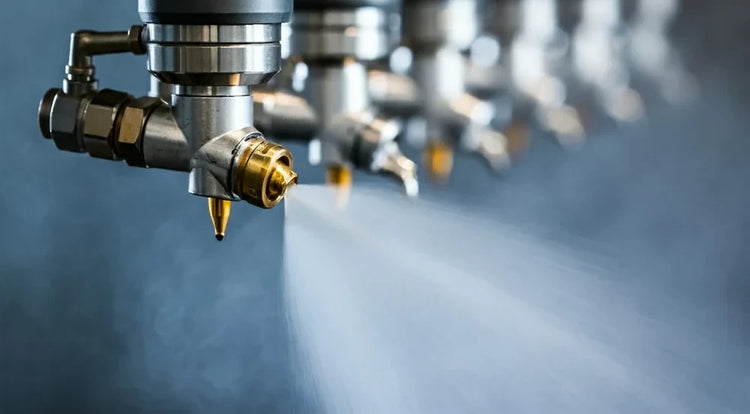
Spray Nozzles for Cleaning & Washing Applications
Spray nozzles for cleaning and washing applications deliver consistent flow, pattern, and impact for washdown, CIP, tank rinse, and conveyor cleaning lines. The collection below covers flat-fan, full-cone, hollow-cone, and tank-cleaning nozzles in 316L stainless steel, polypropylene, and brass, sized for the pressure, flow rate, and chemistry of food and beverage washdown, parts cleaning, surface rinse, and equipment sanitation. Compare patterns, materials, and connection options to match your line.


Guide
Spray Nozzles for Cleaning & Washing Applications: Overview & Selection Tips
This Cleaning & Washing collection groups nozzles and assemblies commonly used for Cleaning & Washing tasks across industrial lines. It makes it easier to compare nozzle types, spray patterns, materials, and connection options in one place.
Start with the process objective, then narrow by flow rate, operating pressure, coverage target, fluid compatibility, and maintenance needs. Related applications often include Cleaning & Washing, Coating & Surface Treatment, Cooling & Quenching, and Humidification & Conditioning.
Key selection factors
- Compare nozzle types and assemblies commonly used for Cleaning & Washing.
- Related process areas include Cleaning & Washing, Coating & Surface Treatment, Cooling & Quenching, and Humidification & Conditioning.
- Focus on spray pattern and coverage style, flow rate, pressure, and coverage requirements.
- Material options may include 316L stainless steel, brass, 303/304 stainless steel, and hardened stainless steel.
- Check inlet sizes such as 1/4 in., 1/8 in., 3/8 in., and 1/2 in. with NPT connections where available.
Common applications
- Cleaning & Washing
- Coating & Surface Treatment
- Cooling & Quenching
- Humidification & Conditioning
How to choose Cleaning & Washing
- Start with the required flow rate and operating pressure at the nozzle or assembly.
- Choose the spray pattern and coverage style that best matches the coverage, impact, atomization, or washdown result you need.
- Confirm material compatibility using options such as 316L stainless steel, brass, 303/304 stainless steel, and hardened stainless steel.
- Finally, verify thread style and inlet size, including 1/4 in., 1/8 in., 3/8 in., and 1/2 in. with NPT connections where available.
Related collections
Cleaning & Washing | Coating & Surface Treatment | Cooling & Quenching | Humidification & Conditioning
Industrial Spray Nozzles for Cleaning & Washing: Overview
Cleaning and washing nozzles deliver the right combination of impact force, coverage, and flow rate for thorough industrial cleaning.

Spray Pattern
Multiple spray patterns
Available SKUs
6357 Products
Quality
Industrial Grade
Shipping
Ships Fast
How Industrial Spray Nozzles Optimize Cleaning Performance
Spray nozzles convert pump energy into the impact, coverage, and droplet behavior that determines whether a cleaning process actually removes the target soil. Matching nozzle design to the cleaning task is the difference between a 30-second rinse and a five-minute scrub.
Operating Principle
An industrial spray nozzle's job in a cleaning system is to take the pressure and flow available at the inlet and convert it into a controlled spray pattern with a specific impact force per unit area. Three variables govern that conversion: the orifice geometry (which sets the pattern type - flat fan, hollow cone, full cone, solid stream, or rotating jet), the discharge coefficient (which sets how much flow you actually get at a given pressure), and the spray angle (which sets the coverage footprint at a given standoff distance). Impact force at the surface scales with both the flow rate and the inverse of the coverage area, so a narrower, harder-hitting pattern delivers more pounds-per-square-inch at the surface but covers less area per pass. The trade-off - impact versus coverage versus cycle time - is the central engineering decision in every cleaning nozzle selection.
For applications above 1,000 PSI - including industrial parts cleaning, surface preparation, and tank-bottom descaling - see our industrial high-pressure spray nozzles collection.
What to Compare
When evaluating nozzles for a cleaning application, compare them across five parameters before comparing on price.
First, flow rate at operating pressure - the rated GPM at your actual line pressure, not at the catalog reference pressure.
Second, spray pattern and angle - flat fan for line coverage and lap rinses, hollow cone for sheeting and gentle rinses, full cone for uniform area coverage, and solid stream for high-impact spot cleaning.
Third, wetted material - 316L stainless for caustic CIP loops, hardened stainless for abrasive slurries, 303/304 stainless for general washdown, and brass for low-temperature potable water service.
Fourth, connection size and type - NPT thread sizes from 1/8 in. through 1/2 in. dominate this collection, with quick-disconnect assemblies available where line-change frequency is high.
Fifth, filtration and clog tolerance - orifice size determines the upstream filter mesh you'll need; the smaller the orifice, the finer the required prefilter and the more frequent the cleaning cycle.
Installation & Maintenance
The nozzle's performance over time depends as much on installation as on selection. Mount nozzles at the standoff distance that matches the rated spray angle to the surface geometry - a 65° flat fan at 12 in. produces a different impact profile than the same nozzle at 18 in., and the published coverage figures assume the catalog standoff.Verify pressure at the nozzle, not at the pump or header - line losses, throttle valves, and elevation can drop 10-30 psi between the pump and the spray tip.For cleaning lines that run multiple shifts, establish a baseline flow rate at install and check monthly; a 10% flow increase at constant pressure usually indicates orifice wear and a 10% flow decrease usually indicates clogging or filter loading.Replace tips before wear changes the spray pattern enough to compromise cleaning quality - most industrial users find that scheduled replacement on a usage-hour interval costs less per year than reactive replacement on a quality-failure interval. NozzlePro publishes wear-life ranges on each product page; if your service environment is outside those ranges, contact engineering for a material upgrade recommendation.
Cleaning and Washing Spray Applications
Applications include parts washing, CIP systems, vehicle washing, conveyor cleaning, floor washdown, and pressure washing.
Cleaning & Washing
Support rinsing, washdown, parts cleaning, and surface cleanup with coverage and impact matched to the soil load and line speed.
Coating & Surface Treatment
Apply coatings, chemicals, and pretreatment fluids with repeatable coverage and controlled transfer efficiency.
Cooling & Quenching
Control part temperature and process heat with spray coverage sized for the required cooling rate and heat removal.
Humidification & Conditioning
Produce droplets suited to humidity control, evaporative conditioning, and air treatment tasks.
Selecting Nozzles for Cleaning Applications
Balance impact force, flow rate, and spray angle to match your cleaning application — high impact for stubborn soils, wide fan for rinsing.
Flow Rate & Pressure
Start with the flow rate you need at the operating pressure available at the nozzle or assembly.
Spray Pattern & Coverage
Choose the spray pattern and coverage style that best matches the coverage width, impact, atomization, or washdown result your process requires.
Materials & Connections
Select wetted materials compatible with the fluid, temperature, and wear conditions; common options may include 316L stainless steel, brass, 303/304 stainless steel, and hardened stainless steel; common sizes include 1/4 in., 1/8 in., 3/8 in., and 1/2 in. with NPT connections where available.
Maintenance & Reliability
Consider clogging risk, wear life, ease of change-out, and the maintenance routine your process can realistically support.
Industries Requiring Industrial Cleaning Nozzles
Food processing, automotive, manufacturing, municipal, and commercial cleaning operations all depend on properly specified spray nozzles.
Cleaning Nozzle FAQ
Answers to common questions about nozzle selection for cleaning, pressure requirements, chemical compatibility, and cleaning efficiency.
What is an industrial spray nozzle and how does it differ from a consumer or garden nozzle?
An industrial spray nozzle is engineered for continuous-duty service in process and washdown environments — typically 30 to 3,000 psi operating range, NPT threaded connections, and wetted materials selected for chemical compatibility (316L stainless, hardened stainless, brass, or specialty alloys). A consumer hose nozzle is generally limited to 60–80 psi, uses brass or plastic, and is not designed for the duty cycle or chemistry an industrial cleaning line imposes.
Which nozzle types are most commonly used for industrial cleaning and washdown?
The most common types in cleaning service are flat fan (line coverage and lap rinses), hollow cone and full cone (uniform area rinse), solid stream (high-impact soil removal), spiral (clog-resistant low-pressure washdown), and rotating or static tank-cleaning heads (internal vessel washdown). Eductor nozzles are also used inside CIP and immersion baths to mix and circulate cleaning chemistry without external pumps.
What pressure range do industrial spray nozzles for cleaning typically operate at?
Most cleaning and washdown nozzles operate between 40 and 1,500 psi at the nozzle tip. Low-pressure washdown stations and spiral nozzles typically run 40–150 psi; standard CIP and surface rinse applications run 150–500 psi; high-impact cleaning, paint stripping, and surface preparation can run 1,000–3,000 psi with hardened-stainless or carbide tips.
What materials should I choose for nozzles in food and beverage cleaning applications?
For food, beverage, and pharmaceutical cleaning, 316L stainless steel is the industry default — it resists caustic CIP chemistry, chloride pitting, and standard sanitizing agents. For sanitary-certified service, choose nozzles with 3-A or FDA-compliant assemblies and avoid brass or unsealed materials in product-contact zones. See the food & beverage nozzles collection for certified options.
How do I select the right spray pattern for my cleaning application?
Match the pattern to the soil type and the surface geometry. Flat fan patterns work for rinsing belts, conveyors, and flat surfaces in overlapping passes. Hollow cones produce gentle sheeting action for rinse-aid distribution. Full cones cover broad surfaces uniformly with moderate impact. Solid streams concentrate force on a small footprint for stubborn soils, weld spatter, or process residue. Rotating tank-cleaning heads are required for internal vessel washdown where stationary patterns leave shadow zones.
How do I calculate the flow rate I need for a cleaning line?
Start with the coverage area and the dwell time the process requires, then back-calculate the gallons per minute needed to deliver adequate impact across that area. As a rough industrial baseline, light rinse applications use 0.5–2 GPM per nozzle, general washdown uses 3–8 GPM per nozzle, and high-impact cleaning uses 8–25 GPM per nozzle. Use the spray nozzle flow rate calculator to size precisely against your operating pressure.
What causes spray nozzle clogging and how do I prevent it?
Clogging usually comes from upstream particulates larger than the nozzle's free passage diameter — scale, weld slag, hose debris, hard-water deposits, or recirculated cleaning residue. Prevent it by installing a strainer or filter upstream sized for at least 50% smaller mesh than the nozzle orifice, draining and flushing the line on shutdown, and choosing spiral or clog-resistant designs for applications where fine filtration isn't practical. Replace strainer elements on a scheduled interval, not after a flow failure.
How long do industrial spray nozzles typically last in a cleaning application?
Service life depends on material, pressure, and the abrasiveness of the spray fluid. Hardened-stainless nozzles in clean-water service can run 2,000–10,000 hours before pattern degradation; standard stainless in caustic CIP service typically runs 500–2,000 hours; brass in light-duty washdown runs 1,000–4,000 hours. Most users find that scheduled replacement on a usage-hour basis costs less per year than reactive replacement after a quality failure.
Can NozzlePro nozzles be retrofit to existing manifolds or replace other manufacturers' nozzles?
Yes — most NozzlePro nozzles use industry-standard NPT connections in 1/8 in., 1/4 in., 3/8 in., and 1/2 in. sizes, and dimensional drawings are published on each product page for cross-reference. For non-NPT or specialty connection retrofits (BSP, quick-disconnect, sanitary tri-clamp), contact us with the part number you're replacing and we'll cross-reference dimensions, flow rate, and material.
Does NozzlePro offer custom flow rates, materials, or spray patterns for cleaning applications?
Yes. For non-catalog flow rates, special materials (hardened stainless, ceramic inserts, PTFE-lined assemblies), or unique pattern requirements, contact NozzlePro engineering. Custom-orifice modifications are available on most standard NozzlePro series with typical lead times of 2–4 weeks.
Related Cleaning and Washdown Products
Flat fan, full cone, and solid stream nozzles are the primary spray types for industrial cleaning and washing systems.

NPHU
Compare NPHU by spray performance, material compatibility, connection size, and application fit.

NP3U
Compare NP3U by spray performance, material compatibility, connection size, and application fit.

NPHV
Compare NPHV by spray performance, material compatibility, connection size, and application fit.

NPHVL
Compare NPHVL by spray performance, material compatibility, connection size, and application fit.

NPQV
Compare NPQV by spray performance, material compatibility, connection size, and application fit.

NPSJ
Compare NPSJ by spray performance, material compatibility, connection size, and application fit.

NPHSJ
Compare NPHSJ by spray performance, material compatibility, connection size, and application fit.

NPQU
Compare NPQU by spray performance, material compatibility, connection size, and application fit.
Need Help Selecting the Right Nozzle?
Our engineering team is ready to help you find the perfect spray solution for your application.