
Improving Bread Scoring Safety & Precision with Robotics and Precision Spray Nozzles
Eliminated
Worker safety risk from manual scoring
Precise
Repeatable scoring location on every loaf
Consistent
Artisan quality maintained at scale
Automated
Full robotic integration achieved
A Growing Bakery Needed a Safer, More Scalable Scoring Process
An artisanal bakery specializing in specialty bread products was manually scoring bread dough prior to baking. While the process produced the desired result, manually scoring each loaf with a blade presented a real worker safety concern — and made it impossible to achieve the same level of precision and consistency from one product to the next.
Bread scoring — the deliberate cuts made in the surface of dough immediately before baking — is one of the most important steps in artisan bread production. The score controls how the loaf expands during baking, directing the oven spring outward through the cut rather than randomly through the weakest point in the crust. When done well, scoring creates the characteristic open crumb, defined grigne (the ear or ridge along the score), and the visual signature that defines an artisan loaf.
Doing this consistently by hand at production scale is genuinely difficult. Angle, depth, speed, and moisture all affect the final result — and small variations between operators or between fatigue states within a single shift show up clearly in the finished product. As the bakery grew its specialty bread line, the limits of manual scoring became impossible to ignore: worker injury risk from sharp lame blades, inconsistent product appearance, and a process that couldn't keep pace with production volume.
Why bread scoring matters for product quality
When unscored dough enters a hot oven, the rapid gas expansion (oven spring) forces the loaf to rupture wherever the crust is weakest — typically at the sides or bottom, creating an irregular, uncontrolled expansion. A correctly placed score creates a controlled weak point, directing the expansion upward and outward through the cut. The result is better oven spring, more open crumb structure, and the defined visual appearance that signals artisan quality to consumers. Water applied at the score line during scoring reduces surface drag, allowing the blade (or robot effector) to cut cleanly and the score to open evenly as the dough expands.
Precision Spray Nozzle Integrated with a Robotic Scoring System
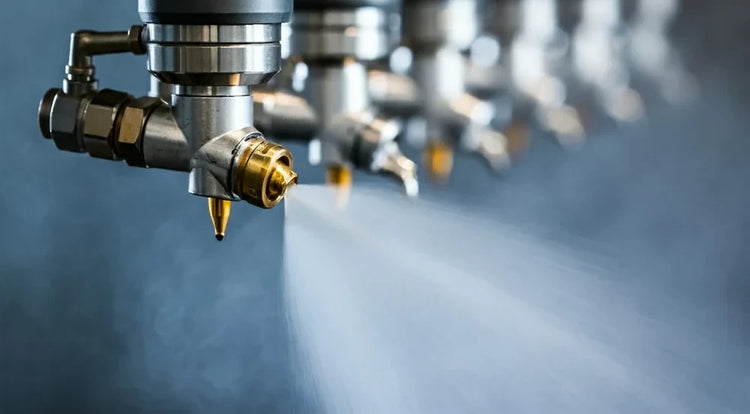
NozzlePro worked with the bakery to automate the scoring process using robotics and precision spray nozzles. The nozzle was integrated directly with the robotic system, applying water at precisely controlled locations along the score path with repeatable accuracy — enabling the robot to score each loaf the same way, every time, at production speed.
The spray nozzle serves a critical function in this system beyond simply replacing manual water application. In the robotic scoring process, the nozzle delivers a controlled amount of water to the dough surface immediately ahead of or alongside the scoring effector. This moisture performs two roles: it lubricates the cutting surface to reduce drag and prevent tearing, and it promotes clean score opening during baking by reducing surface tension at the cut edge.
Getting this spray specification right required careful attention to droplet size, flow rate, spray pattern width, and nozzle position relative to the scoring path. Too much water saturates the dough surface and softens the crust formation; too little provides insufficient lubrication and the score doesn't open cleanly. The nozzle had to deliver a precise, repeatable application — not a one-size-fits-all spray.
"The spray nozzle doesn't just add water — it enables the robotic system to perform consistently. Without precise, controlled moisture application, the scoring result varies even if the robot's path is perfect."
How the Robotic Integration Works
The nozzle was mounted on the robot's end-of-arm tooling, positioned precisely relative to the scoring blade or wire. As the robot executes its programmed scoring path, the nozzle activates at the start of each score and deactivates at the end — applying water only where needed, at the exact flow rate required for the bread type and scoring geometry. The combination of robotic positional control and precise spray delivery produces a result no manual process can match for consistency and repeatability.
Safer, More Consistent Bread Production at Scale
The robotic spray system transformed a manual, variable process into a controlled, automated one — with measurable improvements in both worker safety and product quality.
- Eliminated worker safety risks associated with manual blade scoring
- Achieved consistent, repeatable scoring location from loaf to loaf
- Improved scoring precision — depth, angle, and moisture application are identical on every product
- Reduced reliance on skilled manual labor for a critical production step
- Increased automation of the production process overall
- Improved process control and ability to document and repeat specifications
- Maintained the artisanal quality standards expected from the bakery's specialty products
The quality result matters as much as the safety result. For an artisanal bakery, automation is only acceptable if it maintains — or improves — the visual and quality standards that define the brand. The robotic spray system delivered both: a safer process and a more consistent product than manual scoring could achieve at production volume.
The Right Spray Technology Can Do More Than Apply a Liquid
By combining robotics with precision spray nozzle technology, this bakery transformed a manual process that had genuine safety risks and quality limitations into a controlled, automated application that produced better results more consistently — without compromising the artisan product standards that define its market position.
The spray nozzle was not an afterthought in this system — it was a critical enabling component. Without precise, controlled moisture delivery matched to the specific dough type and scoring geometry, the robotic system would not produce the consistent result the bakery required. Selecting and specifying the right nozzle for this application was as important as the robotic integration itself.
Relevant NozzlePro Solutions
Frequently Asked Questions
How do spray nozzles improve automated bread scoring?
In automated bread scoring systems, a precision spray nozzle applies a controlled amount of water along or ahead of the score path on the dough surface. This moisture serves two functions: it lubricates the scoring blade or wire to reduce drag and prevent dough tearing, and it promotes clean score opening during baking by reducing surface tension at the cut edge. When integrated with a robotic system, the nozzle delivers this moisture at exactly the right position and flow rate — identical on every loaf — producing consistent crust formation at the score line and a defined, repeatable expansion pattern during baking. The result is better oven spring, more consistent grigne formation, and the visual product uniformity expected from artisan-quality bread at production scale.
What type of spray nozzle is used for food production robotics?
Spray nozzles for robotic food production applications are selected based on the specific liquid, target area, and required droplet characteristics. For bread scoring water application, flat fan nozzles deliver a controlled sheet along the score path, while air-atomizing nozzles produce a finer mist for delicate moisture application on enriched or specialty doughs. All food-contact nozzles must be manufactured from food-safe materials — 316L stainless steel or PVDF are standard for bakery water application. Nozzle weight and envelope dimensions must also fit within the cobot or robot arm's payload and tooling constraints. NozzlePro can specify the appropriate nozzle type, pattern, material, and connection for your specific robotic integration.
Can spray nozzles be integrated into existing robotic systems?
Yes — spray nozzles can typically be integrated into existing robotic systems through end-of-arm tooling (EOAT) mounting brackets. The nozzle, fluid supply line, and (for air-atomizing designs) compressed air supply are routed to the robot arm through cable management channels or alongside the arm harness. Nozzle activation is controlled by the robot controller's digital outputs — a solenoid valve opens and closes on command from the robot program. NozzlePro can recommend nozzle designs appropriate for EOAT integration, including compact, lightweight configurations that minimize payload impact and provide clean, drip-free cutoff when the robot's program commands spray stop.
What happens if the spray applies too much or too little water during scoring?
Both over-application and under-application produce visible problems in the finished loaf. Too much water saturates the dough surface — it can cause the score to seal back shut before baking is complete, preventing the clean opening and grigne formation that defines the appearance of a well-scored artisan loaf. Excess surface moisture can also affect crust texture, producing an undesirable softness at the score area rather than the characteristic crisp ridge. Too little water fails to lubricate the scoring tool, which can cause tearing or dragging rather than a clean incision — particularly on doughs with higher surface tension. This is why the nozzle specification — orifice size, operating pressure, flow rate, and timing relative to the scoring motion — must be precisely matched to the dough type and scoring geometry. A nozzle delivering too much or too little is as problematic as no nozzle at all.
Does dough type affect how the spray nozzle needs to be specified?
Yes — dough type is a significant factor in spray nozzle specification for bread scoring. Lean doughs (high-hydration sourdough, baguette dough) have a relatively open surface that absorbs moisture quickly, so fine mist application can be appropriate. Enriched doughs (brioche, milk bread, doughs containing fat or eggs) have a more closed, tender surface that behaves differently — too much moisture can cause the enriched surface to become sticky and tear during scoring rather than cutting cleanly. Doughs at different hydration levels have different surface tension and cutting resistance, which affects how much lubrication the scoring tool needs. In automated systems, the nozzle specification — flow rate, droplet size, spray pattern width, and timing — should be reviewed when changing between dough types, particularly when moving between lean and enriched formulations.
What material should spray nozzles be made from for direct bakery food-contact applications?
Spray nozzles used in direct food-contact applications — including water application to bread dough — should be manufactured from food-safe materials with no rough surfaces, crevices, or corrodible components that could harbor contamination. 316L stainless steel is the standard material for food-contact nozzle bodies; its corrosion resistance, surface finish characteristics, and compatibility with standard bakery cleaning and sanitizing chemistries make it appropriate for this service. PVDF is an alternative for applications where chemical resistance requirements favor a plastic body material. Seals and O-rings should be food-grade elastomers — such as silicone or EPDM — appropriate for the specific liquid and cleaning process in use. The nozzle design should also allow for complete drainage and drying between production runs, as standing water in nozzle bodies or supply lines between uses creates a hygiene concern in food production environments.
Is this type of robotic scoring system practical for small or mid-size artisan bakeries, or only for large-scale operations?
Robotic scoring with integrated spray nozzles is increasingly practical at mid-size production volumes — not just at the largest industrial bakeries. Collaborative robots (cobots) designed to operate safely alongside human workers have brought robotic automation within reach of growing artisan bakeries that produce at volumes where manual scoring becomes a bottleneck or safety concern but where full industrial automation is not yet warranted. The spray nozzle component itself is not the cost-driving factor in this type of system — the nozzle specification and installation adds a modest cost to the robot integration. The more relevant question for a bakery evaluating this approach is whether the consistency and safety benefits justify the robotic investment at their current production volume, which depends on the number of loaves scored per shift, the number of workers involved in manual scoring, and the cost of any scoring-related quality variation or worker incidents in the current process.
Have a Food Production Challenge That Spray Technology Could Solve?
NozzlePro works with bakeries, food processors, and manufacturers to develop spray nozzle solutions for real production challenges — from moisture application and coating to process automation and cleaning.
Talk to a Spray Specialist View All Case Studies