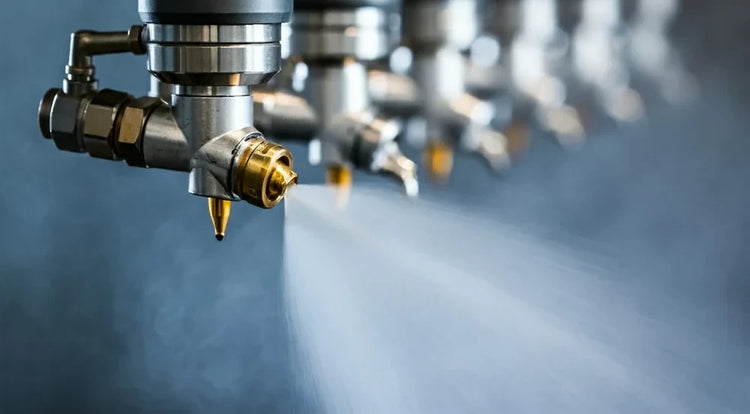
Spray Nozzle Case Studies

Real Solutions · Documented Results

Case Studies

How NozzlePro has helped food processors, bakeries, and manufacturers solve real spray challenges — reducing waste, improving consistency, and enabling automation.

3 Documented spray solutions
3 Industries represented
100% Customer challenges resolved

Featured Case Studies

Each case study documents a real customer challenge, the spray nozzle solution NozzlePro developed, and the measurable results achieved.

Artisan Bakery
Improving Bread Scoring Safety & Precision with Robotics and Precision Spray Nozzles

A growing artisanal bakery needed to automate a manual bread scoring process that posed worker safety risks and couldn't scale with production volume.

  • Eliminated worker safety risks from manual scoring
  • Achieved precise, repeatable scoring location on every loaf
  • Enabled full robotic automation of the scoring process
  • Maintained artisanal quality standards at scale
Meat Processing
Reducing Product Waste and Improving Moisture Consistency in Dried Meat Processing

Uneven smokehouse heating was causing product over-drying and inconsistent moisture levels — resulting in significant product rejection and profit loss.

  • Reduced product loss from over-drying and overcooking
  • Improved finished product moisture consistency
  • Recovered previously rejected product for sale
  • Improved overall production yield and profitability
Commercial Bakery
Reducing Release Agent Waste and Improving Bakery Efficiency Through Proper Nozzle Sizing

Over-application of release agent from worn, improperly sized nozzles was creating a cascade of production problems — from slippery floors to premature pan failure.

  • Significantly reduced release agent consumption
  • Eliminated overspray and airborne carryover
  • Reduced cleaning labor and pan maintenance costs
  • Improved pan glaze life and de-panning quality
How can the right spray nozzle solution reduce waste and improve production efficiency in food manufacturing?

The right spray nozzle solution addresses production inefficiency at its source — whether that is over-application of a processing aid, inconsistent moisture distribution, or a manual process that can't scale safely. NozzlePro's approach starts with understanding the specific process challenge: what liquid is being applied, where it needs to go, at what rate, and what the consequences are when the application is off-target or inconsistent. The documented results across NozzlePro's case studies show consistent themes: reduced material waste, improved product consistency, lower operating costs, and in some cases, full process automation. In each case, the spray nozzle solution was not simply selecting a nozzle from a catalog — it required matching nozzle type, orifice size, operating pressure, and spray pattern to the actual requirements of the process.

How NozzlePro Works With You

Every spray solution starts with understanding the process — not with selecting a nozzle from a catalog.

01

Understand the Challenge

We start by learning about your process — the liquid being applied, target surface, required coverage, operating pressure, and the specific problem you're trying to solve or prevent.

02

Develop a Matched Solution

We match nozzle type, orifice size, operating pressure, spray pattern, and material specification to your actual process requirements — not to a generic recommendation.

03

Supply & Support

We supply the specified nozzle and provide the technical reference you need for correct installation, operating pressure, and ongoing maintenance — so the solution performs as intended.

Frequently Asked Questions

Common questions about spray nozzle solutions for food processing, bakery, and manufacturing applications.

What types of spray challenges does NozzlePro help solve? +
NozzlePro helps solve spray challenges across a wide range of applications — from over-application of processing aids like release agents, to inconsistent moisture coverage in food drying processes, to enabling spray delivery in robotic and automated production systems. Common problems include overspray and material waste, inconsistent product coverage, incorrect droplet size for the intended application, nozzle wear causing performance drift over time, and chemical compatibility mismatches between nozzle materials and the liquid being sprayed. The starting point for any solution is understanding the specific process: what is being sprayed, where it needs to land, at what rate, and what the consequences are when the spray system underperforms. Contact NozzlePro with a description of your application and what problem you're experiencing or trying to prevent.
What information does NozzlePro need to recommend a nozzle solution? +
The most useful information for a nozzle recommendation includes: the liquid being sprayed (chemical name, viscosity, density if not water), the target surface or area (dimensions, material, orientation), the required flow rate or application rate per unit area, the available supply pressure at the nozzle, the number of application points, and the specific problem you're trying to solve — whether that's overspray, inconsistent coverage, incompatible nozzle materials, or something else. If you are replacing an existing nozzle, the current part number is the fastest starting point. If the current nozzle is unknown or unspecified, describing the performance symptoms you're seeing often allows NozzlePro to identify the likely cause and recommend a corrective specification.
Why does proper nozzle sizing matter — isn't any nozzle with the right connection size good enough? +
Connection size determines whether a nozzle physically fits — it says nothing about how the nozzle will perform in the application. The variables that determine spray performance are orifice size (which controls flow rate at a given pressure), spray angle (which controls coverage area at a given mounting distance), and nozzle design (which controls droplet size distribution, spray pattern uniformity, and how the spray behaves in the specific operating environment). A nozzle with the correct connection but an incorrectly sized orifice will deliver either too much or too little liquid — and the consequences compound downstream, as the bakery release agent case study demonstrates. In food manufacturing specifically, where liquid consumption, product quality, and workplace safety are all affected by spray performance, selecting a nozzle based solely on connection compatibility is a common source of production problems.
Does spray nozzle performance change over time, and how would I know? +
Yes — nozzle performance changes over time as orifice geometry changes from wear, scaling, or damage. An orifice that enlarges from wear flows more liquid than its rated capacity at the same pressure, producing a higher application rate than intended. A partially blocked orifice flows less, producing under-application. A damaged air cap on an air-atomizing nozzle changes the atomization pattern, producing a different droplet size distribution and spray shape than the nozzle was designed to deliver. The change is gradual and easy to miss until a symptom appears — higher material consumption, product quality variation, cleaning problems, or equipment wear. Establishing a periodic spray pattern check (spraying onto a flat surface at the operating distance to verify pattern shape and coverage) and a periodic flow rate check (measuring actual output against rated capacity) gives early warning of nozzle wear before it creates downstream problems. Contact NozzlePro if you suspect a nozzle in your system is no longer performing to specification.
What nozzle materials are safe for food-contact applications? +
316L stainless steel is the standard nozzle body material for food-contact spray applications. It is corrosion resistant, maintains a cleanable surface finish, is compatible with standard food facility cleaning and sanitizing chemistries, and is widely accepted in food manufacturing environments globally. PVDF is used in applications where chemical resistance requirements go beyond what stainless steel provides — such as applications involving acidic or oxidizing cleaning agents, or where the liquid being sprayed has unusual chemical properties. Polypropylene is appropriate for some lower-temperature, non-direct-food-contact applications. For sealing materials (O-rings, seats), food-grade elastomers such as silicone or EPDM are standard. Customers are responsible for confirming material suitability within their own food safety management systems — NozzlePro can provide material data sheets for the specific nozzle materials to support that evaluation.

Facing a Spray Challenge in Your Facility?

NozzlePro works with food processors, manufacturers, and industrial operations to diagnose spray problems and develop solutions matched to your specific process, liquid, and production requirements.

Talk to a Spray Specialist Browse Nozzle Collections