
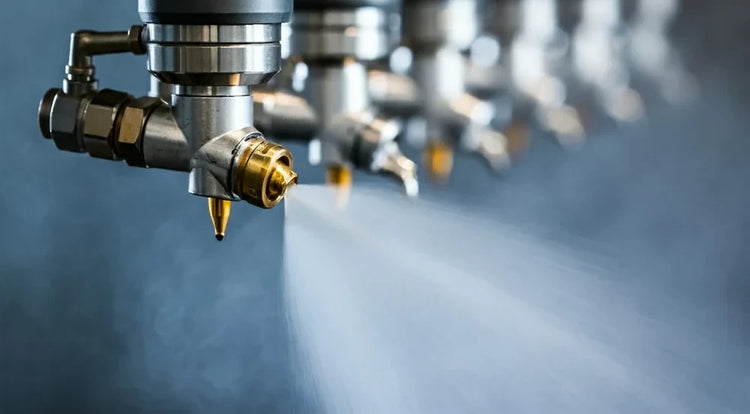
Tank Cleaning Spray Nozzles
CIP-ready spray nozzles for tanks, vessels, and processing equipment. Static spray balls, rotary jet heads, and orbital cleaners in sanitary stainless steel and industrial-grade materials.


Guide
Tank Cleaning Spray Nozzles: Overview & Selection Tips
This Tank Cleaning collection groups nozzles and assemblies commonly used for Tank Cleaning tasks across industrial lines. It makes it easier to compare nozzle types, spray patterns, materials, and connection options in one place.
Start with the process objective, then narrow by flow rate, operating pressure, coverage target, fluid compatibility, and maintenance needs. Related applications often include Tank Cleaning, Cleaning & Washing, Cooling & Quenching, and Dust & Pollution Control.
Key selection factors
- Compare nozzle types and assemblies commonly used for Tank Cleaning.
- Related process areas include Tank Cleaning, Cleaning & Washing, Cooling & Quenching, and Dust & Pollution Control.
- Focus on spray pattern and coverage style, flow rate, pressure, and coverage requirements.
- Material options may include 316L stainless steel, 303/304 stainless steel, PTFE, and PVDF.
Common applications
- Tank Cleaning
- Cleaning & Washing
- Cooling & Quenching
- Dust & Pollution Control
How to choose Tank Cleaning
- Start with the required flow rate and operating pressure at the nozzle or assembly.
- Choose the spray pattern and coverage style that best matches the coverage, impact, atomization, or washdown result you need.
- Confirm material compatibility using options such as 316L stainless steel, 303/304 stainless steel, PTFE, and PVDF.
- Finally, verify thread style and inlet size with NPT connections where available.
Related collections
What Are Tank Cleaning Spray Nozzles?
Tank cleaning nozzles deliver 360-degree rotating or static spray coverage inside vessels, ensuring complete internal surface contact.

Spray Pattern
Multiple spray patterns
Available SKUs
32 Products
Quality
Industrial Grade
Shipping
Ships Fast
How Tank Cleaning Nozzles Work
Each type of tank cleaning nozzle uses a different mechanism to achieve internal surface coverage:
Operating Principle
Tank cleaning nozzles operate by distributing cleaning liquid across vessel surfaces using different mechanical principles depending on the design. The level of cleaning effectiveness depends on spray coverage, impact force, and fluid dynamics.
Static Spray Balls: Static spray balls are the simplest and most widely used design. They consist of a hollow sphere or hemisphere with precision-drilled holes that distribute liquid in a cascading rinse pattern. The liquid exits at relatively low impact and flows down tank walls by gravity. With no moving parts, they are highly reliable, easy to maintain, and cost-effective. Best suited for light-to-moderate soiling where chemical action and contact time perform most of the cleaning.
Rotary Spray Heads (Spinning Spray Balls): Rotary spray heads use the reaction force of liquid jets to rotate and provide full 360° coverage. As the head spins, the spray continuously sweeps across interior surfaces, delivering greater impact than static designs. They are effective for moderate-to-heavy soiling, combining chemical cleaning with improved mechanical action.
Orbital Cleaners (Rotary Jet Heads): Orbital cleaners use a gear-driven mechanism to rotate high-velocity liquid jets in a precise three-dimensional pattern, ensuring complete coverage of all internal surfaces. These concentrated jets deliver significantly higher mechanical impact — typically 10–50× greater than spray balls — making them ideal for heavy soiling, stubborn residues, and demanding cleaning applications. They also reduce water and chemical usage but involve higher complexity and cost.
Selection Consideration: The choice between these designs depends on soiling level, required cleanliness standards, water and chemical consumption targets, and vessel size and geometry.
Tank Cleaning Nozzle Applications
Applications include IBC cleaning, process tank CIP, reactor vessel washout, storage tank cleaning, and food and chemical vessel sanitation.
Tank Cleaning
Clean tanks, vessels, and process equipment with spray coverage and mechanical action matched to residue, geometry, and cycle time.
Cleaning & Washing
Support rinsing, washdown, parts cleaning, and surface cleanup with coverage and impact matched to the soil load and line speed.
Cooling & Quenching
Control part temperature and process heat with spray coverage sized for the required cooling rate and heat removal.
Dust & Pollution Control
Capture airborne dust, cool gas streams, and suppress fugitive emissions with the right droplet size and coverage.
Selecting Tank Cleaning Nozzles
Match Nozzle throw distance, flow rate, rotation speed, and material to tank size, soil type, and chemical compatibility requirements.
Flow Rate & Pressure
Start with the flow rate you need at the operating pressure available at the nozzle or assembly.
Spray Pattern & Coverage
Choose the spray pattern and coverage style that best matches the coverage width, impact, atomization, or washdown result your process requires.
Materials & Connections
Select wetted materials compatible with the fluid, temperature, and wear conditions; common options may include 316L stainless steel, 303/304 stainless steel, PTFE, and PVDF with NPT connections where available.
Maintenance & Reliability
Consider clogging risk, wear life, ease of change-out, and the maintenance routine your process can realistically support.
Industries Using Tank Cleaning Spray Nozzles
Food and beverage, chemical, pharmaceutical, dairy, and brewery industries all rely on tank cleaning nozzles for hygienic vessel maintenance.
Tank Cleaning Nozzle FAQ
Common questions about tank cleaning nozzle coverage, rotation mechanisms, CIP validation, and selection for different vessel sizes.
What is the difference between a static spray ball and a rotary tank cleaning nozzle?
A static spray ball has no moving parts and distributes cleaning liquid through fixed holes in a cascading rinse pattern, relying on chemical action and contact time for cleaning. A rotary tank cleaning nozzle uses the reaction force of liquid jets or a gear-driven mechanism to rotate and sweep concentrated streams across the tank interior, providing higher mechanical impact. Static spray balls are simpler and cost-effective for light-to-moderate cleaning, while rotary and orbital cleaners are better suited for heavier soiling, larger tanks, and reduced water and chemical usage.
How do I size a tank cleaning nozzle for my vessel?
Start with tank diameter and height to ensure the nozzle provides sufficient spray coverage and throw. Manufacturers provide coverage charts showing the maximum tank size each nozzle can clean effectively. As a general guideline, static spray balls suit tanks up to around 10 feet, rotary heads up to 15–20 feet, and orbital cleaners for 30 feet or larger. Also calculate total flow rate to ensure all surfaces are wetted within the cleaning cycle time.
Are tank cleaning nozzles compatible with CIP chemicals?
Yes, tank cleaning nozzles are designed for use with standard CIP chemicals such as caustic soda, nitric acid, phosphoric acid, peracetic acid, and chlorinated detergents. 316L stainless steel is commonly used for sanitary applications. For aggressive chemicals, materials like PVDF or specialized alloys may be required. Always verify compatibility of seals and gaskets such as EPDM, Viton, or PTFE with your cleaning chemicals.
What cleaning validation considerations apply to tank cleaning nozzles?
In regulated industries like food, pharma, and biotech, cleaning systems must deliver consistent and verifiable coverage. Key validation factors include spray coverage testing, shadow zone analysis, repeatable cycle times, and routine inspection procedures. Rotary jet heads are often preferred because their controlled spray patterns are predictable and easier to validate.
How often should tank cleaning nozzles be inspected or replaced?
Inspection frequency depends on application severity and compliance requirements. Static spray balls should be visually inspected regularly for clogging or wear and thoroughly checked at scheduled intervals. Rotary and orbital nozzles should be inspected according to manufacturer guidelines, focusing on moving parts such as bearings and seals. Replace nozzles when spray performance declines or as part of a preventive maintenance schedule to avoid downtime.
Related Tank and Vessel Cleaning Products
CIP spray balls, eductor nozzles, and solid stream nozzles complement tank cleaning nozzles in complete vessel cleaning systems.

CY21370
Compare CY21370 by fit-up, material compatibility, durability, and maintenance requirements in industrial spray systems.

NPD
Compare NPD by spray performance, material compatibility, connection size, and application fit.
NP360E
Compare NP360E spray nozzles and assemblies by spray pattern, pressure, materials, and connection requirements.
NPKZ75
Compare NPKZ75 spray nozzles and assemblies by spray pattern, pressure, materials, and connection requirements.

NPSL
Compare NPSL spray nozzles and assemblies by spray pattern, pressure, materials, and connection requirements.
NPDN15
Compare NPDN15 spray nozzles and assemblies by spray pattern, pressure, materials, and connection requirements.
NPDN20
Compare NPDN20 spray nozzles and assemblies by spray pattern, pressure, materials, and connection requirements.

NPKX
Compare NPKX spray nozzles and assemblies by spray pattern, pressure, materials, and connection requirements.
Need Help Selecting the Right Nozzle?
Our engineering team is ready to help you find the perfect spray solution for your application.