
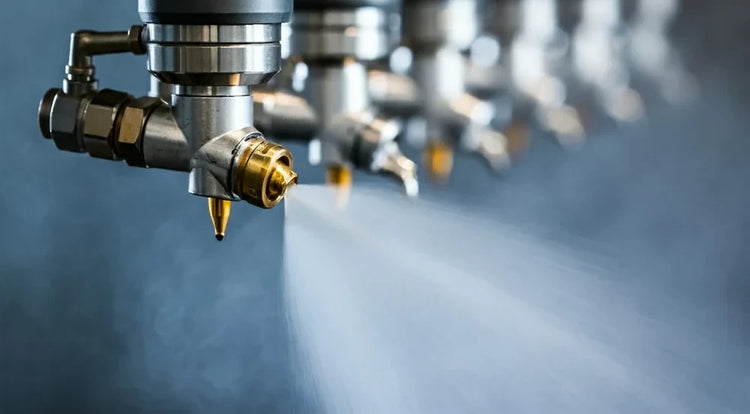
Mining Nozzles
Industrial spray nozzles for dust suppression, ore washing, slurry transport, and underground mining operations. Engineered for abrasive environments in tungsten carbide, stainless steel, and hardened alloys. Browse NozzlePro's mining spray nozzles, purpose-built for the harsh conditions found in surface mining, underground operations, mineral processing plants, and material handling facilities. Available in full cone, flat fan, solid stream, and air atomizing configurations. Select by application type, material of construction, flow rate, and connection size.


Guide
Mining Nozzles: Overview & Selection Tips
This Mining collection highlights spray nozzles and assemblies commonly selected for mining operations. It helps engineers compare process fit, spray performance, material options, and maintenance requirements.
Common spray tasks in this environment include Cleaning & Washing, Coating & Surface Treatment, Cooling & Quenching, and Humidification & Conditioning. Final selection depends on chemistry, pressure, coverage requirements, and how easily the Nozzle or assembly can be maintained on the line.
Key selection factors
- Common spray tasks in this industry include Cleaning & Washing, Coating & Surface Treatment, Cooling & Quenching, and Humidification & Conditioning.
- Compare spray performance, chemical compatibility, and maintenance fit for the production environment.
- Material options may include 316L stainless steel, brass, 303/304 stainless steel, and hardened stainless steel.
- Check inlet sizes such as 1/4 in., 1/8 in., 3/8 in., and 1/2 in. with NPT connections where available.
Common applications
- Cleaning & Washing
- Coating & Surface Treatment
- Cooling & Quenching
- Humidification & Conditioning
How to choose Mining Nozzles
- Start with the required flow rate and operating pressure at the nozzle or assembly.
- Choose the spray pattern and coverage style that best matches the coverage, impact, atomization, or washdown result you need.
- Confirm material compatibility using options such as 316L stainless steel, brass, 303/304 stainless steel, and hardened stainless steel.
- Finally, verify thread style and inlet size, including 1/4 in., 1/8 in., 3/8 in., and 1/2 in. with NPT connections where available.
Related collections
Cleaning & Washing | Coating & Surface Treatment | Cooling & Quenching | Humidification & Conditioning
Heavy-Duty Spray Nozzles for Mining and Mineral Processing
Mining spray nozzles handle abrasive slurries, dust suppression, and ore processing with the durability that demanding mine environments require.

Spray Pattern
Multiple spray patterns
Available SKUs
5385 Products
Quality
Industrial Grade
Shipping
Ships Fast
How Mining Nozzles Work?
Mining nozzles operate on the same hydraulic and pneumatic principles as all industrial spray nozzles, but are configured specifically for mining conditions:
Dust suppression nozzles
produce fine water droplets (typically 10–150 microns) that capture and agglomerate airborne dust particles. The key principle is matching droplet size to particle size — the most effective suppression occurs when the water droplets are close in size to the dust particles they need to capture. Too-large droplets fall without capturing fine dust; too-fine a mist evaporates before contact. Full cone, hollow cone, and air atomizing nozzles are used depending on the coverage area, water availability, and dust particle size distribution.
Ore washing and classification nozzles
Use high-impact flat fan or solid stream spray patterns to separate valuable minerals from waste material, wash oversize material on screens and trommels, and classify ore by size. These nozzles operate at higher pressures (60–1,500+ PSI) and must deliver consistent impact force across the spray footprint to ensure efficient material separation.
Slurry transport and tank mixing nozzles
typically eductor nozzles or full cone nozzles, create turbulence and fluid movement to keep solids suspended in slurry pipelines, mixing tanks, and settling basins. In acidic leach circuits, they must resist both chemical corrosion and particulate abrasion simultaneously.
Gas scrubbing nozzles
inject scrubbing liquor into exhaust gas streams from smelters, kilns, and drying operations. Full cone and spiral nozzles distribute the liquid uniformly across the scrubber cross-section for maximum gas-liquid contact and pollutant removal.
Mining Spray Nozzle Applications
Key applications include haul road dust suppression, conveyor belt dust control, ore crushing cooling, and heap leach irrigation.
Cleaning & Washing
haul roads, transfer points, and stockpiles - Controlling respirable and nuisance dust at truck loading zones, conveyor transfer points, crusher discharge areas, stockpile surfaces, and unpaved haul roads. This is the highest-volume mining nozzle application. Nozzle selection determines water consumption efficiency, dust capture rate, and whether the material becomes over-wet.
Coating & Surface Treatment
Apply coatings, chemicals, and pretreatment fluids with repeatable coverage and controlled transfer efficiency.
Cooling & Quenching
Control part temperature and process heat with spray coverage sized for the required cooling rate and heat removal.
Humidification & Conditioning
Produce droplets suited to humidity control, evaporative conditioning, and air treatment tasks.
Selecting Spray Nozzles for Mining
Choose wear-resistant materials like tungsten carbide or ceramic for abrasive slurry service, and consider clog-free designs for dusty environments.
Flow Rate & Pressure
Start with the flow rate you need at the operating pressure available at the nozzle or assembly.
Spray Pattern & Coverage
Choose the spray pattern and coverage style that best matches the coverage width, impact, atomization, or washdown result your process requires.
Materials & Connections
Select wetted materials compatible with the fluid, temperature, and wear conditions; common options may include 316L stainless steel, brass, 303/304 stainless steel, and hardened stainless steel; common sizes include 1/4 in., 1/8 in., 3/8 in., and 1/2 in. with NPT connections where available.
Maintenance & Reliability
Consider clogging risk, wear life, ease of change-out, and the maintenance routine your process can realistically support.
Mining Industry Spray Applications
Coal, gold, copper, iron ore, aggregates, and mineral processing operations all depend on industrial spray nozzles for safe, efficient production.
Mining Spray Nozzle FAQ
Common questions about nozzle wear life, abrasion resistance, dust suppression performance, and maintenance in mining environments.
What nozzle material should I use for mining applications?
It depends on the wear mechanism. For abrasion from ore, rock, sand, or slurry, use tungsten carbide or silicon carbide inserts, these materials offer 10–50x the service life of stainless steel in abrasive conditions. For chemical corrosion (acid leach, alkaline processing), use 316L stainless steel, Hastelloy, or PVDF depending on the specific chemicals and temperatures involved. In combined abrasion-plus-corrosion service (the most common mining scenario), tungsten carbide orifices in stainless steel bodies are the standard solution. Always compare the cost of a wear-resistant nozzle against the downtime cost of frequent replacements in most mining operations, the longer-life nozzle pays for itself quickly.
How do I control dust suppression water consumption in mining?
The key is matching droplet size to dust particle size and applying water only where and when it is needed. Air atomizing nozzles produce the finest droplets with the least water consumption, they are ideal for enclosed transfer points and crusher areas. For open-area applications (haul roads, stockpiles), full cone or hollow cone nozzles at controlled pressures provide broad coverage with manageable water use. Automated systems with dust sensors or timer controls prevent over-wetting. As a guideline, effective dust suppression typically requires 0.5–2% moisture content by weight of the material being treated, exceeding this wastes water and can create handling problems.
What nozzles are used for underground mining dust suppression?
Underground dust suppression typically uses compact hollow cone or air atomizing nozzles mounted directly on mining equipment, longwall shearers, continuous miners, roof bolters, and shuttle cars. The confined space requires small-diameter nozzles with high atomization quality to capture respirable dust (under 10 microns) without creating visibility problems from excess mist. External spray bars at transfer points and dump stations use flat fan or full cone nozzles for broader area coverage. Water pressure is often limited underground, so nozzle selection must account for available supply pressure (commonly 60–150 PSI at the nozzle).
How often should mining nozzles be replaced?
Replacement frequency varies dramatically depending on the abrasion severity, nozzle material, and operating conditions. Stainless steel nozzles in heavy slurry service may wear out in days to weeks. Tungsten carbide nozzles in the same service may last months. The key indicator is flow rate drift, as the orifice erodes, the nozzle passes more water at the same pressure, which changes the spray pattern, droplet size, and coverage. Establish a baseline flow rate for each nozzle position and replace when flow exceeds 10–15% of the original specification. Implement a scheduled inspection program based on your specific wear rate.
Can I use the same nozzles for both dust suppression and ore washing?
No, these are fundamentally different applications. Dust suppression requires fine droplets (10–150 microns) at relatively low flow rates to capture airborne particles without over-wetting material. Ore washing requires high-impact streams at high flow rates and pressures to physically dislodge clay, dirt, and fines from rock surfaces. Using a dust suppression nozzle for washing gives insufficient cleaning impact; using a washing nozzle for dust suppression wastes water and saturates the material. Select the correct nozzle type for each specific application point.
How do pressure and flow affect Nozzle selection in Mining?
Flow rate and pressure determine coverage, impact, and droplet formation, so they should be defined before the final series is chosen.
Which processes in Mining are most likely to need maintenance-focused Nozzle choices?
Processes with abrasive media, sticky fluids, scale buildup, or limited access usually benefit from designs that are easier to service or replace.
How can I reduce clogging and wear in Mining spray systems?
Match material and orifice design to the fluid and contamination level, then verify filtration, cleaning practices, and replacement intervals.
When should I contact NozzlePro about Mining applications?
Reach out when the process has tight performance requirements, difficult chemistry, sanitation demands, or multiple candidate Nozzle types to compare.
Related Mining Spray Products
Spiral nozzles, tungsten carbide tips, and fog mist systems serve the abrasive and dust control needs of mining operations.

NPHU
Compare NPHU by spray performance, material compatibility, connection size, and application fit.

NP3U
Compare NP3U by spray performance, material compatibility, connection size, and application fit.

NPHV
Compare NPHV by spray performance, material compatibility, connection size, and application fit.

NPHVL
Compare NPHVL by spray performance, material compatibility, connection size, and application fit.

NPSJ
Compare NPSJ by spray performance, material compatibility, connection size, and application fit.

NPHSJ
Compare NPHSJ by spray performance, material compatibility, connection size, and application fit.

NPMEG
Compare NPMEG by spray performance, material compatibility, connection size, and application fit.

NPSAMEG
Compare NPSAMEG by spray performance, material compatibility, connection size, and application fit.
Need Help Selecting the Right Nozzle?
Our engineering team is ready to help you find the perfect spray solution for your application.