
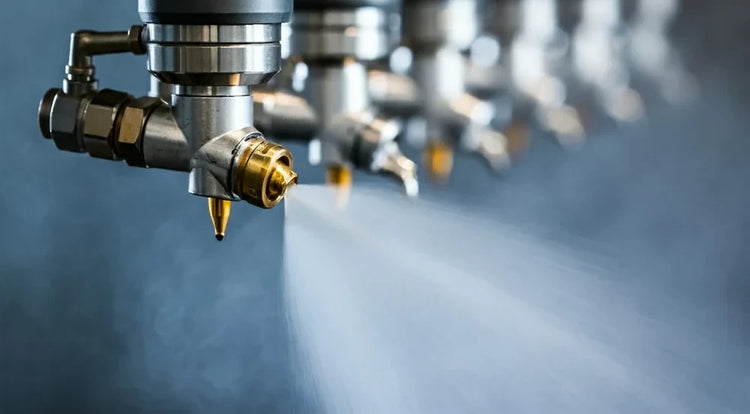
Food & Beverage Spray Nozzles
Food and beverage spray nozzles are engineered for hygienic processing environments where material safety, cleanability, and consistent spray performance are required by regulation and production standards. NozzlePro food processing nozzles are available in 316L stainless steel and food-grade polymer construction with crevice-free designs for direct and indirect product contact. Applications include CIP cleaning, conveyor lubrication, batter and coating application, pasteurization rinsing, frying oil misting, and high-pressure equipment washdown across meat processing, dairy, bakery, snack food, and beverage bottling facilities.


Guide
Food & Beverage Nozzles: Overview & Selection Tips
This Food & Beverage collection highlights spray nozzles and assemblies commonly selected for Food & Beverage operations. It helps engineers compare process fit, spray performance, material options, and maintenance requirements.
Common spray tasks in this environment include Cleaning & Washing, Coating & Surface Treatment, Cooling & Quenching, and Humidification & Conditioning. Final selection depends on chemistry, pressure, coverage requirements, and how easily the Nozzle or assembly can be maintained on the line.
Key selection factors
- Common spray tasks in this industry include Cleaning & Washing, Coating & Surface Treatment, Cooling & Quenching, and Humidification & Conditioning.
- Compare spray performance, chemical compatibility, and maintenance fit for the production environment.
- Material options may include 303/304 stainless steel, brass, 316L stainless steel, and hardened stainless steel.
- Check inlet sizes such as 1/4 in., 1/8 in., 3/8 in., and 1/2 in. with NPT connections where available.
Common applications
- Cleaning & Washing
- Coating & Surface Treatment
- Cooling & Quenching
- Humidification & Conditioning
How to choose Food & Beverage
- Start with the required flow rate and operating pressure at the nozzle or assembly.
- Choose the spray pattern and coverage style that best matches the coverage, impact, atomization, or washdown result you need.
- Confirm material compatibility using options such as 303/304 stainless steel, brass, 316L stainless steel, and hardened stainless steel.
- Finally, verify thread style and inlet size, including 1/4 in., 1/8 in., 3/8 in., and 1/2 in. with NPT connections where available.
Related collections
Cleaning & Washing | Coating & Surface Treatment | Cooling & Quenching | Humidification & Conditioning
Food & Beverage Spray Nozzles for Hygienic Processing and Washdown
Food-grade spray nozzles meet 3-A and USDA standards for cleaning, coating, and rinsing in hygienic food and beverage production environments.

Spray Pattern
Multiple spray patterns
Available SKUs
5723 Products
Quality
Industrial Grade
Shipping
Ships Fast
How Food Processing Spray Nozzles Are Designed for Hygienic Environments
Sanitary Nozzles clean product contact surfaces, apply coatings and release agents, and rinse equipment without harboring bacterial growth.
Operating Context
Food processing spray nozzles use the same hydraulic atomization principles as standard industrial nozzles - flat fan, full cone, hollow cone, and fog patterns are all available, but the construction standards are different at every point. Bodies are machined from 316L stainless steel rather than 303/304 SS, eliminating crevices, threads, and surface features that trap food particles and support bacterial growth. Inlet connections use sanitary clamp, tri-clover, or hygienic thread fittings that allow full-bore flow and tool-free disassembly for inspection. Internal surfaces are smooth and polished to a hygienic finish, with no blind ports or dead legs where product can accumulate. CIP-compatible designs allow cleaning solution to flow through the full nozzle assembly at elevated temperature and concentration without disassembly, and are constructed from materials that withstand repeated exposure to sodium hydroxide, peracetic acid, and hypochlorite at standard CIP temperatures. The result is a nozzle that delivers reliable, consistent spray performance while meeting the hygienic design requirements of food processing audits and USDA facility standards.
What to Compare
Compare spray performance, material compatibility, including 303/304 stainless steel, brass, 316L stainless steel, and hardened stainless steel, and connection details such as 1/4 in., 1/8 in., 3/8 in., and 1/2 in. with NPT connections where available.
Selection Guidance
Start with the process objective, then narrow by chemistry, coverage, pressure, and maintenance access for the equipment on your line.
Food and Beverage Spray Applications
Key applications include CIP cleaning, conveyor lubrication, batter coating, frying oil misting, pasteurization, and product rinsing.
Cleaning & Washing
Support rinsing, washdown, parts cleaning, and surface cleanup with coverage and impact matched to the soil load and line speed.
Coating & Surface Treatment
Apply coatings, chemicals, and pretreatment fluids with repeatable coverage and controlled transfer efficiency.
Cooling & Quenching
Control part temperature and process heat with spray coverage sized for the required cooling rate and heat removal.
Humidification & Conditioning
Produce droplets suited to humidity control, evaporative conditioning, and air treatment tasks.
Selecting Food-Grade Spray Nozzles
Specify crevice-free designs, 316SS or food-grade polymer materials, and CIP compatibility to meet food safety requirements.
Flow Rate & Pressure
Start with the flow rate you need at the operating pressure available at the nozzle or assembly.
Spray Pattern & Coverage
Choose the spray pattern and coverage style that best matches the coverage width, impact, atomization, or washdown result your process requires.
Materials & Connections
Select wetted materials compatible with the fluid, temperature, and wear conditions; common options may include 303/304 stainless steel, brass, 316L stainless steel, and hardened stainless steel; common sizes include 1/4 in., 1/8 in., 3/8 in., and 1/2 in. with NPT connections where available.
Maintenance & Reliability
Consider clogging risk, wear life, ease of change-out, and the maintenance routine your process can realistically support.
Food and Beverage Industries Using Spray Nozzles
Meat processing, bakeries, breweries, beverage bottling, dairy, and snack food manufacturers all rely on sanitary spray nozzles.
Food and Beverage Spray Nozzle FAQ
Common questions about hygienic design standards, cleanability, material certifications, and CIP performance for food industry nozzles.
What is a food-grade spray nozzle?
A food-grade spray nozzle is constructed from materials certified safe for direct or indirect food contact, typically 316L stainless steel, food-grade PTFE, or food-grade polypropylene, with a crevice-free external profile that prevents bacterial harboring. They conform to 3-A Sanitary Standards and/or USDA guidelines and are designed to be fully cleanable in CIP systems without disassembly. Standard industrial spray nozzles (303/304 SS, threaded connections, unpolished surfaces) do not meet these requirements.
What spray nozzles are used for CIP (clean-in-place) systems?
CIP systems use high-flow flat fan, full cone, and solid stream nozzles mounted in fixed spray balls or rotating heads to deliver cleaning solution at the impact force and coverage required to remove product residue from vessel walls, pipework, and equipment surfaces without manual intervention. Nozzle selection depends on vessel geometry, cleaning chemistry concentration, and required impingement force. NozzlePro CIP nozzles are available in sanitary clamp, hygienic thread, and tri-clover fitting configurations in 316L stainless steel.
What spray pattern works best in Food & Beverage?
The best spray pattern and coverage style depends on the process result you need, the available pressure, and how the spray has to interact with the part, surface, or environment.
What material should be specified for food and beverage spray nozzles?
316L stainless steel is the standard material for food contact applications. It provides superior corrosion resistance compared to 303/304 SS and is widely accepted under 3-A and USDA standards. PTFE (Teflon) is specified for applications involving aggressive cleaning chemistries that attack stainless steel, or where metal ions cannot be tolerated in the process fluid. Food-grade polypropylene is suitable for low-temperature, low-pressure applications such as ambient rinsing and non-contact spray systems.
How do pressure and flow affect Nozzle selection in Food & Beverage?
Flow rate and pressure determine coverage, impact, and droplet formation, so they should be defined before the final series is chosen.
Which processes in Food & Beverage are most likely to need maintenance-focused Nozzle choices?
Processes with abrasive media, sticky fluids, scale buildup, or limited access usually benefit from designs that are easier to service or replace.
How can I reduce clogging and wear in Food & Beverage spray systems?
Match material and orifice design to the fluid and contamination level, then verify filtration, cleaning practices, and replacement intervals.
Do food processing spray nozzles need to be CIP-compatible?
Yes, in most food processing environments. CIP compatibility means the nozzle can be cleaned in place without disassembly, resists repeated exposure to standard cleaning and sanitizing chemicals at elevated temperatures (typically 70–90°C), and presents no crevices or dead zones where residue can accumulate. CIP-compatible NozzlePro food nozzles are designed with hygienic external profiles and rated for the specific chemical concentrations and temperatures used in standard CIP protocols.
Related Sanitary Spray Products
Tank cleaning nozzles, CIP spray balls, and flat fan wash nozzles complement food processing spray systems.

NPHU
Compare NPHU by spray performance, material compatibility, connection size, and application fit.

NP3U
Compare NP3U by spray performance, material compatibility, connection size, and application fit.

NPHV
Compare NPHV by spray performance, material compatibility, connection size, and application fit.

NPHVL
Compare NPHVL by spray performance, material compatibility, connection size, and application fit.

NPQV
Compare NPQV by spray performance, material compatibility, connection size, and application fit.

NPQU
Compare NPQU by spray performance, material compatibility, connection size, and application fit.

NPMEG
Compare NPMEG by spray performance, material compatibility, connection size, and application fit.

NPSAMEG
Compare NPSAMEG by spray performance, material compatibility, connection size, and application fit.
Need Help Selecting the Right Nozzle?
Our engineering team is ready to help you find the perfect spray solution for your application.