
⚠️ Sorry, no products available
This collection doesn't have any products yet. Please check back later or browse our other collections.
Browse CollectionsWhat Are Air Atomizing Spray Nozzles?
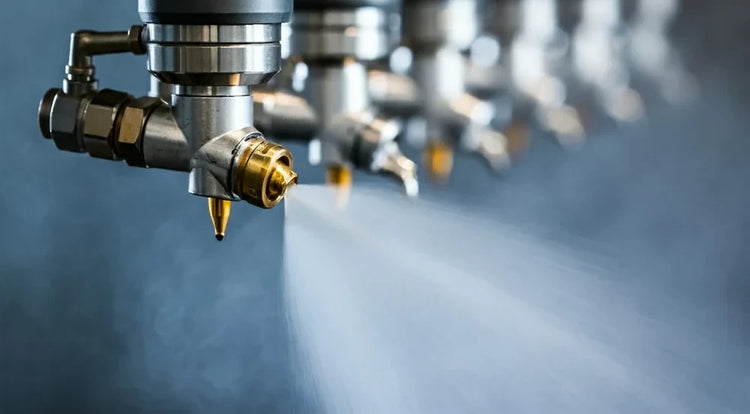
Air atomizing nozzles use compressed air to break liquid into ultra-fine droplets, delivering precise spray control for critical processes.

Spray Pattern
Air Atomizing
Available SKUs
0 Products
Quality
Industrial Grade
Shipping
Ships Fast
How Air Atomizing Nozzles Work
Compressed air and liquid meet at the Nozzle tip, shearing the fluid into fine, uniform droplets across a controlled spray pattern.
Operating Principle
Air atomizing nozzles operate on the principle of pneumatic atomization, where compressed air (typically 10–100 PSI) interacts with liquid feed to produce fine droplets. A high-velocity air stream shears the liquid into droplets, enabling precise control over spray quality and atomization.
Internal Mix Nozzles: Internal mix nozzles combine air and liquid inside a mixing chamber before exiting through a single orifice. This produces the finest droplets and most uniform spray patterns, making them ideal for low-flow applications and fine atomization requirements. However, they are not suitable for intermittent spray cycles because liquid remains in the chamber when the flow stops.
External Mix Nozzles: External mix nozzles keep air and liquid separate until they meet at the nozzle cap. The air streams impact the liquid outside the orifice, breaking it into droplets. These nozzles are better suited for intermittent operation, viscous fluids, and applications requiring independent control of air and liquid. They produce slightly larger droplets but offer greater flexibility and reliability.
Key Performance Variables:
• Air Pressure: Higher air pressure produces finer droplets and wider spray dispersion.
• Liquid Viscosity: Higher viscosity fluids require more air energy for proper atomization.
• Air-to-Liquid Ratio: Controls droplet size and spray quality.
• Nozzle Geometry: Determines spray pattern and distribution characteristics.
Engineers can adjust these parameters to achieve target droplet sizes (VMD/SMD) and optimize performance for specific industrial
Air Atomizing Nozzle Applications
These Nozzles are used for humidification, cooling, coating, lubrication, and chemical injection requiring fine droplet size.
Coating & Lubrication
Apply thin, uniform layers of lubricants, release agents, coatings, and adhesives onto surfaces, molds, conveyors, and parts. Air atomizing nozzles minimize material waste by delivering precisely controlled spray volumes with consistent coverage.
Humidification & Moisture Control
Maintain controlled humidity in cleanrooms, data centers, textile mills, printing facilities, and HVAC systems. Fine droplets (typically under 30 microns) evaporate quickly without wetting surfaces or equipment.
Gas Cooling & Conditioning
Inject water into hot gas streams in flue gas treatment, cement kilns, steel mills, and power plants. Fine atomization enables rapid evaporation and efficient temperature reduction without liquid carryover.
Dust Suppression
Control airborne particulates in mining operations, transfer points, demolition sites, and bulk material handling. Fine mist captures respirable dust without saturating the material.
Chemical Treatment & Injection
Meter and disperse reagents, catalysts, and treatment chemicals into process streams. Air atomizing nozzles provide precise dosing at low flow rates for consistent process control.
Food & Pharmaceutical Processing
Support spray drying, tablet coating, flavor application, and sanitization in hygienic environments where droplet size control and uniform coverage are critical.
How to Select the Right Air Atomizing Nozzle
Key factors for choosing the ideal nozzle for your application
Flow Rate & Pressure
Start with the flow rate you need at the operating pressure available at the nozzle or assembly.
Spray Pattern & Coverage
Choose the air atomizing spray pattern that best matches the coverage width, impact, atomization, or washdown result your process requires.
Materials & Connections
Select wetted materials compatible with the fluid, temperature, and wear conditions; common options may include 303/304 stainless steel, brass, 316L stainless steel, and nickel-plated brass; common sizes include 1/4 in., 3/16 in., 1/8 in., and 3/4 in. with NPT connections where available.
Maintenance & Reliability
Consider clogging risk, wear life, ease of change-out, and the maintenance routine your process can realistically support.
Industries Using Air Atomizing Spray Nozzles
Pharmaceutical, food processing, chemical, and electronics industries depend on air atomizing nozzles for critical fine-spray applications.
Air Atomizing Nozzle FAQ
Answers to common questions about droplet size, air pressure, flow control, and air atomizing nozzle maintenance.
What is the difference between internal mix and external mix air atomizing nozzles?
Internal mix air atomizing nozzles combine compressed air and liquid inside the nozzle body before exiting through a single orifice, producing the finest droplets and most uniform spray. They are best suited for continuous, low-flow applications with clean liquids. External mix nozzles keep air and liquid separate until they meet outside the nozzle tip, making them ideal for intermittent spray-on/spray-off operation, viscous fluids, and applications requiring independent control. External mix designs produce slightly larger droplets but offer greater flexibility and resistance to clogging.
What droplet size can air atomizing nozzles produce?
Air atomizing nozzles typically produce droplets in the 10–100 micron range (VMD), depending on nozzle type, air pressure, liquid pressure, and fluid properties. Internal mix designs can achieve droplets as fine as 10–20 microns at higher air-to-liquid ratios, while external mix nozzles generally produce droplets in the 20–80 micron range. Increasing air pressure reduces droplet size, while higher liquid viscosity or flow rate increases it.
How much compressed air do air atomizing nozzles consume?
Air consumption depends on nozzle design, air cap configuration, and operating pressure, typically ranging from 2 SCFM to 20+ SCFM per nozzle. Internal mix nozzles generally consume more air because atomization occurs within the chamber. When using multiple nozzles, total air demand should be calculated by multiplying SCFM per nozzle by the number of nozzles, with an additional 20–30% safety margin to ensure consistent system performance.
Can air atomizing nozzles handle viscous liquids?
Yes, but nozzle configuration is important. External mix nozzles are preferred for viscous fluids because they keep air and liquid separate, reducing the risk of clogging. They can handle liquids with viscosities up to several hundred centipoise depending on air pressure. Internal mix nozzles are better suited for low-viscosity, clean liquids and may struggle with thicker materials.
What maintenance do air atomizing nozzles require?
Routine maintenance includes cleaning the air cap and liquid orifice, checking for buildup or wear, and ensuring air and liquid pressures remain within specified ranges. Use compatible solvents for cleaning and avoid metal tools that could damage precision components. Replace worn air caps and fluid tips regularly, as even minor wear can affect spray quality. For critical operations, keep spare nozzle assemblies available to minimize downtime.
Related Fine-Spray Nozzle Types
Fog and mist nozzles, humidification systems, and hydraulic atomizing nozzles address overlapping fine-spray requirements.

NPMAS
Compare NPMAS by spray performance, material compatibility, connection size, and application fit.

NPFAS
Compare NPFAS by spray performance, material compatibility, connection size, and application fit.

NPFA
Compare NPFA by spray performance, material compatibility, connection size, and application fit.

NPMA
Compare NPMA by spray performance, material compatibility, connection size, and application fit.

NPM
Compare NPM by spray performance, material compatibility, connection size, and application fit.

NPFD
Compare NPFD by spray performance, material compatibility, connection size, and application fit.

NPJM
Compare NPJM by spray performance, material compatibility, connection size, and application fit.

NP7G
Compare NP7G by spray performance, material compatibility, connection size, and application fit.
Need Help Selecting the Right Nozzle?
Our engineering team is ready to help you find the perfect spray solution for your application.