

Puntos clave
-
Las boquillas atomizadoras de aire utilizan aire comprimido para descomponer el líquido en finas gotas, ofreciendo un control superior sobre las características de pulverización en comparación con las boquillas hidráulicas.
-
Los diseños de mezcla interna combinan aire y líquido dentro de la boquilla para una atomización más fina, mientras que las configuraciones de mezcla externa mantienen los fluidos separados para una manipulación más segura de materiales reactivos.
-
El control del tamaño de la gota es la ventaja crítica, con boquillas atomizadoras de aire que producen partículas que van de 10 a 200 micras, dependiendo de los requisitos de la aplicación.
- Estas boquillas destacan en aplicaciones de precisión como recubrimiento, humidificación, dosificación química y fabricación farmacéutica, donde la uniformidad de las gotas impacta directamente en la calidad del producto.
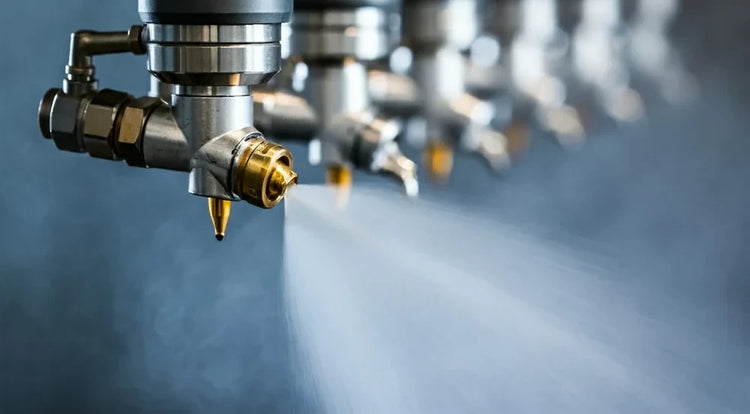
Las boquillas atomizadoras de aire representan una tecnología fundamental en los procesos industriales modernos donde la calidad de la pulverización es importante. A diferencia de sus contrapartes hidráulicas que dependen puramente de la presión del líquido, las boquillas atomizadoras de aire aprovechan el aire comprimido para lograr un control de atomización excepcional.
La distinción se reduce al control y la flexibilidad. Las boquillas hidráulicas fuerzan el líquido a través de pequeños orificios a alta presión. Las boquillas atomizadoras de aire usan energía de aire comprimido para cortar el líquido en gotas, dando a los operadores un control independiente sobre el caudal y el tamaño de la gota.
La atomización por aire se convierte en la opción preferida cuando los procesos exigen gotas finas por debajo de las 100 micras, cuando se trabaja con fluidos viscosos o cuando las características de pulverización necesitan ajuste sin cambiar el hardware. Las industrias donde esta precisión resulta fundamental incluyen el recubrimiento automotriz, el recubrimiento de tabletas farmacéuticas, la humidificación en el procesamiento de alimentos y la fabricación de semiconductores.
¿Qué son las boquillas atomizadoras de aire?
Las boquillas atomizadoras de aire son dispositivos de precisión que mezclan aire comprimido con líquido para producir patrones de pulverización controlados. El aire comprimido proporciona energía cinética para romper los chorros de líquido en pequeñas gotas.
La diferencia clave con las boquillas pulverizadoras hidráulicas radica en cómo se produce la atomización. Las boquillas hidráulicas requieren una presión de líquido de 40 a 300 psi. Las boquillas atomizadoras de aire operan con presiones de líquido tan bajas como de 5 a 30 psi porque el aire comprimido realiza la mayor parte del trabajo.
Este aire comprimido permite un control más fino de las gotas al proporcionar una entrada de energía independiente del flujo de líquido. Puede ajustar la presión del aire para hacer las gotas más finas o más gruesas mientras mantiene el mismo caudal de líquido.
Los rangos operativos típicos incluyen presiones de aire entre 20 y 100 psi y presiones de líquido de 5 a 50 psi. La presión de líquido relativamente baja significa sistemas de bombeo más simples y una operación más segura con materiales peligrosos.
Cómo funcionan las boquillas atomizadoras de aire
El papel del aire comprimido en la atomización
El aire comprimido descompone el líquido en gotas mediante fuerzas de cizallamiento y turbulencias. A medida que el aire de alta velocidad entra en contacto con el chorro de líquido, crea inestabilidades superficiales que se convierten en ligamentos que se separan en gotas.
La relación aire-líquido (RAL) cuantifica la cantidad de aire que se utiliza en relación con el flujo de líquido. Los rangos típicos de RAL van de 0,1:1 a 2:1 en volumen. Las RAL más altas producen gotas más finas pero consumen más aire comprimido.
Debido a que el aire proporciona energía de atomización, la presión del líquido puede ser mucho menor que en las boquillas hidráulicas. Una aplicación de recubrimiento que requiere 80 psi hidráulicamente podría funcionar con una presión de líquido de 15 psi y una presión de aire de 60 psi.
Mezcla interna vs. mezcla externa
Las boquillas de mezcla interna combinan aire y líquido dentro del cuerpo de la boquilla antes de la eyección. La cámara de mezcla crea una turbulencia intensa que produce gotas muy finas, a menudo de 10 a 50 micras. Estas son excelentes cuando se necesita la atomización más fina con fluidos limpios no reactivos.
Las boquillas de mezcla externa mantienen el aire y el líquido separados hasta que salen de la boquilla. Esta configuración es más segura para materiales reactivos, corrosivos o de alta viscosidad. Los diseños de mezcla externa ofrecen una limpieza más fácil y relaciones de reducción más amplias.
Al elegir, considere primero la viscosidad. Los fluidos por encima de 200 centipoises funcionan mejor con mezcla externa. Para la seguridad con fluidos reactivos, la mezcla externa es la elección clara. Para la atomización más fina de líquidos limpios, la mezcla interna ofrece resultados superiores.
Tipos de boquillas atomizadoras de aire
Comprender los tipos de boquillas atomizadoras de aire ayuda a adaptar el hardware a los requisitos. La guía de tipos de boquillas pulverizadoras cubre una tecnología más amplia, pero las boquillas pulverizadoras neumáticas merecen una atención específica.
Boquillas atomizadoras de aire de mezcla interna
Los diseños de mezcla interna unen aire y líquido dentro del cuerpo de la boquilla. El contacto íntimo entre el aire de alta velocidad y el líquido crea una atomización excepcional, produciendo típicamente gotas de 10 a 60 micras. Estas funcionan mejor con fluidos de baja viscosidad por debajo de 100 centipoises. Las encontrará en sistemas de humidificación y aplicaciones de recubrimiento fino.
Boquillas atomizadoras de aire de mezcla externa
Las configuraciones de mezcla externa mantienen la separación entre el aire y el líquido hasta la salida. Esto crea gotas ligeramente más gruesas, típicamente de 30 a 150 micras, pero ofrece ventajas operativas significativas.
El principal beneficio es la seguridad con fluidos reactivos. Las boquillas de mezcla externa también manejan viscosidades más altas de manera más efectiva, funcionando con fluidos de hasta 1,000 centipoises. El ajuste del flujo es más simple porque se pueden variar los flujos de aire y líquido de manera más independiente.
Diseños de pulverización fina vs. atomización gruesa
Las boquillas atomizadoras de pulverización fina apuntan a gotas por debajo de las 50 micras, destacando en la refrigeración por evaporación y la humidificación, donde la evaporación rápida es esencial.
Los diseños de atomización gruesa producen gotas de 100 a 300 micras. Estos funcionan mejor cuando las gotas necesitan recorrer una distancia antes de evaporarse o cuando se aplican líquidos que deben mojar las superficies. La supresión de polvo a menudo utiliza una atomización más gruesa porque las gotas más grandes capturan eficazmente las partículas en el aire.
Patrones de pulverización producidos por boquillas atomizadoras de aire
Las boquillas atomizadoras de aire generan patrones de pulverización distintos según el diseño de la tapa de aire y el orificio.
Los patrones de pulverización plana crean láminas en forma de abanico para recubrir cintas móviles o tratar superficies en pasadas lineales. Los patrones de cono redondo o lleno distribuyen gotas en huellas circulares para humidificación y enfriamiento de gases. Los patrones de cono hueco concentran las gotas en anillos anulares, destacando en el lavado de paredes de cilindros. Los patrones de niebla enfocada producen una pulverización estrecha y concentrada para aplicaciones específicas.
El patrón está influenciado principalmente por el diseño de la tapa de aire. Diferentes tapas de aire en el mismo cuerpo de boquilla cambian completamente la geometría de la pulverización. La elección del patrón es tan importante como el tamaño de la gota porque determina la eficiencia de la cobertura.
Control del tamaño de las gotas en boquillas pulverizadoras atomizadoras de aire
Qué significa realmente el tamaño de las gotas
Las especificaciones suelen referirse a Dv0.5, el diámetro mediano por volumen. Esto significa que el 50% del volumen del líquido se encuentra en gotas de menor tamaño. Dv0.1 representa el 10% más pequeño del volumen del líquido. Dv0.9 captura las gotas más grandes. La dispersión entre estos valores indica uniformidad.
El tamaño promedio de la gota por sí solo es engañoso porque los aerosoles contienen rangos de tamaños. Dos boquillas con el mismo Dv0.5 de 50 micras podrían funcionar de manera diferente si una tiene una distribución estrecha y la otra produce de 10 a 200 micras.
Factores que influyen en el tamaño de la gota
La presión del aire es su control principal. Aumentar la presión del aire manteniendo el caudal de líquido constante produce gotas más finas. El caudal de líquido afecta inversamente al tamaño. Más líquido a la misma presión de aire crea gotas más grandes. La viscosidad del fluido dificulta la atomización. Los fluidos espesos resisten la ruptura, requiriendo más energía de aire. La geometría de la boquilla determina las características de atomización de referencia.
La calculadora de tamaño de gota ayuda a predecir cómo interactúan estas variables.
Rangos típicos de tamaño de gota
Las boquillas atomizadoras de aire sobresalen en el rango de 10 a 200 micras. La atomización fina alcanza de 15 a 30 micras. La pulverización industrial estándar opera de 40 a 100 micras. Las aplicaciones más gruesas van de 100 a 200 micras.
Compare esto con las boquillas hidráulicas, que suelen producir de 100 a 500 micras. Obtener menos de 100 micras hidráulicamente requiere una presión extremadamente alta u orificios pequeños que se obstruyen fácilmente.
Aplicaciones industriales de las boquillas atomizadoras de aire
La precisión de las boquillas atomizadoras de aire se traduce en roles esenciales en diversas industrias. Estas aplicaciones de boquillas pulverizadoras atomizadoras demuestran por qué el control de las gotas es importante.
Recubrimiento y tratamiento de superficies
Las cabinas de pintura automotriz y las líneas de acabado de muebles dependen de las boquillas atomizadoras de aire para aplicar pinturas, lubricantes y adhesivos con un espesor de película uniforme. Las gotas finas crean una cobertura suave y consistente sin goteos ni problemas de textura.
Refrigeración y humidificación
Los sistemas de enfriamiento por evaporación en instalaciones industriales, invernaderos y centros de datos utilizan boquillas atomizadoras de aire para inyectar una fina niebla que absorbe el calor. Las gotas en el rango de 10 a 50 micras se evaporan casi instantáneamente, proporcionando la máxima eficiencia de enfriamiento sin mojar las superficies.
Inyección y dosificación de productos químicos
El acondicionamiento de gases de combustión y los procesos de reacción química utilizan boquillas atomizadoras de aire para inyectar cantidades precisas de productos químicos en forma de finas gotas. La gran superficie acelera las reacciones y mejora la eficiencia de la mezcla, al tiempo que reduce el desperdicio y la pulverización excesiva.
Supresión de polvo y control ambiental
Las operaciones mineras y las instalaciones de manipulación de materiales utilizan boquillas atomizadoras de aire para aglutinar el polvo en el aire. Las ventajas de la niebla fina provienen de gotas dimensionadas para capturar partículas de polvo de manera efectiva, típicamente de 50 a 150 micras.
Alimentos, productos farmacéuticos y procesos limpios
El recubrimiento de tabletas farmacéuticas y el glaseado de productos alimenticios exigen un diseño higiénico. Las boquillas atomizadoras de aire de acero inoxidable con acabados lisos proporcionan una entrega controlada de gotas para un recubrimiento constante del producto y el cumplimiento normativo.
Beneficios de usar boquillas atomizadoras de aire
-
Control superior de gotas mediante el ajuste independiente de los flujos de aire y líquido.
-
Reducción del consumo de líquido porque la atomización eficiente minimiza el exceso de pulverización.
-
Menor presión de operación en el lado del líquido simplifica los sistemas de bombeo.
-
Mejor consistencia del proceso en rangos de operación más amplios.
- Calidad de producto mejorada donde la uniformidad impacta directamente en los resultados.
Cómo elegir la boquilla atomizadora de aire adecuada
1. Defina el objetivo de su aplicación
Empiece por tener claro lo que desea conseguir. El recubrimiento requiere características diferentes a la refrigeración o la supresión de polvo. ¿Está humedeciendo superficies, creando gotas en el aire o inyectando productos químicos en corrientes de gas?
2. Seleccione el método de mezcla adecuado
Elija la mezcla interna para la atomización más fina con fluidos limpios y de baja viscosidad. Seleccione la mezcla externa para materiales viscosos, productos químicos reactivos o flexibilidad operativa. Las consideraciones de seguridad a menudo hacen que esta decisión sea clara.
3. Adapte el tamaño de la gota al proceso
Consulte los tamaños de gota objetivo para su aplicación. La refrigeración por evaporación requiere de 10 a 40 micras. El recubrimiento apunta de 40 a 80 micras. La supresión de polvo funciona mejor de 80 a 150 micras.
4. Considere las propiedades del fluido
La viscosidad es fundamental. Por encima de 200 centipoises, inclínese por la mezcla externa. La temperatura afecta la viscosidad y la compatibilidad del material. La compatibilidad química entre el fluido y los materiales de la boquilla determina la vida útil.
Materiales y construcción de las boquillas atomizadoras de aire
El acero inoxidable (303, 304 o 316) proporciona una excelente resistencia a la corrosión. El latón es más económico y funciona bien con fluidos no corrosivos. Las aleaciones especiales como el Hastelloy manejan productos químicos extremadamente corrosivos. Los materiales de sellado también deben resistir su fluido.
La elección del material afecta la longevidad porque la corrosión o el desgaste alteran las dimensiones del orificio. Incluso pequeños cambios modifican los patrones de pulverización y los tamaños de las gotas.
Desafíos de rendimiento comunes
La calidad de pulverización inconsistente a menudo se debe a variaciones de presión, contaminación u orificios parcialmente obstruidos. El consumo excesivo de aire indica una presión de aire innecesaria o fugas en el sistema. El exceso de pulverización es el resultado de gotas demasiado finas para la aplicación. La inestabilidad del patrón indica desgaste interno o fluctuaciones de presión.
Para soluciones detalladas, consulte la guía de resolución de problemas de boquillas atomizadoras de aire.
Mantenimiento y mejores prácticas
La limpieza debe seguir las recomendaciones del fabricante. La limpieza ultrasónica funciona bien para los pasajes internos. La filtración en las líneas de aire y líquido previene la contaminación. Los filtros con una clasificación de 10 micras más fina que el orificio más pequeño proporcionan una buena protección. La frecuencia de inspección depende de las horas de funcionamiento y las características del fluido. El reemplazo es mejor que intentar reparar cuando las boquillas muestran un desgaste significativo.
Boquillas atomizadoras de aire vs. boquillas pulverizadoras hidráulicas
|
Característica |
Atomización por aire |
Hidráulica |
|
Presión de líquido |
5-50 psi |
40-300+ psi |
|
Tamaño de gota |
10-200 micras |
100-500+ micras |
|
Control de gotas |
Excelente |
Bueno |
|
Manejo de viscosidad |
Excelente |
Limitado |
|
Aplicaciones |
Recubrimiento fino, humidificación |
Lavado, recubrimiento grueso |
Elija la atomización por aire cuando el control del tamaño de la gota sea importante o cuando trabaje con fluidos viscosos. Seleccione la hidráulica cuando los caudales más altos sean más importantes que la precisión.
Conclusión
Las boquillas atomizadoras de aire ofrecen un control de pulverización de precisión que exigen los procesos industriales modernos. Su capacidad para producir gotas finas y consistentes las hace esenciales cuando la calidad de la pulverización impacta directamente en la calidad del producto, la eficiencia del proceso o el cumplimiento normativo.
Las ventajas de ingeniería son claras: control superior de gotas, flexibilidad operativa mediante el ajuste independiente de aire y líquido, y capacidad para manejar propiedades de fluidos desafiantes. Ya sea recubriendo piezas automotrices, enfriando procesos industriales, humidificando la producción farmacéutica o suprimiendo el polvo, la tecnología de atomización de aire proporciona un control que las alternativas hidráulicas no pueden igualar.
En NozzlePro, entendemos que la selección de boquillas es una decisión de ingeniería. Explore nuestra colección de boquillas atomizadoras de aire para ver opciones, use nuestra calculadora de tamaño de gotas para predecir el rendimiento o contáctenos para obtener asistencia experta con su aplicación.


