
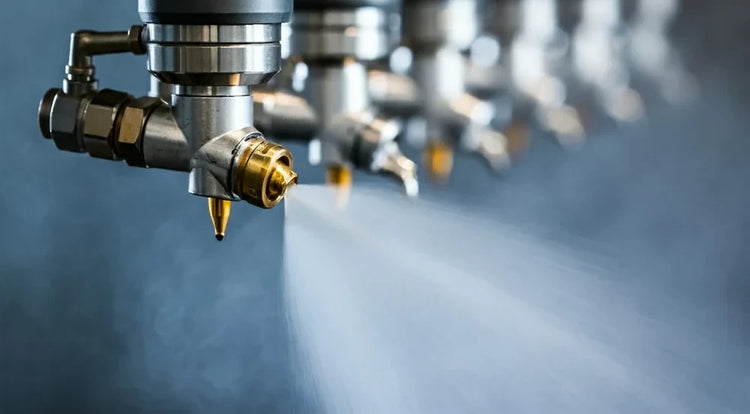
Cleaning & Washing Spray Nozzles
Industrial spray nozzles for CIP systems, equipment washdown, conveyor cleaning, vehicle wash, parts washing, and facility sanitation
Effective industrial cleaning starts with the right spray nozzle. The wrong pattern, orifice size, or material choice wastes water, reduces cleaning effectiveness, and shortens nozzle service life. NozzlePro supplies the full range of industrial cleaning and washing nozzles—from flat-fan washdown bars to high-impact rotary tank cleaners—matched to your media, pressure, flow rate, temperature, and duty cycle.
Whether you're running a food processing CIP system, a vehicle fleet wash bay, a parts washer, or a pharmaceutical facility washdown, we pair the right technology to your application and provide the documentation you need.
Industrial cleaning and washing applications use different spray nozzle types depending on the task: flat-fan nozzles for uniform sheeting action on conveyors and surfaces, full-cone nozzles for high-volume rinsing of containers and equipment enclosures, high-pressure nozzles for impact-driven removal of tough soils and scale, rotary and static tank cleaning nozzles for CIP vessel and reactor cleaning, air-atomizing and fog nozzles for chemical misting and disinfection, and hollow-cone nozzles for gentle rinsing of delicate components. Selection depends on required impact, flow rate, coverage area, chemical compatibility, and hygiene requirements.
Cleaning & Washing Nozzle Types
Shop by spray pattern or technology — all stocked for industrial cleaning applications
Spray Pattern Selection Guide
Match the right pattern to your cleaning task — the single most important variable in cleaning performance
| Pattern | Best For | Key Advantage | Shop |
|---|---|---|---|
| Flat Fan | Conveyor cleaning, surface washdown, pre-rinse bars, bottle exterior rinsing | Uniform sheeting action across a defined width; easy to array in manifolds | Flat Fan → |
| Full Cone | Container rinsing, equipment enclosures, general high-volume washdown | Volumetric coverage of irregular 3D surfaces; high flow at moderate pressure | Full Cone → |
| Hollow Cone | Delicate component rinsing, PCB and electronics washing, fine residue removal | Concentrated spray ring with gentle impact; good penetration into recesses | Hollow Cone → |
| Solid Stream | Targeted high-impact cleaning, drain flushing, scale and buildup removal | Maximum impact force at point of contact; long throw distance | Solid Stream → |
| High-Pressure | Heavy soils, caked-on residue, fleet undercarriage, concrete and metal surfaces | High impact energy for mechanical soil removal; cuts through grease and scale | High-Pressure → |
| Rotary / Tank Cleaning | CIP vessel and reactor cleaning, IBCs, tanks, mixing vessels | 360° coverage from a single nozzle; validated cleaning with minimal water volume | Tank Cleaning → |
| Fog & Mist | Chemical disinfection, surface sanitization, odor control, humidification | Ultra-fine droplets maximize chemical contact area and dwell time | Fog & Mist → |
| Air-Atomizing | Chemical application at low liquid volumes, coating and disinfectant misting | Precise droplet size control; reduces liquid consumption vs. hydraulic nozzles | Air-Atomizing → |
Cleaning Applications by Use Case
Targeted nozzle recommendations for common industrial cleaning scenarios
CIP & Tank Cleaning
Automated Clean-in-Place systems for vessels, reactors, mixing tanks, and IBCs. Static and rotary tank cleaning nozzles deliver validated, repeatable coverage with minimal water and chemical volume. Critical for food, beverage, dairy, pharma, and chemical processing.
- Rotating jet nozzles for large vessels
- Static spray balls for smaller tanks and IBCs
- Coverage maps and flow data available
Car Wash & Vehicle Cleaning
High-throughput spray systems for tunnel car washes, self-serve bays, and fleet wash facilities. Pre-soak, detergent, rinse, spot-free, undercarriage, and wheel arch nozzle positions all require specific patterns and pressures.
- Flat-fan nozzles for pre-soak and detergent stages
- Full-cone for high-volume rinse arches
- High-pressure for undercarriage and wheel blasters
Fleet & Truck Wash
Efficient exterior, undercarriage, and chassis cleaning for trucks, trailers, buses, and municipal fleets. High-volume, high-impact spray systems that clean effectively at speed without excessive dwell time.
- High-pressure flat-fan for exterior panels
- Solid-stream jets for undercarriage
- Flat-fan bars for pre-soak and detergent laydown
Parts & Component Washing
Degreasing, rinsing, and precision cleaning for automated cabinet washers, immersion tanks, and conveyor wash systems. Nozzle selection depends on soil type, part geometry, temperature, and whether rinsing follows a chemical cleaning stage.
- Flat-fan nozzles for edge-to-edge wash zone coverage
- High-pressure jets for heavy oil and scale removal
- Hollow-cone for delicate parts and geometries
Conveyor & Belt Cleaning
Continuous spray cleaning to keep conveyor belts free of carryback, product residue, and microbial buildup in food processing, packaging, and mining environments. Nozzle positioning and spray angle relative to belt travel direction are critical for effective cleaning.
- Flat-fan bars arrayed across belt width
- High-pressure nozzles for stubborn carryback
- Stainless construction for sanitary environments
Facility & Equipment Washdown
Sanitary washdown of floors, walls, drains, and processing equipment in food, beverage, pharmaceutical, and chemical plants. Systems must balance cleaning effectiveness with water management, drainage, and contamination control.
- High-pressure flat-fan for floor and wall washdown
- Tank cleaning nozzles for vessel exteriors
- Disinfection nozzles for final sanitation stage
Food, Beverage & Dairy
Hygienic cleaning and sanitization for bottling lines, dairy processing, brewery and winery tank cleaning, and food conveyor sanitation. 316L stainless steel nozzles with electropolished finishes and FDA-compliant elastomers for compliance with food safety standards.
- Sanitary tank cleaning nozzles for CIP systems
- Disinfection nozzles for conveyor and surface sanitization
- Full documentation packages available
Electronics & Precision Assembly
Delicate spray cleaning for PCBs, optical components, semiconductor assemblies, and precision-machined parts. Applications demand low impact forces, chemical compatibility with defluxing agents, and controlled droplet characteristics that prevent damage.
- Hollow-cone nozzles for gentle, penetrating rinse
- Fog/mist nozzles for ultra-fine chemical application
- Adjustable nozzles for flexibility across part sizes
Mining & Heavy Industry
High-volume, high-impact spray cleaning for mining equipment, conveyor systems, screens, and haul vehicles operating in abrasive, high-solids environments. Nozzle materials and orifice designs selected for wear resistance and long service intervals.
- High-pressure and solid-stream nozzles for equipment cleaning
- Tungsten carbide orifice options for abrasive media
- High-flow full-cone nozzles for screen washing
How to Select the Right Cleaning Nozzle
Five variables that determine the correct nozzle for any washing application
- Spray Pattern & Coverage Geometry — Flat-fan for uniform sheeting across a defined width; full-cone for 3D volumetric coverage; solid-stream or high-pressure for maximum impact at a point; rotary for full internal vessel coverage from a single connection.
- Required Impact Force — Mechanical cleaning energy (impact × area) drives soil removal. High-pressure and narrow-angle nozzles concentrate force; wider patterns distribute it. Match impact to the soil type—light residue versus caked-on scale require very different approaches.
- Orifice Size & Flow Rate — Orifice size determines flow rate at your operating pressure. Under-sized orifices build back-pressure; over-sized ones reduce impact. Always size to your pump's GPM rating, accounting for the number of nozzles running simultaneously.
- Chemical & Temperature Compatibility — Nozzle body, orifice, and seal materials must be compatible with your cleaning chemicals (caustic, acid, sanitants, solvents) and operating temperature. Stainless steel for most industrial applications; PTFE or ceramic inserts for aggressive chemistries; hardened materials for abrasive slurries.
- Hygiene & Documentation Requirements — Food, beverage, dairy, and pharmaceutical applications require 316L stainless construction, electropolished finishes (Ra ≤ 0.4 µm), crevice-free designs, and material certifications. Ask about our sanitary nozzle documentation packages.
Why Choose NozzlePro for Industrial Cleaning?
Engineering expertise, broad product range, and application support
Application Engineering — Not Just a Catalog
NozzlePro's application engineers work through your cleaning parameters—media, temperature, pressure, flow, standoff distance, and hygiene requirements—to identify the right nozzle and system configuration. We provide spray coverage data, flow curves, and material documentation to support your design and validation work, not just a product number.
Full Spray Pattern Range: Flat-fan, full-cone, hollow-cone, solid-stream, high-pressure, air-atomizing, fog/mist, rotary tank cleaning, and adjustable nozzles—all stocked and available for industrial cleaning applications.
Material Options: 316L stainless steel, brass, engineered polymers (PVDF, PP, PEEK), and tungsten carbide orifice inserts for abrasive and high-wear applications. FDA-compliant elastomers for food and pharmaceutical contact.
ISO 9001 Manufacturing: Consistent dimensional tolerances and material traceability across every nozzle. Material certifications, certificates of conformance, and inspection data available on request.
Industries Served
Cleaning and washing nozzles for every regulated and industrial environment
Food & Beverage
CIP systems, conveyor sanitation, bottle rinsing, and facility washdown.
Food & Beverage →Dairy
Hygienic CIP nozzles for dairy processing, pasteurization, and filling equipment.
Dairy Nozzles →Breweries & Wineries
Tank cleaning, fermentor CIP, bottle rinsing, and sanitary washdown.
Breweries & Wineries →Pharmaceutical
GMP-compliant CIP nozzles for cleanrooms and regulated manufacturing.
Pharmaceutical →Chemical Processing
Chemically resistant nozzles for vessel cleaning and equipment washdown.
Chemical Processing →Frequently Asked Questions
Common questions about industrial cleaning and washing spray nozzles
What is the best spray nozzle pattern for conveyor belt cleaning?
Flat-fan nozzles arrayed in a manifold bar are the standard choice for conveyor belt cleaning because they deliver uniform sheeting action across the full belt width. For stubborn carryback and heavy residues, high-pressure flat-fan or solid-stream nozzles provide the impact energy needed for mechanical soil removal. The nozzle angle relative to belt travel direction (typically 15–30° from perpendicular) affects how aggressively the spray undercuts and lifts deposits.
How do I select a CIP tank cleaning nozzle for my vessel?
CIP tank cleaning nozzle selection depends on vessel volume, geometry, inlet connection size, available pump flow rate and pressure, and the cleaning cycle parameters. Rotating jet nozzles are preferred for larger vessels because they deliver high-impact targeted coverage across all internal surfaces with less water than static spray balls. Static spray balls work well for smaller tanks and IBCs. Key sizing parameters are minimum tangential wall velocity, flow rate at operating pressure, and full 360° coverage verification. NozzlePro application engineers can assist with sizing based on your vessel drawings and CIP system specs.
What nozzle materials are recommended for caustic CIP cleaning?
316L stainless steel is the standard material for nozzles used in caustic CIP cleaning solutions (sodium hydroxide, potassium hydroxide) due to its excellent resistance to alkaline chemistries. EPDM and silicone elastomers are compatible with most CIP caustics and acids. PTFE is preferred for aggressive acid cleaning stages. Brass and zinc die-cast nozzles should be avoided in caustic CIP applications due to corrosion and contamination risk. For nozzles with non-metallic bodies, PVDF (Kynar) and polypropylene are common options with good caustic resistance.
How can I reduce water consumption in my industrial wash system?
Water reduction in industrial wash systems comes from optimizing nozzle selection and system parameters rather than just reducing pressure or flow. Key strategies include: right-sizing orifice diameter to match your pump's actual GPM output, selecting the spray pattern that delivers the required coverage with minimum overspray, optimizing standoff distance to minimize under- or over-coverage, sequencing spray zones rather than running all nozzles simultaneously, and using rotary tank cleaning nozzles for CIP (which clean more effectively at lower water volumes than static spray balls). NozzlePro can conduct a system audit and recommend optimizations based on your current setup.
What nozzles are used in automated parts washers?
Automated parts washers typically use flat-fan nozzles arrayed in wash zones to deliver uniform coverage across the conveyor or turntable footprint. High-pressure flat-fan or solid-stream nozzles handle heavy oil and scale removal stages. Hollow-cone nozzles are used when parts have complex geometries requiring good spray penetration into recesses with lower impact force. Rinse stages often use full-cone nozzles for volumetric water coverage. Nozzle material selection—typically 316L stainless or engineered polymer—depends on the cleaning chemistry, operating temperature, and sanitary requirements.
What is the difference between a flat-fan and a full-cone spray nozzle for washing?
A flat-fan nozzle produces a thin, sheet-like spray across a defined angular width (typically 15°–120°) that delivers uniform impact along a line—ideal for conveyors, manifold wash bars, and surface washdown where consistent coverage in a single direction is needed. A full-cone nozzle distributes water across a solid circular or square spray pattern, providing volumetric 3D coverage for enclosed spaces, container interiors, and equipment enclosures. Full-cone nozzles flow more water per unit time but deliver less impact per unit area than flat-fan nozzles at the same pressure.
Talk with a Cleaning & Washing Specialist
Share your media, operating pressure, flow rate, coverage area, and duty cycle — we'll identify the right nozzle, array, or system configuration for your application.